• Fri frakt över 249 kr
  • •
  • Snabba leveranser
  • •
  • Billiga böcker
Kundservice

Du är på sajten för privatpersoner.

Företag, bibliotek eller offentlig verksamhet?

Du handlar på classic.bokus.com, där alla dina funktioner finns intakta.
Till classic.bokus.com
Bokus logotyp. Gå till startsidan.
  • Erbjudanden
  • Nyheter
  • Student
  • Topplistor
  • Barn & ungdom
  • Bokus Play
  • E-böcker
  • Pocketböcker
  • Spel & pussel

10% rabatt på allt med kod NYSTART10 →

Sidfot

Mina sidor

    Hjälp

    • Kundservice
    • Vanliga frågor och svar
    • Frakt och leverans
    • Retur vid ångerrätt
    • Reklamera vara
    • Betalning
    • Köpvillkor
    • Allmänna villkor
    • Information om webbplatsens tillgänglighet

    Om Bokus

    • Om oss
    • Pressrum
    • För studenter
    • För företag
    • För bibliotek och offentlig verksamhet
    • För leverantörer
    • Hållbarhet

    Populärt

    • Aktuella erbjudanden
    • Presentkort
    • Studentlitteratur
    • Nya böcker
    • Topplistor
    • Signerade böcker
    • Engelska böcker

    Inspiration

    • Boktips
    • BookTok
    • Populära bokserier
    • Barnbokskaraktärer
    • Populära författare
    Logotyp för Bokus
    Följ oss på Facebook (extern länk)Följ oss på Instagram (extern länk)Följ oss på YouTube (extern länk)Följ oss på TikTok (extern länk)
    bokus @ CookiesAnpassa cookiesIntegritetspolicyKöpvillkor
    Till Citymail hemsida (extern länk)Till Budbee hemsida (extern länk)Till Postnord hemsida (extern länk)Till Schenker hemsida (extern länk)Till Early Bird hemsida (extern länk)Till Walleys hemsida (extern länk)
    1. Naturvetenskap och teknik
    2. Matematik och naturvetenskap
    3. Matematik
    4. Tillämpad matematik

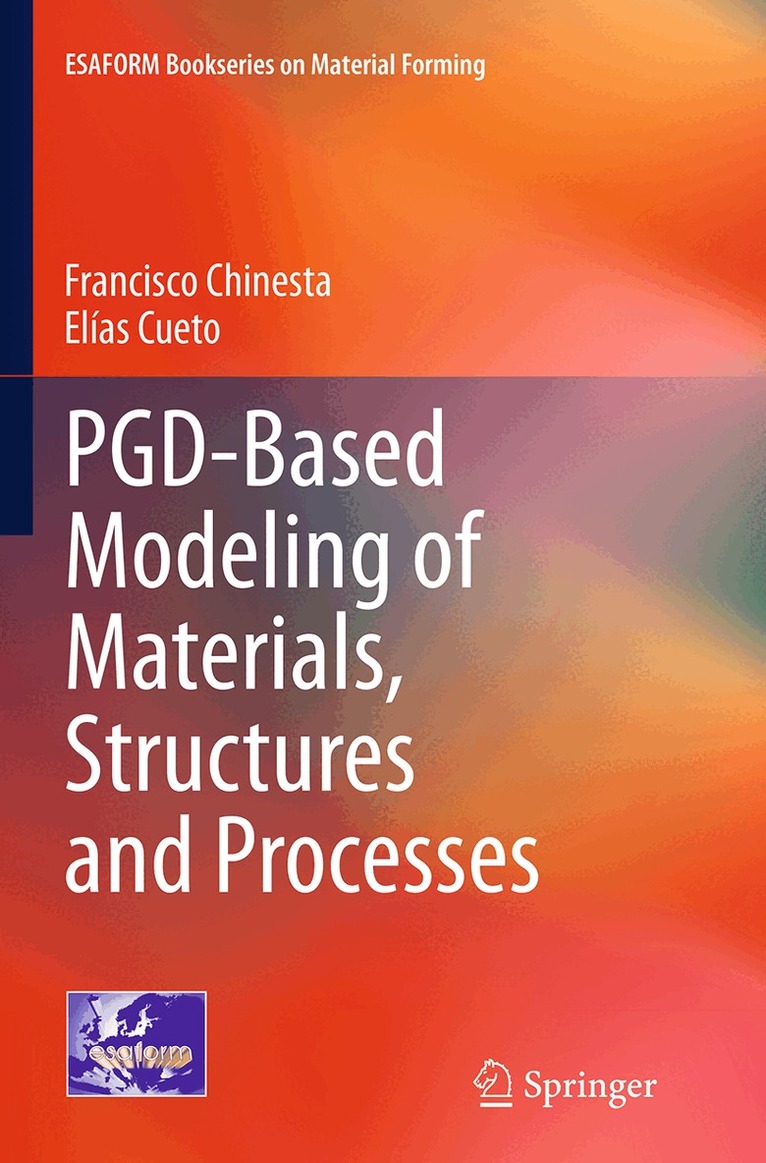
    PGD-Based Modeling of Materials, Structures and Processes

    AvFrancisco Chinesta,Elías Cueto

    Häftad, Engelska, 2016

    Del i serien ESAFORM Bookseries on Material Forming

    1 085 kr

    Beställningsvara. Skickas inom 10-15 vardagar. Fri frakt över 249 kr.

    Fler format och utgåvor

    Inbunden

    1 085 kr

    Beskrivning

    This book focuses on the development of a new simulation paradigm allowing for the solution of models that up to now have never been resolved and which result in spectacular CPU time savings (in the order of millions) that, combined with supercomputing, could revolutionize future ICT (information and communication technologies) at the heart of science and technology. The authors have recently proposed a new paradigm for simulation-based engineering sciences called Proper Generalized Decomposition, PGD, which has proved a tremendous potential in many aspects of forming process simulation. In this book a review of the basics of the technique is made, together with different examples of application.

    Produktinformation

    • Utgivningsdatum:2016-09-03
    • Mått:155 x 235 x 14 mm
    • Vikt:371 g
    • Format:Häftad
    • Språk:Engelska
    • Serie:ESAFORM Bookseries on Material Forming
    • Antal sidor:219
    • Förlag:Springer International Publishing AG
    • ISBN:9783319348360

    Utforska kategorier

    • Tillämpad matematik inom Naturvetenskap och teknik
    • Teknik: allmänt inom Naturvetenskap och teknik
    • Maskinteknik och material inom Naturvetenskap och teknik

    Innehållsförteckning

    • 1 Introduction.- 1.1 Recurrent issues in numerical simulation.- 1.2 Model reduction: information versus relevant information.- 1.3 PGD at a glance.- 1.4 Revisiting the simulation challenges.- 1.5 A brief state of the art on PGD-based model order reduction.- 2 Multiscale modelling.- 2.1 From quantum mechanics to kinetic theory.- 2.2 Advanced solvers for multi-dimensional models.- 2.3 Numerical examples.- 2.4 Conclusions.- 3 Homogenization.- 3.1 Homogenization of linear heterogenous models.- 3.2 Non-concurrent nonlinear homogenization.- 3.3 Numerical examples.- 3.4 Conclusions.- 4 Coupled models.- 4.1 Efficient coupling of global and local models.- 4.2 Fully globalized local models.- 4.3 Heterogeneous time integration.- 4.4 Numerical example.- 4.5 Discussion.- 5 Parametric models in evolving domains.- 5.1 Evolving domains issues.- 5.2 PGD in evolving domains.- 5.3 Separated representation constructor.- 5.4 Numerical test.- 5.5 Towards parametric modeling in evolving domains.- 5.6 Numerical test involving parametric modeling.- 5.7 Conclusions.- 6 Space separation.- 6.1 In-plane/out-of-plane separated representation.- 6.2 Laminates.- 6.3 Conclusions.- 7 Process optimization.- 7.1 Parametric boundary conditions.- 7.2 Parametric modeling of pultrusion.- 7.3 Optimization strategy.- 7.4 Conclusion 8 Shape optimization.- 8.1 Introduction.- 8.2 Geometrical parameters as extra-coordinates.- 8.3 Numerical results.- 8.4 Conclusions.- 9 DDDAS.- 9.1 Introduction to DDDAS.- 9.2 PGD solution of a flowing process.- 9.3 Simulating a breakdown scenario.- 9.4 Post-processing in a smartphone.- 9.5 Conclusions.- 10 Inverse analysis.- 10.1 PGD based parameter identification.- 10.2 PGD based Cauchy’s problem.- 10.3 Parameter identification examples.- 10.4 Cauchy’s problem example.- 10.5 Conclusions.- 11 Tape placement.- 11.1 Parametric modeling.- 11.2 ATP thermal model.- 11.3 ATP mechanical modeling.- 11.4 Numerical results.- 11.5 Conclusions.- 12 Augmented learning.- 12.1 Towards augmented learning.- 12.2 Examples of augmented learning.- 12.3 Conclusions.- References.- Index.