• Fri frakt över 249 kr
  • •
  • Snabba leveranser
  • •
  • Billiga böcker
Kundservice

Du är på sajten för privatpersoner.

Företag, bibliotek eller offentlig verksamhet?

Du handlar på classic.bokus.com, där alla dina funktioner finns intakta.
Till classic.bokus.com
Bokus logotyp. Gå till startsidan.
  • Erbjudanden
  • Nyheter
  • Student
  • Topplistor
  • Barn & ungdom
  • Bokus Play
  • E-böcker
  • Pocketböcker
  • Spel & pussel

10% rabatt på allt med kod: NYSTART10 →

Sidfot

Mina sidor

    Hjälp

    • Kundservice
    • Vanliga frågor och svar
    • Frakt och leverans
    • Retur vid ångerrätt
    • Reklamera vara
    • Betalning
    • Köpvillkor
    • Allmänna villkor
    • Information om webbplatsens tillgänglighet

    Om Bokus

    • Om oss
    • Pressrum
    • För studenter
    • För företag
    • För bibliotek och offentlig verksamhet
    • För leverantörer
    • Hållbarhet

    Populärt

    • Aktuella erbjudanden
    • Presentkort
    • Studentlitteratur
    • Nya böcker
    • Topplistor
    • Signerade böcker
    • Engelska böcker

    Inspiration

    • Boktips
    • BookTok
    • Populära bokserier
    • Barnbokskaraktärer
    • Populära författare
    Logotyp för Bokus
    Följ oss på Facebook (extern länk)Följ oss på Instagram (extern länk)Följ oss på YouTube (extern länk)Följ oss på TikTok (extern länk)
    bokus @ CookiesAnpassa cookiesIntegritetspolicyKöpvillkor
    Till Citymail hemsida (extern länk)Till Budbee hemsida (extern länk)Till Postnord hemsida (extern länk)Till Schenker hemsida (extern länk)Till Early Bird hemsida (extern länk)Till Walleys hemsida (extern länk)
    1. Naturvetenskap och teknik
    2. Matematik och naturvetenskap
    3. Matematik
    4. Tillämpad matematik

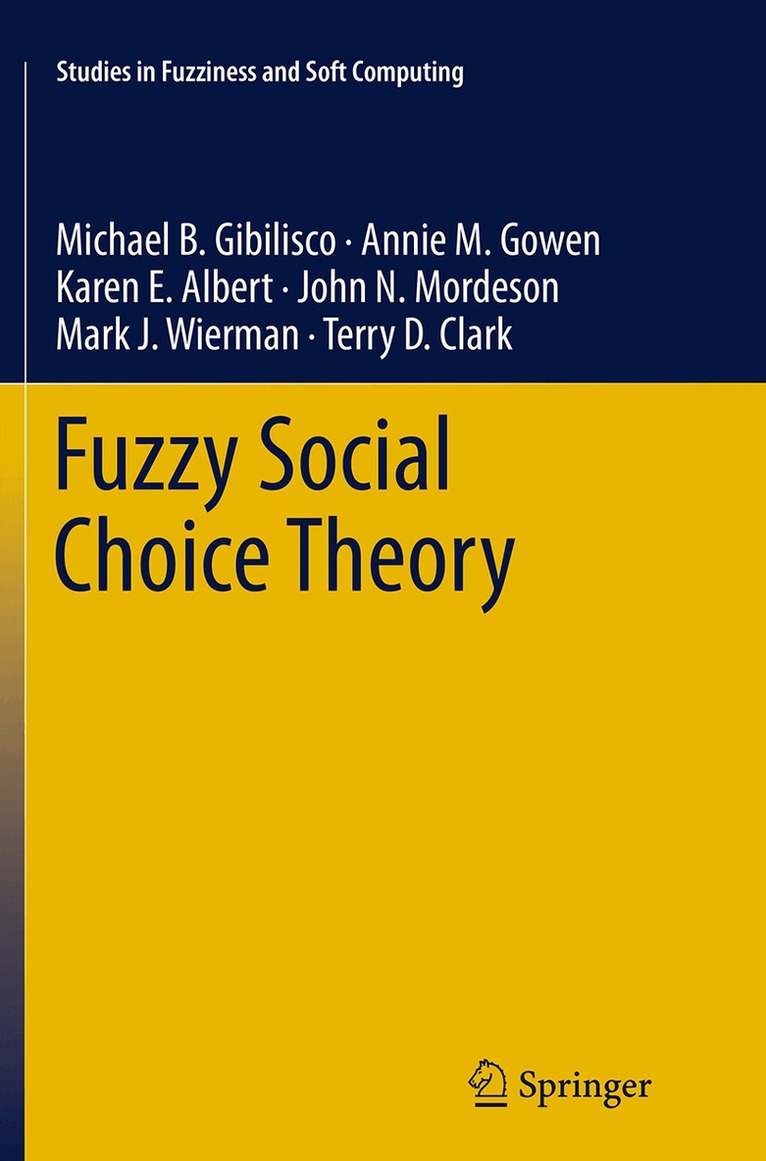
    Fuzzy Social Choice Theory

    AvMichael B. Gibilisco,Annie M. Gowen

    Häftad, Engelska, 2016

    Del 315 i serien Studies in Fuzziness and Soft Computing

    1 086 kr

    Beställningsvara. Skickas inom 10-15 vardagar. Fri frakt över 249 kr.

    Fler format och utgåvor

    Inbunden

    1 086 kr

    Beskrivning

    This book offers a comprehensive analysis of the social choice literature and shows, by applying fuzzy sets, how the use of fuzzy preferences, rather than that of strict ones, may affect the social choice theorems. To do this, the book explores the presupposition of rationality within the fuzzy framework and shows that the two conditions for rationality, completeness and transitivity, do exist with fuzzy preferences. Specifically, this book examines: the conditions under which a maximal set exists; the Arrow’s theorem; the Gibbard-Satterthwaite theorem and the median voter theorem. After showing that a non-empty maximal set does exists for fuzzy preference relations, this book goes on to demonstrating the existence of a fuzzy aggregation rule satisfying all five Arrowian conditions, including non-dictatorship. While the Gibbard-Satterthwaite theorem only considers individual fuzzy preferences, this work shows that both individuals and groups can choose alternatives to various degrees, resulting in a social choice that can be both strategy-proof and non-dictatorial. Moreover, the median voter theorem is shown to hold under strict fuzzy preferences but not under weak fuzzy preferences. By providing a standard model of fuzzy social choice and by drawing the necessary connections between the major theorems, this book fills an important gap in the current literature and encourages future empirical research in the field.

    Produktinformation

    • Utgivningsdatum:2016-09-03
    • Mått:155 x 235 x 12 mm
    • Vikt:318 g
    • Format:Häftad
    • Språk:Engelska
    • Serie:Studies in Fuzziness and Soft Computing
    • Antal sidor:185
    • Förlag:Springer International Publishing AG
    • ISBN:9783319356716

    Utforska kategorier

    • Tillämpad matematik inom Naturvetenskap och teknik
    • Artificiell intelligens inom Data och IT
    • Statsvetenskap och politisk teori inom Samhälle och politik

    Innehållsförteckning

    • Fuzzy Social Choice.- Classical Social Choice Theorems.- Rationality of Fuzzy Preferences.- Arrow and the Aggregation of Fuzzy Preferences.- Characteristics of Strategy-Proof Fuzzy Social Choice.- Fuzzy Black’s Median Voter Theorem.- Representing Thick Indifference in Spatial Models.- Conclusion.