• Fri frakt över 249 kr
  • •
  • Snabba leveranser
  • •
  • Billiga böcker
Kundservice

Du är på sajten för privatpersoner.

Företag, bibliotek eller offentlig verksamhet?

Du handlar på classic.bokus.com, där alla dina funktioner finns intakta.
Till classic.bokus.com
Bokus logotyp. Gå till startsidan.
  • Erbjudanden
  • Nyheter
  • Student
  • Topplistor
  • Barn & ungdom
  • Bokus Play
  • E-böcker
  • Pocketböcker
  • Spel & pussel

10% rabatt på allt med kod: NYSTART10 →

Sidfot

Mina sidor

    Hjälp

    • Kundservice
    • Vanliga frågor och svar
    • Frakt och leverans
    • Retur vid ångerrätt
    • Reklamera vara
    • Betalning
    • Köpvillkor
    • Allmänna villkor
    • Information om webbplatsens tillgänglighet

    Om Bokus

    • Om oss
    • Pressrum
    • För studenter
    • För företag
    • För bibliotek och offentlig verksamhet
    • För leverantörer
    • Hållbarhet

    Populärt

    • Aktuella erbjudanden
    • Presentkort
    • Studentlitteratur
    • Nya böcker
    • Topplistor
    • Signerade böcker
    • Engelska böcker

    Inspiration

    • Boktips
    • BookTok
    • Populära bokserier
    • Barnbokskaraktärer
    • Populära författare
    Logotyp för Bokus
    Följ oss på Facebook (extern länk)Följ oss på Instagram (extern länk)Följ oss på YouTube (extern länk)Följ oss på TikTok (extern länk)
    bokus @ CookiesAnpassa cookiesIntegritetspolicyKöpvillkor
    Till Citymail hemsida (extern länk)Till Budbee hemsida (extern länk)Till Postnord hemsida (extern länk)Till Schenker hemsida (extern länk)Till Early Bird hemsida (extern länk)Till Walleys hemsida (extern länk)
    1. Psykologi och pedagogik
    2. Pedagogik
    3. Material och digital teknik i undervisningen

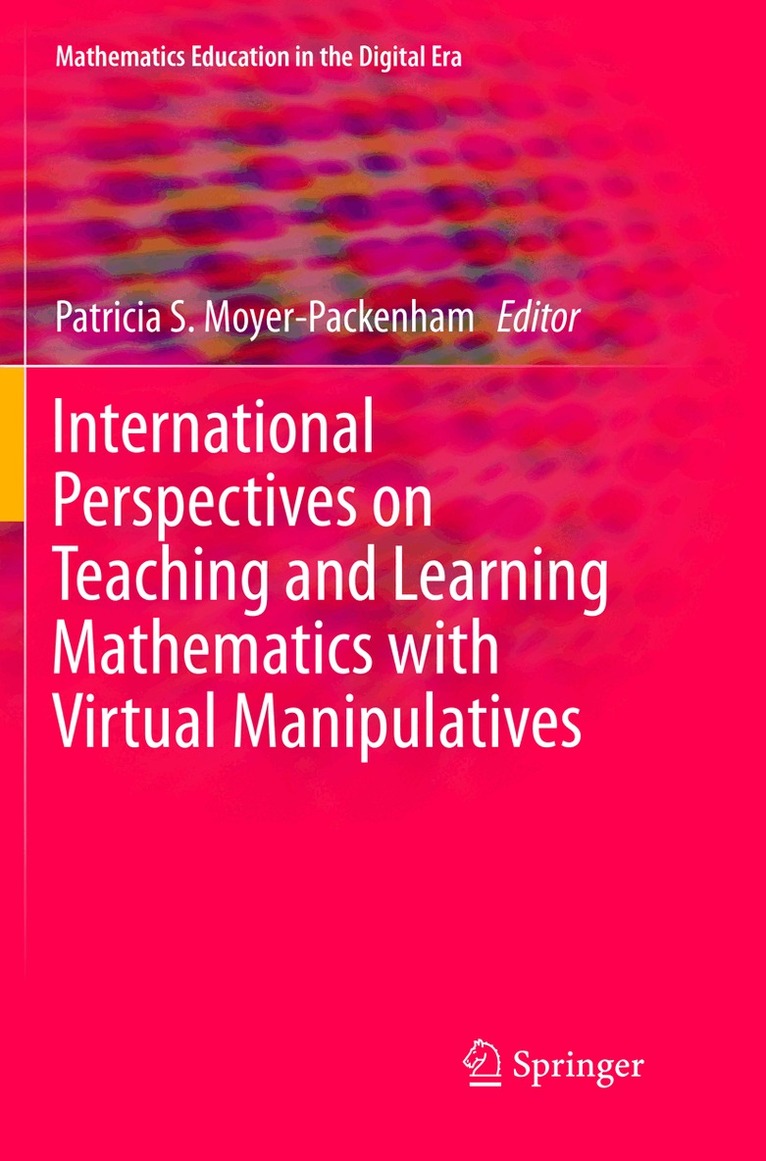
    International Perspectives on Teaching and Learning Mathematics with Virtual Manipulatives

    AvPatricia S. Moyer-Packenham

    Häftad, Engelska, 2018

    Del 7 i serien Mathematics Education in the Digital Era

    1 055 kr

    Beställningsvara. Skickas inom 10-15 vardagar. Fri frakt över 249 kr.

    Beskrivning

    This book explores terminology, frameworks, and research being conducted worldwide on virtual manipulatives. It brings together international authors who provide their perspectives on virtual manipulatives in research and teaching. By defining terminology, explaining conceptual and theoretical frameworks, and reporting research, the authors provide a comprehensive foundation on the study and use of virtual manipulatives for mathematics teaching and learning. This foundation provides a common way for researchers to communicate about virtual manipulatives and build on the major works that have been conducted on this topic. By discussing these big ideas, the book advances knowledge for future research on virtual manipulatives as these dynamic tools move from computer platforms to hand-held, touch-screen, and augmented platforms.

    Produktinformation

    • Utgivningsdatum:2018-05-31
    • Mått:155 x 235 x 20 mm
    • Vikt:540 g
    • Format:Häftad
    • Språk:Engelska
    • Serie:Mathematics Education in the Digital Era
    • Antal sidor:345
    • Förlag:Springer International Publishing AG
    • ISBN:9783319813530

    Utforska kategorier

    • Material och digital teknik i undervisningen inom Psykologi och pedagogik
    • Lärarutbildning inom Psykologi och pedagogik
    • Undervisning i specifika ämnen inom Psykologi och pedagogik

    Innehållsförteckning

    • SECTION 1: Frameworks and Definitions.- 1. Revisiting the Definition of a Virtual Manipulative. Patricia S. Moyer-Packenham & Johnna J. Bolyard (United States).- 2. Artifact-Centric Activity Theory – A Framework for the Analysis of the Design and Use of Virtual Manipulatives. Silke Ladel & Ulrich Kortenkamp (Germany).- 3. The Modification of Attributes, Affordances, Abilities, and Distance for Learning Framework and its Applications to Interactions with Mathematics Virtual Manipulatives. Stephen I. Tucker (United States).- 4. Physical and Virtual Manipulatives: What is “Concrete”? Julie Sarama and Douglas H. Clements (United States).- 5. Manipulatives, Diagrams, and Mathematics: A Framework for Future Research on Virtual Manipulatives. Helena P. Osana and Nathalie Duponsel (Canada).- SECTION 2: Research and Design.- 6. Fingu – A Game to Support Children’s Development of Arithmetic Competence: Theory, Design and Empirical Research. Ingemar Holgersson, Wolmet Barendregt, JonasEmanuelsson, Torgny Ottosson, Elisabeth Rietz & Berner Lindstrom (Sweden).- 7. Developing Virtual Mathematics Manipulatives: The SAMAP Project. Erol Karakirik (Turkey).- 8. Enhancing Mathematical Skills through Interventions with Virtual Manipulatives. Annemie Desoete, Magda Praet, Claire Van de Velde, Brigitte De Craene, & Edwin Hantson (Belgium).- 9. Influence of Prior Knowledge and Teaching Approaches Integrating Non-Routine Worked Examples and Virtual Manipulatives on the Performance and Attitude of Fifth-Graders in Learning Equivalent Fractions. Chun-Yi Lee & Ming-Jang Chen (Taiwan).- 10. The Role of Virtual Manipulatives in High School Students’ Understanding of Geometric Transformations. Hilal Gulkilik (Turkey).- SECTION 3: Tools for Research.- 11. Geometry and iPads in Primary Schools: Does Their Usefulness Extend beyond Tracing an Oblong? Kevin Larkin (Australia).- 12. Selection of Apps for Teaching Difficult Mathematics Topics: An Instrument to Evaluate Touch-Screen Tablet and Smart Phone Mathematics Apps. K. Aryee, George Gadanidis, Immaculate K. Namukasa, V. Sarina, & S. Scucuglia (Canada & Brazil).- 13. Ambitious Teaching: Designing Practice-Based Assignments for Integrating Virtual Manipulatives into Mathematics Lessons. Jennifer M. Suh (United States).- 14. Developing an Interactive Instrument for Measuring Teachers’ Professionally Situated Knowledge in Geometry and Measurement. Agida G. Manizade & Dragana Martinovic (United States & Canada).