• Fri frakt över 249 kr
  • •
  • Snabba leveranser
  • •
  • Billiga böcker
Kundservice

Du är på sajten för privatpersoner.

Företag, bibliotek eller offentlig verksamhet?

Du handlar på classic.bokus.com, där alla dina funktioner finns intakta.
Till classic.bokus.com
Bokus logotyp. Gå till startsidan.
  • Erbjudanden
  • Nyheter
  • Student
  • Topplistor
  • Barn & ungdom
  • Bokus Play
  • E-böcker
  • Pocketböcker
  • Spel & pussel

10% rabatt på allt med kod NYSTART10 →

Sidfot

Mina sidor

    Hjälp

    • Kundservice
    • Vanliga frågor och svar
    • Frakt och leverans
    • Retur vid ångerrätt
    • Reklamera vara
    • Betalning
    • Köpvillkor
    • Allmänna villkor
    • Information om webbplatsens tillgänglighet

    Om Bokus

    • Om oss
    • Pressrum
    • För studenter
    • För företag
    • För bibliotek och offentlig verksamhet
    • För leverantörer
    • Hållbarhet

    Populärt

    • Aktuella erbjudanden
    • Presentkort
    • Studentlitteratur
    • Nya böcker
    • Topplistor
    • Signerade böcker
    • Engelska böcker

    Inspiration

    • Boktips
    • BookTok
    • Populära bokserier
    • Barnbokskaraktärer
    • Populära författare
    Logotyp för Bokus
    Följ oss på Facebook (extern länk)Följ oss på Instagram (extern länk)Följ oss på YouTube (extern länk)Följ oss på TikTok (extern länk)
    bokus @ CookiesAnpassa cookiesIntegritetspolicyKöpvillkor
    Till Citymail hemsida (extern länk)Till Budbee hemsida (extern länk)Till Postnord hemsida (extern länk)Till Schenker hemsida (extern länk)Till Early Bird hemsida (extern länk)Till Walleys hemsida (extern länk)
    1. Naturvetenskap och teknik
    2. Matematik och naturvetenskap
    3. Biologi
    4. Biovetenskap

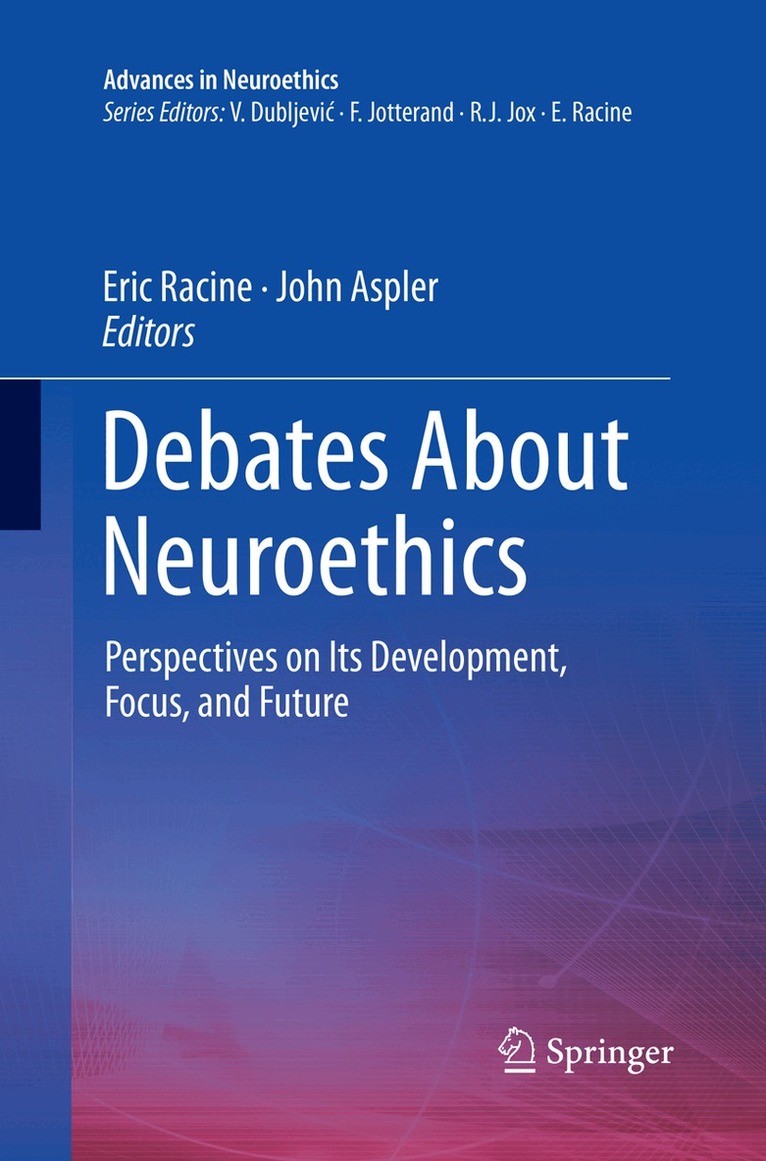
    Debates About Neuroethics

    Perspectives on Its Development, Focus, and Future

    AvEric Racine,John Aspler

    Häftad, Engelska, 2018

    Del i serien Advances in Neuroethics

    1 228 kr

    Beställningsvara. Skickas inom 10-15 vardagar. Fri frakt över 249 kr.

    Beskrivning

    This is the first book entirely dedicated to exploring issues associated with the nature of neuroethics. It reflects on some of the underlying assumptions in neuroethics, and the implications of those assumptions with respect to training and education programs, research activities, policy engagement, public discourse, teaching, ethics consultation and mentoring, to name but a few areas of interest.  Internationally respected and emerging leaders in the area have taken up the pen to express and debate their views about the development, focus and future of neuroethics. They share their analyses and make recommendations regarding how neuroscience could more effectively explore and tackle its philosophical, ethical, and societal implications.

    Produktinformation

    • Utgivningsdatum:2018-08-03
    • Mått:155 x 235 x 15 mm
    • Vikt:480 g
    • Format:Häftad
    • Språk:Engelska
    • Serie:Advances in Neuroethics
    • Antal sidor:263
    • Förlag:Springer International Publishing AG
    • ISBN:9783319854458

    Utforska kategorier

    • Biovetenskap inom Naturvetenskap och teknik
    • Neurologi och klinisk neurofysiologi inom Medicin

    Mer om författaren

    Dr. Eric Racine is the director of the Neuroethics Research Unit and full research professor at the IRCM (Institut de recherches cliniques de Montréal). He holds other academic appointments at the University of Montreal (Bioethics and Medicine) and McGill University (Neurology and Neurosurgery and Bioethics). Dr. Racine is a pioneer researcher in neuroethics and a prolific author of peer-reviewed papers, chapters and columns published in leading bioethics, neuroscience, social science, and medical journals. His book Pragmatic Neuroethics, was published by MIT Press in 2010 and captures some of his work and views in neuroethics. He has delivered talks and guest lectures to researchers, policy-makers, the general public, and public officials worldwide. His research unit is a hub for the training of international visiting fellows and graduate students, public conferences as well as specialized workshops and seminars. Dr. Racine is a member of the advisory board of the Canadian Institutes of Health Research’s Institute for Neurosciences, Mental Health and Addiction, member of the Dana Alliance for Brain Initiatives, associate editor of the journal Neuroethics, and member of the editorial board of AJOB-Neuroscience. Dr. Racine has been a visiting fellow at the Brocher Foundation in Geneva (Switzerland), at the International Institute of Biomedical Ethics at Uppsala University (Sweden), and the Center for Advanced Studies at the University of Munich (Germany). His research is supported by grants and awards, notably from the Canadian Institutes of Health Research and the Social Sciences and Humanities Research Council of Canada.John Aspler graduated from McGill University with a BSc in Neuroscience and a minor in Music. Although originally interested in music cognition, his exposure to a stream of problematic neuroscience-related news publications both cultivated and cemented in him an interest in improving the state of science communication. This includesan interest in the potential stigmatization faced by various marginalized communities, related to their media portrayal in health and science writing. At present, John is pursuing a PhD at McGill University and at the Neuroethics Research Unit, where he is working on several projects concerning the media discourse surrounding fetal alcohol spectrum disorder, as well as key stakeholder perspectives about disability and stigma. He has also co-authored articles about the ethics of complementary and alternative medicine in Alzheimer's disease, and has presented his work on FASD at various national and international conferences. In keeping with his interest in science education, he has significant experience lecturing college and undergraduate students about ethics, communication, disability, and critical thinking in science.

    Recensioner i media

    “This book explores the development, focus, and future of neuroethics. … intended audience is anyone interested in learning about the study of neuroethics. It will be of interest to academics curious about whether and how the field of neuroethics can be differentiated from ethics and neuroscience. … a useful book for scholars who are interested in orienting themselves to neuroethics as a field distinct from both ethics and neuroscience, or anyone interested in the status and history of neuroethics research.” (Dane S. Muckler, Doody's Book Reviews, October, 2017)

    Innehållsförteckning

    • History and foundations of neuroethics (What is neuroethics?).- Theories and methodologies in neuroethics (How does neuroethics “work”?).- Training and research programs in neuroethics (How are neuroethicists trained?).- Networking and capacity building in neuroethics (How does neuroethics reach out)?.