• Fri frakt över 249 kr
  • •
  • Snabba leveranser
  • •
  • Billiga böcker
Kundservice

Du är på sajten för privatpersoner.

Företag, bibliotek eller offentlig verksamhet?

Du handlar på classic.bokus.com, där alla dina funktioner finns intakta.
Till classic.bokus.com
Bokus logotyp. Gå till startsidan.
  • Erbjudanden
  • Nyheter
  • Student
  • Topplistor
  • Barn & ungdom
  • Bokus Play
  • E-böcker
  • Pocketböcker
  • Spel & pussel

10% rabatt på allt med kod NYSTART10 →

Sidfot

Mina sidor

    Hjälp

    • Kundservice
    • Vanliga frågor och svar
    • Frakt och leverans
    • Retur vid ångerrätt
    • Reklamera vara
    • Betalning
    • Köpvillkor
    • Allmänna villkor
    • Information om webbplatsens tillgänglighet

    Om Bokus

    • Om oss
    • Pressrum
    • För studenter
    • För företag
    • För bibliotek och offentlig verksamhet
    • För leverantörer
    • Hållbarhet

    Populärt

    • Aktuella erbjudanden
    • Presentkort
    • Studentlitteratur
    • Nya böcker
    • Topplistor
    • Signerade böcker
    • Engelska böcker

    Inspiration

    • Boktips
    • BookTok
    • Populära bokserier
    • Barnbokskaraktärer
    • Populära författare
    Logotyp för Bokus
    Följ oss på Facebook (extern länk)Följ oss på Instagram (extern länk)Följ oss på YouTube (extern länk)Följ oss på TikTok (extern länk)
    bokus @ CookiesAnpassa cookiesIntegritetspolicyKöpvillkor
    Till Citymail hemsida (extern länk)Till Budbee hemsida (extern länk)Till Postnord hemsida (extern länk)Till Schenker hemsida (extern länk)Till Early Bird hemsida (extern länk)Till Walleys hemsida (extern länk)
    1. Psykologi och pedagogik
    2. Pedagogik
    3. Skolväsen och utbildningssystem
    4. Examination och betygsättning

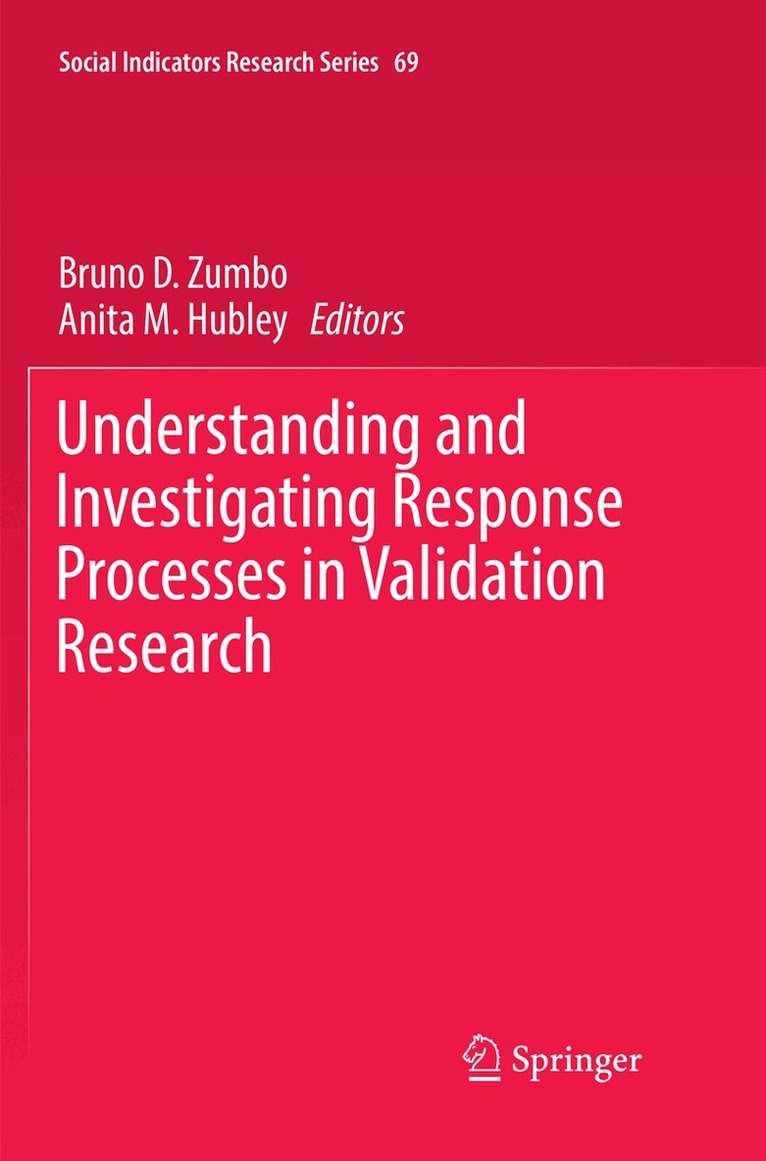
    Understanding and Investigating Response Processes in Validation Research

    AvBruno D. Zumbo,Anita M. Hubley

    Häftad, Engelska, 2018

    Del 69 i serien Social Indicators Research Series

    1 055 kr

    Beställningsvara. Skickas inom 10-15 vardagar. Fri frakt över 249 kr.

    Beskrivning

    This volume addresses an urgent need across multiple disciplines to broaden our understanding and use of response processes evidence of test validity. It builds on the themes and findings of the volume Validity and Validation in Social, Behavioral, and Health Sciences (Zumbo & Chan, 2014), with a focus on measurement validity evidence based on response processes. Approximately 1000 studies are published each year examining the validity of inferences made from tests and measures in the social, behavioural, and health sciences. The widely accepted Standards for Educational and Psychological Testing (1999, 2014) present five sources of evidence for validity: content-related, response processes, internal structure, relationships with other variables, and consequences of testing. Many studies focus on internal structure and relationships with other variables sources of evidence, which have a long history in validation research, known methodologies, and numerous exemplars in the literature. Far less is understood by test users and researchers conducting validation work about how to think about and apply new and emerging sources of validity evidence. This groundbreaking volume is the first to present conceptual models of response processes, methodological issues that arise in gathering response processes evidence, as well as applications and exemplars for providing response processes evidence in validation work.

    Produktinformation

    • Utgivningsdatum:2018-08-12
    • Mått:155 x 235 x 20 mm
    • Vikt:662 g
    • Format:Häftad
    • Språk:Engelska
    • Serie:Social Indicators Research Series
    • Antal sidor:370
    • Förlag:Springer International Publishing AG
    • ISBN:9783319858333

    Utforska kategorier

    • Examination och betygsättning inom Psykologi och pedagogik
    • Sociologi inom Samhälle och politik
    • Psykologisk metod inom Psykologi och pedagogik

    Mer om författaren

    Bruno D. Zumbo (Ph.D.) is the Paragon-UBC Professor of Psychometrics and Measurement, and Full Professor of Measurement, Evaluation, & Research Methodology and Distinguished University Scholar with additional appointment in the Institute of Applied Mathematics at the University of British Columbia (UBC) in Vancouver, British Columbia, Canada.  Prior to arriving at UBC in 2000, he held Professorships in the Departments of Psychology, Education, and Mathematics at the University of Ottawa and then the University of Northern British Columbia. Over the last 25 years his interdisciplinary program of research has emerged to have broad interdisciplinary impact and as such is well-recognized in a variety of disciplines including psychology, applied social science research (quality of life and well being), assessment, educational research, language testing, health and human development. His research on validity and validation is at the core of his program of research and has elements of working at the foundations of the discipline, including philosophy of science, scientific methodology as well as practical psychometric methods at the intersection of measurement, statistical science and mathematics. Professor Zumbo’s research and teaching have been recognized with international awards. He was recipient of the 2005 Samuel J. Messick Memorial Lecture Award for his work in validity, 2010 Research Fellow Award by the International Society for Quality of Life Studies, and selected as a Fellow of American Educational Research Association (AERA) in 2011.Dr. Hubley (Ph.D.) is a Full Professor in Measurement, Evaluation, & Research Methodology and Director of the Adult Development and Psychometrics Lab in the Department of Educational and Counselling Psychology and Special Education (ECPS) at the University of British Columbia (UBC). Dr. Hubley is recognized internationally for her expertise in validity, test development, and psychological and health assessment and measurement in areas such as neuropsychology, quality of life, depression, subjective age, and homelessness. She has also developed several clinical, health, and psychological tests, including the Memory Test for Older Adults (MTOA), Modified Taylor Complex Figure (MTCF), and Quality of Life in Homeless and Hard-to-House Individuals (QoLHHI), to name just a few of her measures. She is a former member of the Executive Council of the International Test Commission (ITC), which provides guidance in testing practices to individuals and organizations around the world, and former Editor of their publication, Testing International.

    Innehållsförteckning

    • Response Processes in the Context of Validity: Setting the Stage (Anita M. Hubley and Bruno D. Zumbo).- Chapter 2. Response Processes and Measurement Validity in Health Psychology (Mark R. Beauchamp and Desmond McEwan).- Chapter 3. Contributions of Response Process Analysis to the Validation of an Assessment of Higher Education Students’ Competence in Business and Economics (Sebastian Brückner and James W. Pellegrino) .- Chapter 4. Ecological Framework of Item Responding as Validity Evidence: An Application of Multilevel DIF Modeling Using PISA Data (Michelle Y. Chen and Bruno D. Zumbo) .- Chapter 5. Putting Flesh on the Psychometric Bone: Making Sense of IRT Parameters in Non-cognitive Measures by Investigating the Social-cognitive Aspects of the Items (Anita M. Hubley, Amery D. Wu, Yan Liu, and Bruno D. Zumbo).- Chapter 6 Some Observations on Response Processes Research  and Its Future Theoretical and Methodological Directions (Mihaela Launeanu and Anita M. Hubley).- Chapter7. A Model Building Approach to Examining Response Processes as a Source of Validity Evidence for Self-Report Items and Measures (Mihaela Launeanu and Anita M. Hubley).- Chapter 8. Response Processes and Validity Evidence: Controlling for Emotions in Think Aloud Interviews (Jacqueline P. Leighton, Wei Tang, and Qi Guo).- Chapter 9. Response Time Data as Validity Evidence: Has It Lived It Up Its Promise, and If Not, What Would It Take To Do So (Zhi Li, Jayanti Banerjee, and Bruno D. Zumbo).- Chapter 10. Observing Testing Situations: Validation as Jazz (Bryan Maddox and Bruno D. Zumbo).- Chapter 11. A Rationale for and Demonstration of the Use of DIF and Mixed Methods (Jose-Luis Padilla, and Isabel Benítez).- Chapter 12. Cognitive Interviewing and Think Aloud Methods (Jose-Luis Padilla and Jacqueline P. Leighton).- Chapter 13. Some Thoughts on Gathering Response Processes Validity Evidence in the Context of Online Measurement and the Digital Revolution (Lara B. Russell and Anita M. Hubley).- Chapter 14. Longitudinal Change in Response Processes: A Response Shift Perspective (Richard Sawatzky, Tolulope T. Sajobi, Ronak Brahmbhatt, Eric K. H. Chan, Lisa M. Lix, and Bruno D. Zumbo).- Chapter 15. Validating a Distractor-Driven Geometry Test Using a Generalized Diagnostic Classification Model (Benjamin R. Shear and Louis A. Roussos).- Chapter 16. Understanding Test-taking Strategies for a Reading Comprehension Test via Latent Variable Regression with Pratt’s Importance Measures (Amery D. Wu and Bruno D. Zumbo).- Chapter 17. An Investigation of Writing Processes Employed in Scenario-Based Assessment (Mo Zhang, Danjie Zou, Amery D. Wu, Paul Deane, and Chen Li).- Chapter 18. National and International Educational Achievement Testing: A Case of Multi-Level Validation Framed by the Ecological Model of Item Responding (Bruno D. Zumbo, Yan Liu, Amery D. Wu, Barry Forer, and Benjamin R. Shear).- Chapter 19. On Models and Modeling in Measurement and Validation Studies (Bruno D. Zumbo).