• Fri frakt över 249 kr
  • •
  • Snabba leveranser
  • •
  • Billiga böcker
Kundservice

Du är på sajten för privatpersoner.

Företag, bibliotek eller offentlig verksamhet?

Du handlar på classic.bokus.com, där alla dina funktioner finns intakta.
Till classic.bokus.com
Bokus logotyp. Gå till startsidan.
  • Erbjudanden
  • Nyheter
  • Student
  • Topplistor
  • Barn & ungdom
  • Bokus Play
  • E-böcker
  • Pocketböcker
  • Spel & pussel

10% rabatt på allt med kod: NYSTART10 →

Sidfot

Mina sidor

    Hjälp

    • Kundservice
    • Vanliga frågor och svar
    • Frakt och leverans
    • Retur vid ångerrätt
    • Reklamera vara
    • Betalning
    • Köpvillkor
    • Allmänna villkor
    • Information om webbplatsens tillgänglighet

    Om Bokus

    • Om oss
    • Pressrum
    • För studenter
    • För företag
    • För bibliotek och offentlig verksamhet
    • För leverantörer
    • Hållbarhet

    Populärt

    • Aktuella erbjudanden
    • Presentkort
    • Studentlitteratur
    • Nya böcker
    • Topplistor
    • Signerade böcker
    • Engelska böcker

    Inspiration

    • Boktips
    • BookTok
    • Populära bokserier
    • Barnbokskaraktärer
    • Populära författare
    Logotyp för Bokus
    Följ oss på Facebook (extern länk)Följ oss på Instagram (extern länk)Följ oss på YouTube (extern länk)Följ oss på TikTok (extern länk)
    bokus @ CookiesAnpassa cookiesIntegritetspolicyKöpvillkor
    Till Citymail hemsida (extern länk)Till Budbee hemsida (extern länk)Till Postnord hemsida (extern länk)Till Schenker hemsida (extern länk)Till Early Bird hemsida (extern länk)Till Walleys hemsida (extern länk)
    1. Psykologi och pedagogik
    2. Pedagogik
    3. Pedagogisk psykologi

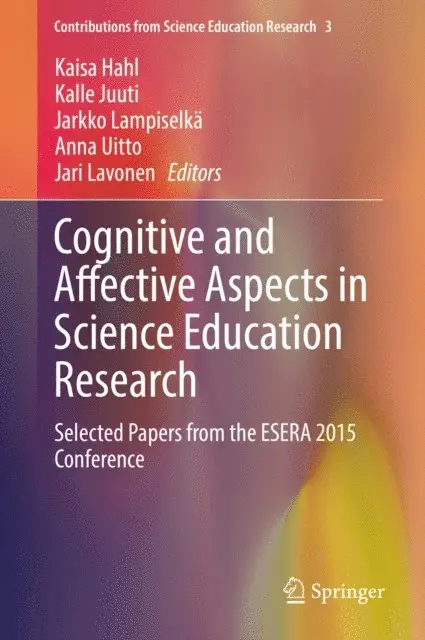
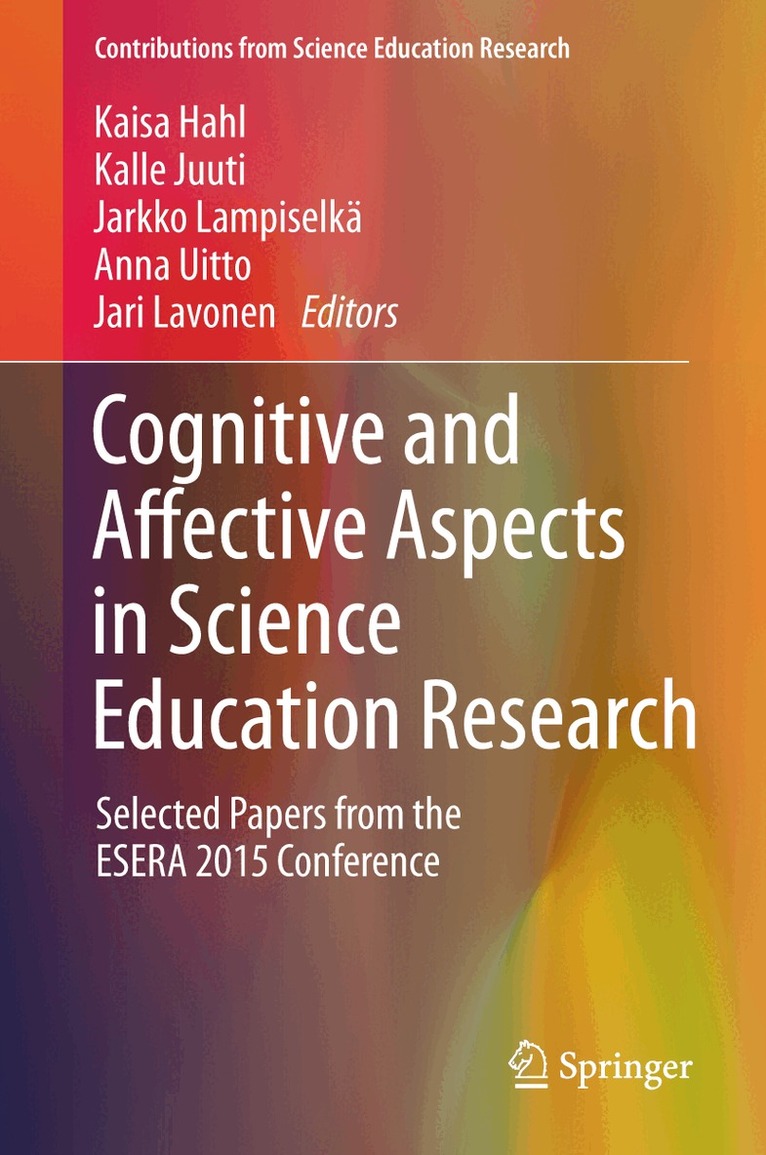
    Cognitive and Affective Aspects in Science Education Research

    Selected Papers from the ESERA 2015 Conference

    AvKaisa Hahl,Kalle Juuti

    Häftad, Engelska, 2018

    Del 3 i serien Contributions from Science Education Research

    1 410 kr

    Beställningsvara. Skickas inom 10-15 vardagar. Fri frakt över 249 kr.

    Beskrivning

    This edited volume brings forth intriguing, novel and innovative research in the field of science education. The chapters in the book deal with a wide variety of topics and research approaches, conducted in various contexts and settings, all adding a strong contribution to knowledge on science teaching and learning. The book is comprised of selected high-quality studies that were presented at the 11th European Science Education Research Association (ESERA) Conference, held in Helsinki, Finland from 31 August to 4 September, 2015. The ESERA science education research community consists of professionals with diverse disciplinary backgrounds from natural sciences to social sciences. This diversity provides a rich understanding of cognitive and affective aspects of science teaching and learning in this volume. The studies in this book will invoke discussion and ignite further interest in finding new ways of doing and researching science education for the future and looking for international partners for both science education and science education research. The twenty-five chapters showcase current orientations of research in science education and are of interest to science teachers, teacher educators and science education researchers around the world with a commitment to evidence-based and forward-looking science teaching and learning.

    Produktinformation

    • Utgivningsdatum:2018-08-28
    • Mått:155 x 235 x 22 mm
    • Vikt:598 g
    • Format:Häftad
    • Språk:Engelska
    • Serie:Contributions from Science Education Research
    • Antal sidor:370
    • Förlag:Springer International Publishing AG
    • ISBN:9783319864556

    Utforska kategorier

    • Pedagogisk psykologi inom Psykologi och pedagogik
    • Lärarutbildning inom Psykologi och pedagogik
    • Undervisning i specifika ämnen inom Psykologi och pedagogik

    Innehållsförteckning

    • Introduction, Kaisa Hahl, Kalle Juuti, Jarkko Lampiselkä, Anna Uitto and Jari Lavonen.- Section 1 – Teacher Knowledge.- Visualizing the Nature of Science: Beyond Textual
Pieces to Holistic Images in Science Education, Sibel Erduran.- Using assessment materials to stimulate improvements in teaching and learning, Robin Millar.- Chemistry teachers’ perceptions and attitudes towards creativity in chemistry class, Annika Springub, Luzie Semmler, Shingo Uchinokura and Verena Pietzner.- “Creating creativity”: Improving pre-service teachers’ conceptions about creativity in chemistry, Markus Bliersbach and Christiane S. Reiners.- Is topic-specific PCK unique to teachers? Marissa Rollnick, Bette Davidowitz and Marietjie Potgieter.- Pedagogical Content Knowledge and Constructivist Teaching: A Hot Potato’s Last Straw in Swiss Science Classrooms, Alexander F. Koch.- Section 2 – Student engagement.- Quality of SSI scenarios designed by science teachers, Kari Sormunen, Anu Hartikainen-Ahia and Ilpo Jäppinen,- The use of drama in Socio-Scientific Inquiry Based Learning, Roald P. Verhoeff.- Useful plants as potential flagship species to counteract plant blindness, Peter Pany and Christine Heidinger.- Digital Videos of Experiments Produced by Students: Learning Possibilities, Wilmo Ernesto Francisco Junior.- Section 3 – Student learning and assessment.- Making sense of ‘making sense’ in science education: a microgenetic multiple case study, Richard Brock and Keith S. Taber.- Student difficulties with graphs in different contexts, Lana Ivanjek, Maja Planinic, Martin Hopf and Ana Susac.- Students’ mental models of human nutrition from a literature review, Aurelio Cabello-Garrido, Enrique España-Ramos and Ángel Blanco-López.- The PISA Science Assessment for 2015 and the Implications for Science Education: Uses and Abuses, Jonathan Osborne, Magnus Oskarsson, Margareta Serder and Svein Sjøberg.- Section 4 – Language in science classrooms.- Chemistry teachers’ professional knowledge, classroom action and students’ learning: the relevance of technical language, Holger Tröger, Elke Sumfleth and Oliver Tepner.- Analyzing Teachers’ Discursive Participation in Co-Taught Science-and-English CLIL Classrooms, Laura Valdés-Sánchez and Mariona Espinet.- Multilingual contexts overview: A new positioning for STEM Teaching/learning, Philip Clarkson and Lyn Carter.- Section 5 – Professional development.- Models and modelling in elementary school pre-service teacher education: Why we need both, Digna Couso and Anna Garrido.- Designing a course for enhancing prospective teachers’ inquiry competence, Marios Papaevripidou, Maria Irakleous and Zacharias C. Zacharia.- Investigating science teachers’ transformations of inquiry aspects when implementing research-based teaching-learning sequences, Alessandro Zappia, Giuliana Capasso, Silvia Galano, Irene Marzoli, Luigi Smaldone and Italo Testa.- Section 6 – Expanding science teaching and learning.- Cross-curricular goals and raising the relevance of science education, Nadja Belova, Johanna Dittmar, Lena Hansson, Avi Hofstein, Jan Alexis Nielsen, Jesper Sjöström and Ingo Eilks.- Integrating Mathematics into Science: Design, Development and Evaluation of a Curriculum Model, Gráinne Walshe, Jennifer Johnston and George McClelland.- Fostering European students’ STEM vocational choices, Irina Kudenko, Cristina Simarro and Roser Pintó.- The notion of praxeology as a tool to analyze educational process in science museums, Juliana Bueno and Martha Marandino.- Expanding the scope of science education: an activity-theoretical perspective, Yrjö Engeström.