• Fri frakt över 249 kr
  • •
  • Snabba leveranser
  • •
  • Billiga böcker
Kundservice

Du är på sajten för privatpersoner.

Företag, bibliotek eller offentlig verksamhet?

Du handlar på classic.bokus.com, där alla dina funktioner finns intakta.
Till classic.bokus.com
Bokus logotyp. Gå till startsidan.
  • Erbjudanden
  • Nyheter
  • Student
  • Topplistor
  • Barn & ungdom
  • Bokus Play
  • E-böcker
  • Pocketböcker
  • Spel & pussel

10% studentrabatt med kod TERM26

Sidfot

Mina sidor

    Hjälp

    • Kundservice
    • Vanliga frågor och svar
    • Frakt och leverans
    • Retur vid ångerrätt
    • Reklamera vara
    • Betalning
    • Köpvillkor
    • Allmänna villkor
    • Information om webbplatsens tillgänglighet

    Om Bokus

    • Om oss
    • Pressrum
    • För studenter
    • För företag
    • För bibliotek och offentlig verksamhet
    • För leverantörer
    • Hållbarhet

    Populärt

    • Aktuella erbjudanden
    • Presentkort
    • Studentlitteratur
    • Nya böcker
    • Topplistor
    • Signerade böcker
    • Engelska böcker

    Inspiration

    • Boktips
    • BookTok
    • Populära bokserier
    • Barnbokskaraktärer
    • Populära författare
    Logotyp för Bokus
    Följ oss på Facebook (extern länk)Följ oss på Instagram (extern länk)Följ oss på YouTube (extern länk)Följ oss på TikTok (extern länk)
    bokus @ CookiesAnpassa cookiesIntegritetspolicyKöpvillkor
    Till Citymail hemsida (extern länk)Till Budbee hemsida (extern länk)Till Postnord hemsida (extern länk)Till Schenker hemsida (extern länk)Till Early Bird hemsida (extern länk)Till Walleys hemsida (extern länk)
    1. Naturvetenskap och teknik
    2. Matematik och naturvetenskap
    3. Matematik
    4. Optimering

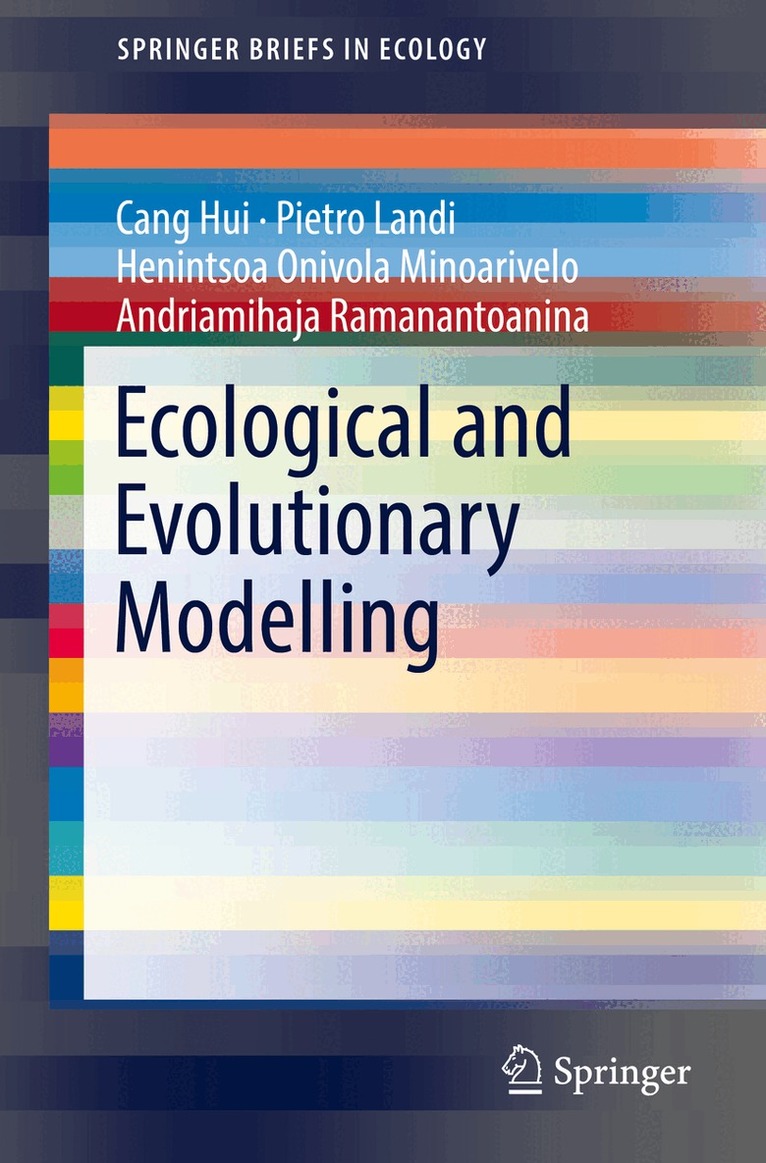
    Ecological and Evolutionary Modelling

    AvCang Hui,Pietro Landi

    Häftad, Engelska, 2018

    Del i serien SpringerBriefs in Ecology

    708 kr

    Beställningsvara. Skickas inom 10-15 vardagar. Fri frakt över 249 kr.

    Beskrivning

    Ecology studies biodiversity in its variety and complexity. It describes how species distribute and perform in response to environmental changes. Ecological processes and structures are highly complex and adaptive. In order to quantify emerging ecological patterns and investigate their hidden mechanisms, we need to rely on the simplicity of mathematical language. Ecological patterns are emerging structures observed in populations, communities and ecosystems. Elucidating drivers behind ecological patterns can greatly improve our knowledge of how ecosystems assemble, function and respond to change and perturbation. Mathematical ecology has, thus, become an important interdisciplinary research field that can provide answers to complex global issues, such as climate change and biological invasions.The aim of this book is to (i) introduce key concepts in ecology and evolution, (ii) explain classic and recent important mathematical models for investigating ecological andevolutionary dynamics, and (iii) provide real examples in ecology/biology/environmental sciences that have used these models to address relevant issues. Readers are exposed to the key concepts, frameworks, and terminology in the studies of ecology and evolution, which will enable them to ask the correct and relevant research questions, and frame the questions using appropriate mathematical models.

    Produktinformation

    • Utgivningsdatum:2018-06-27
    • Mått:155 x 235 x 6 mm
    • Vikt:160 g
    • Format:Häftad
    • Språk:Engelska
    • Serie:SpringerBriefs in Ecology
    • Antal sidor:86
    • Förlag:Springer International Publishing AG
    • ISBN:9783319921495

    Utforska kategorier

    • Optimering inom Naturvetenskap och teknik
    • Miljövetenskap och miljöpolitik inom Naturvetenskap och teknik
    • Biovetenskap inom Naturvetenskap och teknik

    Mer om författaren

    C. Hui is a Professor of Mathematics and the South African Research Chair (SARChI) in Mathematical and Theoretical Physical Biosciences based at Stellenbosch University and the African Institute for Mathematical Sciences in South Africa. His research focuses on developing models and theories for explaining emerging patterns of biodiversity, networks, and traits in ecology and evolution. CH has published more than 190 papers and received the Elsevier Young Scientist Award in 2011. CH and David M. Richardson authored the book Invasion Dynamics (Oxford University Press). CH is a core-team member of the DST-NRF Centre of Excellence for Invasion Biology and is on the editorial board of several journals, including Biological Invasions (Springer), BMC Ecology (BioMed Central), Ecological Complexity (Elsevier), Insect Conservation and Diversity (Wiley), and Frontiers in Ecology and Evolution.P. Landi is a Postdoctoral Fellow at Stellenbosch University and Visiting Scientist at the International Institute for Applied Systems Analysis (IIASA, Austria). He received his PhD with distinction in Information and Communication Technology from Politecnico di Milano in 2014 and involved in the Southern African Young Scientists Summer Programme as a co-supervisor. His main research interests include modelling evolutionary dynamics in socio-ecological systems. PL has published 10 papers and co-authored the book Modelling Love Dynamics (World Scientific).H.O. Minoarivelo is a Postdoctoral Fellow at Stellenbosch University. She received her MSc in Computer Science and PhD in Mathematical Ecology from the same university. Her work focuses on the eco-evolutionary dynamics of mutualistic networks. She has published 6 papers and co-authored a book chapter (Springer).A. Ramanantoanina is a Postdoctoral Fellow currently at the University of Western Cape. She received her PhD in Mathematics from Stellenbosch University. Her research focuses on modelling spatial and trait dynamics of ecological systems using partial differential equations. She has published 5 papers and co-authored one book chapter (Springer).

    Innehållsförteckning

    • Preface.- 1. Biodiversity1.1. Introduction.- 1.2. Aggregation.- 1.3. Entropy.- 1.4. Coexistence.- 1.5. Co-occurrence.- 1.6. Species turnover.- 1.7. Scaling.- 2. Evolution.- 2.1. Introduction.- 2.2. Phylogeny.- 2.3. Optimality.- 2.4. Game theory.- 2.5. Adaptive dynamics.- 2.6. Evolutionary branching.- 3. Networks.- 3.1. Introduction.- 3.2. Network architecture.- 3.3. Network stability.- 3.4. Complexity-stability relationship.- 3.5. Interaction switching.- 3.6. Coevolutionary networks.- 4. Spread.- 4.1.Introduction.- 4.2. Random walks.- 4.3. Metapopulations.- 4.4. Landscape demography.- 4.5. Dispersal kernels.- 4.6. Species distribution models.- References.- Index