• Fri frakt över 249 kr
  • •
  • Snabba leveranser
  • •
  • Billiga böcker
Kundservice

Du är på sajten för privatpersoner.

Företag, bibliotek eller offentlig verksamhet?

Du handlar på classic.bokus.com, där alla dina funktioner finns intakta.
Till classic.bokus.com
Bokus logotyp. Gå till startsidan.
  • Erbjudanden
  • Nyheter
  • Student
  • Topplistor
  • Barn & ungdom
  • Bokus Play
  • E-böcker
  • Pocketböcker
  • Spel & pussel

10% rabatt på allt med kod NYSTART10 →

Sidfot

Mina sidor

    Hjälp

    • Kundservice
    • Vanliga frågor och svar
    • Frakt och leverans
    • Retur vid ångerrätt
    • Reklamera vara
    • Betalning
    • Köpvillkor
    • Allmänna villkor
    • Information om webbplatsens tillgänglighet

    Om Bokus

    • Om oss
    • Pressrum
    • För studenter
    • För företag
    • För bibliotek och offentlig verksamhet
    • För leverantörer
    • Hållbarhet

    Populärt

    • Aktuella erbjudanden
    • Presentkort
    • Studentlitteratur
    • Nya böcker
    • Topplistor
    • Signerade böcker
    • Engelska böcker

    Inspiration

    • Boktips
    • BookTok
    • Populära bokserier
    • Barnbokskaraktärer
    • Populära författare
    Logotyp för Bokus
    Följ oss på Facebook (extern länk)Följ oss på Instagram (extern länk)Följ oss på YouTube (extern länk)Följ oss på TikTok (extern länk)
    bokus @ CookiesAnpassa cookiesIntegritetspolicyKöpvillkor
    Till Citymail hemsida (extern länk)Till Budbee hemsida (extern länk)Till Postnord hemsida (extern länk)Till Schenker hemsida (extern länk)Till Early Bird hemsida (extern länk)Till Walleys hemsida (extern länk)
    1. Naturvetenskap och teknik
    2. Matematik och naturvetenskap
    3. Biologi
    4. Biokemi

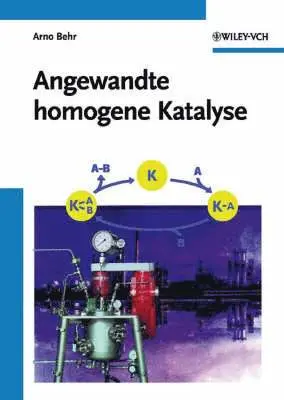
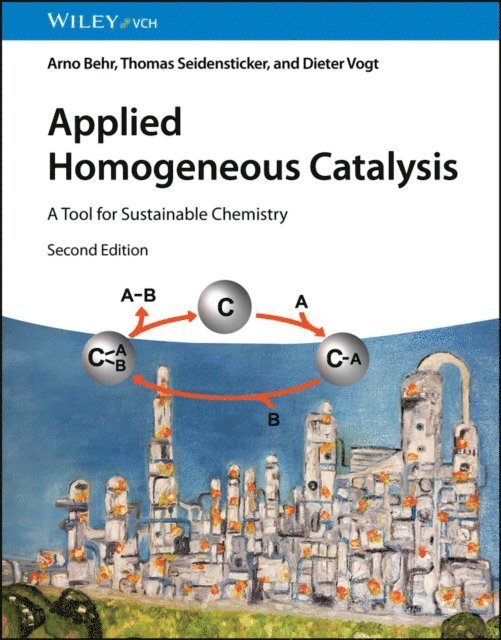
    Applied Homogeneous Catalysis

    A Tool for Sustainable Chemistry

    AvArno Behr,Thomas Seidensticker

    Häftad, Engelska, 2025

    1 478 kr

    Beställningsvara. Skickas inom 5-8 vardagar. Fri frakt över 249 kr.

    Fler format och utgåvor

    Häftad

    1 277 kr

    Beskrivning

    One-stop reference on homogeneous catalysis, from general concepts through detailed examples and industrial applications Accessible and richly illustrated, Applied Homogeneous Catalysis provides a concise overview of the broad field of homogeneous transition metal catalysis and its applications in the chemical industry. This newly revised and updated second edition puts special emphasis on green chemistry, sustainable resources, and processes. The book is divided into five parts. Part I presents the basics of transition metal catalysis. Part II focuses on process engineering aspects. Part III provides details of the most important catalytic reactions. Part IV describes catalytic conversions closely related to classical homogeneous transition metal catalysis, such as nano-, electro-, photo- and organocatalysis. Part V covers new feedstocks and other topics, concluding with an outlook on future challenges of homogeneous catalysis. The book contains numerous mechanistic details, technical information, and illustrative examples. The chapters are enlivened by various excursions that relate the content to everyday life or introduce important personalities. Didactically, the book is completed with learning objectives and take-home messages for each chapter, as well as more than 400 questions and answers for self-testing. Written by a team of internationally renowned experts in the field, with a wealth of experience in industry and teaching, Applied Homogeneous Catalysis includes information on: Economic importance of industrial homogeneously-catalyzed reactions and basics of organometallic chemistry, including types of bonds, elemental steps, and mechanismsCommon approaches for separating the homogeneous catalyst from the products after the reaction and using combinatorial chemistry and high throughput screening to achieve optimal resultsActivating “inactive” molecules such as carbon dioxide and nitrogen, and harnessing homogeneous catalysis for feedstock diversification by recycling polymers or using renewables.Providing expansive coverage of the subject, Applied Homogeneous Catalysis is an essential guide for researchers and professionals in the pharmaceutical, polymer, and fine and bulk chemicals industries working on catalysis or entering the field, as well as for Master’s and PhD students in organic chemistry, chemical engineering, and related fields.

    Produktinformation

    • Utgivningsdatum:2025-04-23
    • Mått:216 x 276 x 15 mm
    • Vikt:680 g
    • Format:Häftad
    • Språk:Engelska
    • Antal sidor:736
    • Upplaga:2
    • Förlag:Wiley-VCH Verlag GmbH
    • ISBN:9783527351114

    Utforska kategorier

    • Biokemi inom Naturvetenskap och teknik
    • Organisk kemi inom Naturvetenskap och teknik
    • Maskinteknik och material inom Naturvetenskap och teknik

    Mer om författaren

    Arno Behr headed the Chair of Industrial Chemistry at TU Dortmund University, Germany, until his retirement in 2017. His research interests included homogeneous transition metal catalysis, conversion of petrochemicals and renewables, and catalyst recycling.Thomas Seidensticker leads a research group at TU Dortmund University, Germany. His research is dedicated to sustainable process design for homogeneous catalysts, including developing innovative recycling methods and converting renewable resources.Dieter Vogt is head of the Chair of Industrial Chemistry at TU Dortmund University, Germany, since 2017. His main research interests are homogeneous transition metal catalysis, ligand and catalyst design, and process development in continuously operated miniplants.

    Recensioner i media

    “This second edition is not merely an update of its predecessor; rather, the presentation here reaches an entirely new level. In terms of content, there is hardly any significant aspect of applied homogeneous catalysis that is not addressed. In a concise and precise manner, the individual chapters cover the spectrum from the historical beginnings to current processes, including their technical, economic and environmental challenges. (…) The uniqueness of this work, however, lies in its presentation, which is exceptional both didactically and aesthetically. (…) Numerous photographs of large-scale plants and smaller technical apparatus provide a striking impression of the significance, complexity and scale of plant engineering in the chemical industry.”(Prof. Armin Börner, Leibniz Institute for Catalysis, Rostock, Germany)“Part II deserves special attention for its expert and authoritative discussion of the complex engineering issues often involved in conducting chemical reactions on a laboratory or industrial scale. This section is what makes the book unique, setting it apart from other publications on catalysis. (…) The book is highly reader-friendly: the text is clear, all terms are precisely defined, and the beautiful illustrations are well designed and helpful for understanding the content. Each chapter begins with a brief introduction to the topic and concludes with a key message. A series of specialized questions enables readers to test their knowledge, with the correct answers provided at the end.”(Prof. Dr. Anna M. Trzeciak, University of Wrocław, Poland)“Although a textbook can never be completely up-to-date, ‘Applied Homogeneous Catalysis’ stands out from its counterparts with the extensive coverage of the field, and the amount of recently achieved results. Several catalysts, reaction types and methods are treated which - beyond isolated examples - have entered the field of homogeneous catalysis only recently (metal-complex catalysts based on stable carbenes, reactions of CO2, mechanochemistry, flow reactions, switchable solvents, theoretical design of catalysts, the use of AI and Machine Learning, and many more).”(Prof. em. Dr. Ferenc Joó, University of Debrecen, Hungary)“The combination of scientific rigor, industrial relevance, and thoughtful pedagogy makes this volume an outstanding contribution to the literature. It is likely to become a standard reference for students of chemistry and chemical engineering and will provide an excellent introduction to homogeneous catalysis and sustainable chemistry. At the same time, its breadth of coverage and practical orientation ensure that it will remain a valuable resource for researchers and practitioners alike.”(Prof. Dr. Reinhard Schomäcker, TU Berlin, Germany)

    Innehållsförteckning

    • Preface of the Authors xvii0 Introduction: Adhering to the 12 Principles of Green Chemistry: How Does Homogeneous Catalysis Contribute? 1Part I Chemical Basics 131 Definition, Variants and Examples: What Actually Is Catalysis? 151.1 Definition of Catalysis 151.2 The Different Varieties of Catalysis 181.3 The Directing Effect of the Catalyst 201.4 Sources of Information About Catalysis 212 A Brief History: Homogeneous Transition Metal Catalysis: A Young Science 252.1 Phase I: Inorganic Basic Chemicals (1898–1918) 262.2 Phase II: Refinery Processes: Syngas and Ethyne Chemistry (1919–1945) 272.3 Phase III: Petrochemical Industrial Products (1946–1970) 272.4 Phase IV: Fine Chemicals and Speciality Products (1971 to Date) 293 Industrial Homogeneous Catalysis: What Is the Economic Importance? 333.1 Application Areas of Catalysis 333.2 Important Homogeneous Catalysed Processes 333.3 Synthesis of Fine and Speciality Chemicals by Homogeneous Catalysis 343.4 Atom Economy and Environmental Factor 354 Definition of Important Terms: X, Y, S, STY, TON, TOF and more… 414.1 Conversion 424.2 Yield 434.3 Selectivity 444.3.1 Chemoselectivity 444.3.2 Regioselectivity 444.3.3 Diastereoselectivity 454.3.4 Enantioselectivity 454.4 Turnover Frequency 454.5 Turnover Number 464.6 Catalyst Lifetime 474.7 Space–Time–Yield 474.8 Catalyst Losses 484.9 Catalyst Stability/Deactivation and Recycling 494.10 Product Purity 494.11 Further Important Terms 514.12 The Choice Is Yours! 515 Basics of Organometallic Chemistry: Bonds, Elementary Steps and Mechanisms 555.1 Metal–Ligand Bonds 555.2 Change of Oxidation State (OS) 585.3 Change of Coordination Number (CN) and Coordination Geometry 585.4 The Elementary Steps 595.5 Catalytic Cycles 636 Transition Metal Compounds: The ‘Captains’ of Homogeneous Catalysis 676.1 Group 3 and Lanthanides 676.2 Metals of Group 4 676.3 MetalsofGroups5– 7 676.4 The ‘Iron Metals’ of Groups 8–10 686.5 The Noble Metals from Groups 8 to 10 706.6 Gold: A Noble Metal of Group 11 746.7 The Costs of Catalyst Metals 746.8 The Availability of Transition Metal Compounds 767 Ligands: The ‘Helmsmen’ of Homogeneous Catalysis 797.1 Steric Effects and Tolman’s Ligand Cone Angle 807.2 Ligand’s Electronic Effects 867.3 Chelating Ligands and Ligand Bite Angle 907.4 Hemilabile Ligands 957.5 Nitrogen-Based Ligands 957.6 Pincer Ligands 967.7 Ligand Syntheses 977.8 Ligand Stability and Decomposition 1027.9 Costs and Accessibility of Ligands 1048 Solvents in Homogeneous Catalysis: The Reaction Medium 1078.1 General Aspects of Solvents 1078.2 Physical Properties of Solvents – Solvent Parameters 1088.3 Influence of Solvents on Homogeneous Catalysts 1158.4 Solvent Availability and Costs 1188.5 Solvent Purity 1198.6 Solvent Selection Guides 1208.7 Advanced Reaction Media for Homogeneous Catalysis 1219 Enantioselective Catalysis: The “Special Case” 1339.1 A Glossary of Asymmetric Catalysis 1339.2 A Quick Look Back 1369.3 The Mechanism of Asymmetric Catalytic Hydrogenation 1399.4 Chiral Ligands 1429.5 Overview of Homogeneously Catalysed Asymmetric Syntheses 1439.6 Industrial Applications 14310 Thermodynamics of Homogeneous Catalysis: When Does a Chemical Reaction Run? 14710.1 Gibbs Energy and Energy Plot 14710.2 Calculation or Assessment of the Free Reaction Enthalpy 14910.3 Thermodynamic Analysis of Complex Reaction Systems 14910.4 Advances in Computational Tools for Thermodynamics in Homogeneous Catalysis 15111 Kinetics of Homogeneous Catalysis: How Does the Reaction Proceed? 15911.1 Frequently Occurring Kinetics 15911.2 The Use of Energy Profiles to Explain Selectivity 16311.3 Execution of Experiments to Determine the Kinetics of a Reaction 16411.4 A Concrete Example: Hydroformylation of Cyclooctene 16511.5 Pitfalls in Kinetic Measurements 16612 Overview of Spectroscopic Methods: Can We See into Homogeneous Catalysis? 16912.1 UV/Visible Spectroscopy 17012.2 IR Spectroscopy 17112.3 Raman Spectroscopy 17312.4 NMR Spectroscopy 17412.5 Electrospray Ionisation Mass Spectroscopy (ESI-MS) 18212.6 X-Ray Absorption Spectroscopy (XAS) and Extended X-ray absorption fine Structure Analysis (exafs) 18412.7 Electron Paramagnetic Resonance Spectroscopy (EPR) 18512.8 Inductively Coupled Plasma Optical Emission Spectroscopy (ICP-OES) 18812.9 In situ, Operando and Combined Spectroscopy 189Part II Process Engineering Fundamentals 19313 Reactor Types: Where Homogeneous Catalysis Actually Occurs 19513.1 Stirred Tank Reactor 19513.2 Tubular Reactor 20113.3 Transition variants between stirred tank reactor and plug flow reactor 20213.4 Reactors for Gas/Liquid Reactions 20313.5 Loop Reactors 20513.6 Jet-Loop Reactor 20513.7 Membrane Reactor 20613.8 Microreactors 20713.9 Special Reactors 20813.10 The ‘Agony of Choice’ 20814 Overview of Catalyst Separation Techniques: How Catalyst and Product Go Their Separate Ways After the Reaction 21314.1 Separation Principles 21314.2 Separation by Distillation 21514.3 Separation by Precipitation 21914.4 Separation by Crystallisation 22114.5 Separation by Adsorption 22214.6 Separation by Heterogenisation on a Solid Support 22314.7 Separation by Membranes 22314.8 Separation by Extraction 22314.9 Separation of a Second Liquid Phase 22515 Catalyst Separation by Membranes: A Barrier Between Products and Catalysts 22915.1 Membranes 23215.2 Key Figures 23415.3 Technical Implementation 23615.4 Industrial Applications 23716 Immobilisation on Solid Supports: From Homogeneity to Heterogeneity 24116.1 The Basic Principles 24116.2 Solid-Phase Immobilisation 24216.3 Supported-Liquid Phase (SLP) Immobilisation 24616.4 Industrial Application 24717 Liquid–Liquid Multiphase Systems: The Smart Approach to Catalyst Separation 24917.1 Alteration of the Solubility of the Ligands by Selective Modifications 24917.2 Variants of Multiphase Catalysis 25118 Switchable Multiphase Systems: Triggering Separation of Homogeneous Mixtures 26118.1 Temperature as a Switch 26218.2 CO 2 Switchable Systems 27018.3 Concluding Remarks to Recycling Methods 27519 Optimisation Strategies: Combinatorial Synthesis, Design of Experiments and High-Throughput Screening 27919.1 Combinatorial Chemistry 28019.2 Design of Experiments (DoE) 28319.3 High-Throughput Screening (HTS) 28619.4 Virtual Screening (Computational Screening, Machine Learning) 29920 Process Development in Miniplants: From Laboratory to Production 30520.1 Combination of TMSs with Other Reactor Types 30720.2 Improved Online Analytics 30820.3 Application of TMSs for Complex Reactions in Continuous Operation 31020.4 Combined Reaction Separation Processes 311Part III Homogeneously Catalysed Reaction Types 31521 An Overview of C––C-Bond Formation: A Guide Through the Jungle 31922 Hydroformylation: The Industrial Route to Aldehydes and Alcohols 32522.1 Main and Side Reactions 32622.2 Catalysts 32722.3 Mechanisms 33122.4 Substrates 33422.5 Asymmetric Hydroformylation 33722.6 Syngas Surrogates 33823 Carbonylation: The Versatile Insertions of Carbon Monoxide 34123.1 Reactions Between CO and Hydrogen 34123.2 Reactions of CO with Alkenes and Vinyl Arenes 34323.3 Reactions of CO with Dienes 34523.4 Reactions of CO with Alkynes 34623.5 Reactions of CO with Alcohols 34723.6 New Trends 34824 Oligomerisation and Cyclooligomerisation: The Conversion of Unsaturated Aliphatics into Short Chains or Medium-Sized Rings 35124.1 Oligomerisation of Alkenes 35124.2 Dienes 35924.3 Alkynes 36124.4 Co-Oligomerisations 36125 Metathesis: A ‘Change-Your-Partners’ Dance 36525.1 The Many Variants of Alkene Metathesis 36525.2 Mechanism and Catalysts 36725.3 Industrial Applications 37125.4 Other Types of Metatheses 37325.5 Some Trends 37526 Polymerisation: The Purposeful Assembly of Macromolecules 38126.1 Polyethylene and Ziegler Catalysts 38126.2 Polypropylene and Metallocene Catalysis 38526.3 Further Polyalkenes and Copolymers 38826.4 Polydienes 39026.5 Polyketones 39226.6 Polyalkynes 39326.7 Post-Metallocenes 39426.8 Some Trends 39527 Telomerisation: The Construction of Functionalised Aliphatic Chains 39727.1 Reactions, Mechanisms and Catalysts 39727.2 Butadiene Telomerisation 39927.3 Telomerisations with C 5 - and C 6 -Dienes 40727.4 Terpenoic 1,3-Dienes 40827.5 Enantioselective Telomerisations 40827.6 Some Trends 40928 Carbon–Carbon Coupling Reactions: Quite a lot of Name Reactions 41328.1 Mizoroki–Heck Reactions 41428.2 Sonogashira–Hagihara Reactions 41728.3 Suzuki–Miyaura Reaction 41928.4 Stille Coupling 42228.5 Hiyama Coupling 42328.6 Negishi Coupling 42528.7 Kumada Coupling 42629 Hydrogenation: C––H Bond Formation 42929.1 Catalysts and Mechanisms 43029.2 Asymmetric Hydrogenation 43029.3 Hydrogenation of Various Functional Groups 43229.4 Transfer Hydrogenations 43629.5 Industrial Applications 43729.6 Some Trends 44030 Oxidation: C––O Bond Formation 44330.1 Wacker Oxidation 44330.2 Epoxidation 44730.3 Asymmetric Dihydroxylation 45130.4 Oxidative Cleavage of C=C Double Bonds 45230.5 Oxidation of Cyclohexane 45330.6 Oxidation of Alkyl Aromatics 45430.7 Oxidation of Alcohols 45630.8 Oxidation of Ketones (Baeyer–Villiger Oxidation) 45731 Amination and Hydroamination: C––N Bond Formation 46131.1 Amination of Aryl Halides 46131.2 Hydroamination of Alkenes 46431.3 Hydroaminations of 1,3-Dienes and Allenes 46831.4 Hydroamination of Alkynes 47031.5 Amination of Functional Groups 47131.6 Aminohydroxylation 47432 Hydrofunctionalisation: Formation of Further C––X Bonds 47732.1 Hydrosilylation 47732.2 Hydroboration 48032.3 Hydration and Hydroalkoxylation 48332.4 Hydrometalation 48433 Isomerisation and Rearrangement: Migration of Double Bonds and Rearrangement of the Carbon Backbone 48933.1 Isomerisation of Alkenes 48933.2 Isomerisation of Alkenes with Functional Groups 49233.3 Isomerisation of 1,3-Dienes, Allenes and Alkynes 49633.4 Cyclic Compounds: Formation, Rearrangement and Splitting 497Part IV Associated Catalysis 50134 Tandem Reactions: Multiple Synthesis Steps in One Pot 50334.1 General Taxonomy 50334.2 Important Examples of Homogeneously Catalysed Tandem Reactions 50835 Nanocatalysis: A Balancing Act Between Homogeneous and Heterogeneous Catalysis 51935.1 Introduction 51935.2 Synthesis and Properties of Nanocatalysts 52135.3 Stabilisation of Nanoparticles 52235.4 Heterogenisation of Nanoparticles on Solid Supports 52535.5 Catalysis Involving Metal Nanoparticles 52535.6 What Can Happen During a Reaction? 52635.7 Homogeneous Catalysis or Nanocatalysis? 52736 Electrocatalysis: Catalysis with Electrons 53136.1 Water Splitting 53336.2 Carbon Dioxide Reduction 53436.3 Electrochemical In Situ Synthesis of Homogeneous Catalysts 53536.4 Electrocatalytic Oxidations 53537 Photocatalysis: Catalysis with Photons 53738 Alternative Ways of Energy Input: Sono-, Microwave- and Mechanocatalysis 54338.1 Sonocatalysis 54338.2 Microwave Catalysis 54638.3 Mechanocatalysis 55139 Organocatalysis: Homogeneous Catalysis only with Organic Compounds 559Part V New Resources 56540 Alkane Activation: Acquisition of New Feedstocks 56740.1 Mechanistic Considerations 56840.2 c –O Formation via Alkane Oxidation 57040.3 c –c-Linking Reactions 57240.4 Hydrogen Migrations and C –C-Splitting Reactions 57440.5 Further Alkane Functionalisations (C –X-Linkage Reactions) 57641 Reactions with Carbon Dioxide: Activating an ‘Inactive’ Molecule 57941.1 Carbon Dioxide and Alkanes 58041.2 Carbon Dioxide and Alkenes 58141.3 Carbon Dioxide and Dienes 58441.4 Carbon Dioxide and Alkynes 58841.5 Carbon Dioxide and Aromatic Compounds 59041.6 Carbon Dioxide and Hydrogen (Reductions of CO 2) 59241.7 Carbon Dioxide and Epoxides 59841.8 Carbon Dioxide and Amines 60041.9 Carbon Dioxide-Containing Polymers 60042 Nitrogen Activation: Reaching for the Air 60542.1 Transition Metal–Nitrogen Complexes 60742.2 Stoichiometric Reactions of the Nitrogen Molecule 60942.3 Homogeneously Catalysed Synthesis of Ammonia 60942.4 What else… 61243 Recycling of Polymers: The Use of Waste 61743.1 Thermal Cracking 61843.2 Solvolysis 61943.3 Hydrogenolyses 62344 Homogeneous Catalysis with Renewables: Using Nature’s Treasures 62944.1 Catalytic Conversion of Oleochemicals 63144.2 Catalytic Reactions of Terpenes 63744.3 Catalytic Reactions of Carbohydrates 63844.4 Catalytic Reactions of Lignin 64045 Future Challenges of Homogeneous Catalysis: What the Crystal Ball Might Tell You 64545.1 New Resources 64545.2 New Reactions 65545.3 New Smart Products 65745.4 New Catalysts 65845.5 New Methods 659Epilogue 661Answers to the Exercise Questions 663Excursions Photo Credits 687Index 691Supplementary literature information can be found at www.wiley.com/go/behr/AHC 2