• Fri frakt över 249 kr
  • •
  • Snabba leveranser
  • •
  • Billiga böcker
Kundservice

Du är på sajten för privatpersoner.

Företag, bibliotek eller offentlig verksamhet?

Du handlar på classic.bokus.com, där alla dina funktioner finns intakta.
Till classic.bokus.com
Bokus logotyp. Gå till startsidan.
  • Erbjudanden
  • Nyheter
  • Student
  • Topplistor
  • Barn & ungdom
  • Bokus Play
  • E-böcker
  • Pocketböcker
  • Spel & pussel

10% rabatt på allt med kod: NYSTART10 →

Sidfot

Mina sidor

    Hjälp

    • Kundservice
    • Vanliga frågor och svar
    • Frakt och leverans
    • Retur vid ångerrätt
    • Reklamera vara
    • Betalning
    • Köpvillkor
    • Allmänna villkor
    • Information om webbplatsens tillgänglighet

    Om Bokus

    • Om oss
    • Pressrum
    • För studenter
    • För företag
    • För bibliotek och offentlig verksamhet
    • För leverantörer
    • Hållbarhet

    Populärt

    • Aktuella erbjudanden
    • Presentkort
    • Studentlitteratur
    • Nya böcker
    • Topplistor
    • Signerade böcker
    • Engelska böcker

    Inspiration

    • Boktips
    • BookTok
    • Populära bokserier
    • Barnbokskaraktärer
    • Populära författare
    Logotyp för Bokus
    Följ oss på Facebook (extern länk)Följ oss på Instagram (extern länk)Följ oss på YouTube (extern länk)Följ oss på TikTok (extern länk)
    bokus @ CookiesAnpassa cookiesIntegritetspolicyKöpvillkor
    Till Citymail hemsida (extern länk)Till Budbee hemsida (extern länk)Till Postnord hemsida (extern länk)Till Schenker hemsida (extern länk)Till Early Bird hemsida (extern länk)Till Walleys hemsida (extern länk)
    1. Naturvetenskap och teknik
    2. Matematik och naturvetenskap
    3. Matematik
    4. Tillämpad matematik

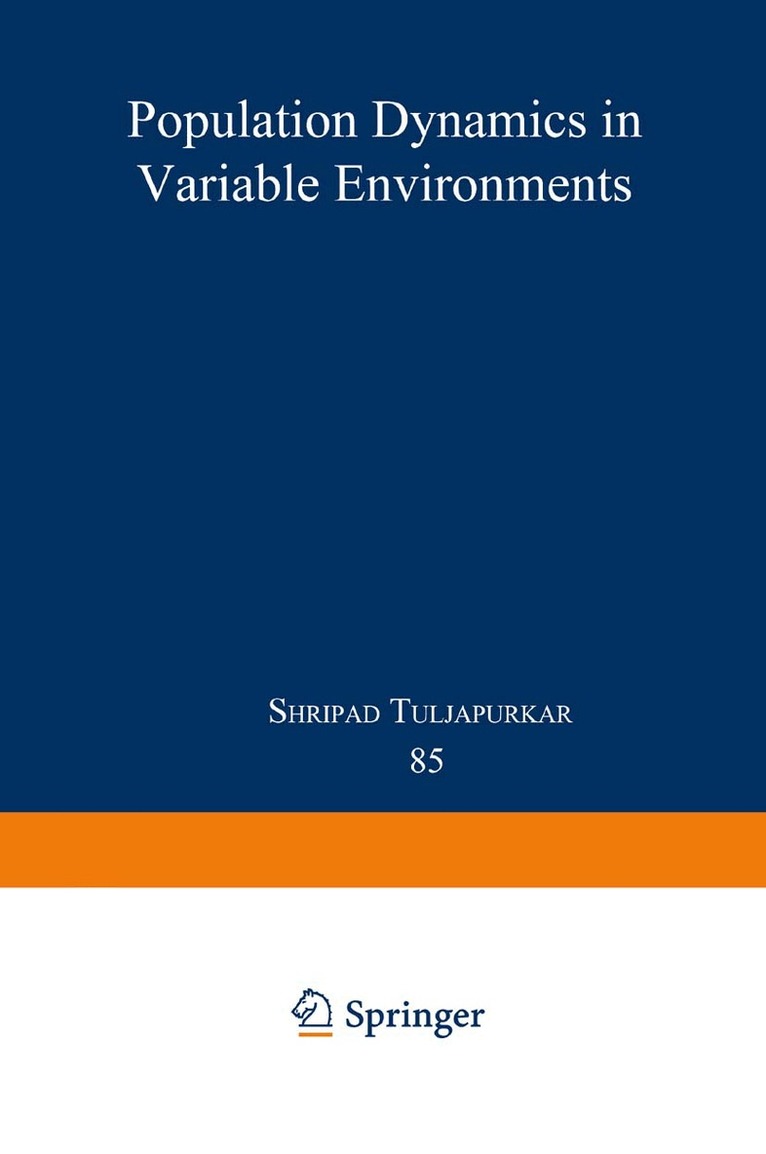
    Population Dynamics in Variable Environments

    AvShripad Tuljapurkar

    Häftad, Engelska, 1990

    Del 85 i serien Lecture Notes in Biomathematics

    547 kr

    Beställningsvara. Skickas inom 10-15 vardagar. Fri frakt över 249 kr.

    Fler format och utgåvor

    E-bok

    710 kr

    Beskrivning

    Demography relates observable facts about individuals to the dynamics of populations. If the dynamics are linear and do not change over time, the classical theory of Lotka (1907) and Leslie (1945) is the central tool of demography. This book addresses the situation when the assumption of constancy is dropped. In many practical situations, a population will display unpredictable variation over time in its vital rates, which must then be described in statistical terms. Most of this book is concerned with the theory of populations which are subject to random temporal changes in their vital rates, although other kinds of variation (e. g. , cyclical) are also dealt with. The central questions are: how does temporal variation work its way into a population's future, and how does it affect our interpretation of a population's past. The results here are directed at demographers of humans and at popula­ tion biologists. The uneven mathematical level is dictated by the material, but the book should be accessible to readers interested in population the­ ory. (Readers looking for background or prerequisites will find much of it in Hal Caswell's Matrix population models: construction, analysis, and in­ terpretation (Sinauer 1989) ). This book is in essence a progress report and is deliberately brief; I hope that it is not mystifying. I have not attempted to be complete about either the history or the subject, although most sig­ nificant results and methods are presented.

    Produktinformation

    • Utgivningsdatum:1990-04-25
    • Mått:152 x 229 x 9 mm
    • Vikt:242 g
    • Format:Häftad
    • Språk:Engelska
    • Serie:Lecture Notes in Biomathematics
    • Antal sidor:154
    • Förlag:Springer-Verlag Berlin and Heidelberg GmbH & Co. KG
    • ISBN:9783540524823

    Utforska kategorier

    • Tillämpad matematik inom Naturvetenskap och teknik
    • Miljövetenskap och miljöpolitik inom Naturvetenskap och teknik
    • Fysik inom Naturvetenskap och teknik

    Innehållsförteckning

    • 1 Introduction.- 2 Beginnings: Classical Theory.- 3 Deterministic Temporal Variation.- 4 Random Rates: General Theory.- 5 Examples.- 6 Ess and Allele Invasion.- 7 Moments of the Population Vector.- 8 Random Survival or Fertility: Exact Results.- 9 Age Structure: Bounds, Growth, Convergence.- 10 Synergy, Constraints, Convexity.- 11 Sensitivity Analysis of Growth Rate.- 12 Growth Rates for Small Noise.- 13 Population Structure for Small Noise.- 14 Population Projection.- 15 Life History and Iteroparity.- 16 Life History Evolution: Delayed Flowering.