• Fri frakt över 249 kr
  • •
  • Snabba leveranser
  • •
  • Billiga böcker
Kundservice

Du är på sajten för privatpersoner.

Företag, bibliotek eller offentlig verksamhet?

Du handlar på classic.bokus.com, där alla dina funktioner finns intakta.
Till classic.bokus.com
Bokus logotyp. Gå till startsidan.
  • Erbjudanden
  • Nyheter
  • Student
  • Topplistor
  • Barn & ungdom
  • Bokus Play
  • E-böcker
  • Pocketböcker
  • Spel & pussel

10% rabatt på allt med kod NYSTART10 →

Sidfot

Mina sidor

    Hjälp

    • Kundservice
    • Vanliga frågor och svar
    • Frakt och leverans
    • Retur vid ångerrätt
    • Reklamera vara
    • Betalning
    • Köpvillkor
    • Allmänna villkor
    • Information om webbplatsens tillgänglighet

    Om Bokus

    • Om oss
    • Pressrum
    • För studenter
    • För företag
    • För bibliotek och offentlig verksamhet
    • För leverantörer
    • Hållbarhet

    Populärt

    • Aktuella erbjudanden
    • Presentkort
    • Studentlitteratur
    • Nya böcker
    • Topplistor
    • Signerade böcker
    • Engelska böcker

    Inspiration

    • Boktips
    • BookTok
    • Populära bokserier
    • Barnbokskaraktärer
    • Populära författare
    Logotyp för Bokus
    Följ oss på Facebook (extern länk)Följ oss på Instagram (extern länk)Följ oss på YouTube (extern länk)Följ oss på TikTok (extern länk)
    bokus @ CookiesAnpassa cookiesIntegritetspolicyKöpvillkor
    Till Citymail hemsida (extern länk)Till Budbee hemsida (extern länk)Till Postnord hemsida (extern länk)Till Schenker hemsida (extern länk)Till Early Bird hemsida (extern länk)Till Walleys hemsida (extern länk)
    1. Ekonomi och Ledarskap
    2. Nationalekonomi

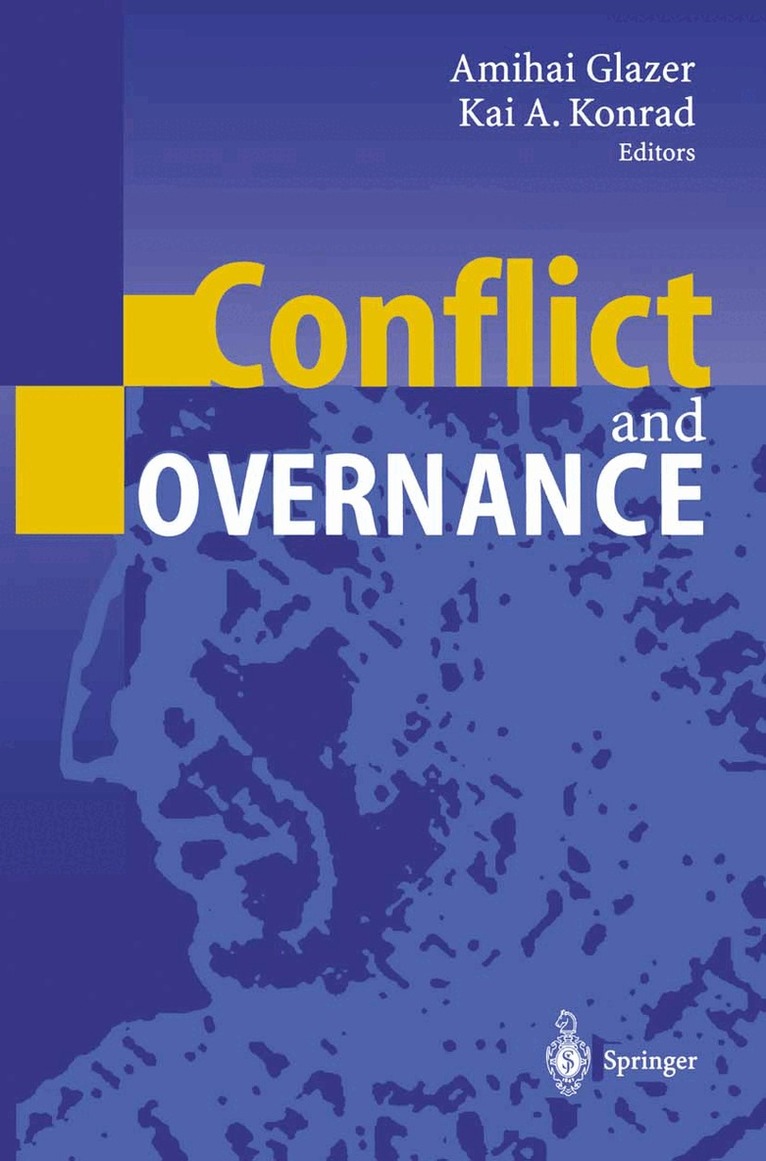
    Conflict and Governance

    AvAmihai Glazer,Kai A. Konrad

    Häftad, Engelska, 2010

    546 kr

    Beställningsvara. Skickas inom 10-15 vardagar. Fri frakt över 249 kr.

    Beskrivning

    Economists and political scientists have recently begun to study formally how conftict and the possibility of conftict affects resource allocation and economic performance.! For example, an extensive empiricalliterature suggests that conftict and political instability adversely affects economic development and that higher 2 inequality causes poor economic performance by inducing increased conftict. In this paper I argue that a serious ftaw in this research has taken too individu­ 3 alistic a view of conftict. While the approach of methodological individualism is attractive, in reality individuals act not purely in isolation, but also as part of larger social groupings and networks. I therefore try to consider how these models of conftict may be extended to this type of situation and thus attempt to place individuals within a larger social setting to see how this alters our intuitions about conftict and its economic and political determinants and implications. But what groups are relevant? Individuals belong to many overlapping and cross cutting groups in society. While traditional Marxist analysis stressed dass groupings so that workers associated with workers and capitalists with capitalists, more recent literature (see Wright, 1985) has stressed the diversity of social groupings. Rather than associate along dass lines one might associate along gender, religious, or perhaps ethnic lines. Many strands of research have show how thinking of groups in this heterogeneous way can iIluminate both economic 4 and political behavior.

    Produktinformation

    • Utgivningsdatum:2010-11-30
    • Mått:155 x 235 x 12 mm
    • Vikt:324 g
    • Format:Häftad
    • Språk:Engelska
    • Antal sidor:202
    • Förlag:Springer-Verlag Berlin and Heidelberg GmbH & Co. KG
    • ISBN:9783642055270

    Utforska kategorier

    • Nationalekonomi inom Ekonomi och Ledarskap
    • Offentliga sektorn inom Ekonomi och Ledarskap
    • Sociologi inom Samhälle och politik

    Innehållsförteckning

    • The wide importance of conflict.- Social identity, inequality and conflict.- Butter and guns: Complementarity between economic and military competition.- Targeting and political support for welfare spending.- How to understand, and deal with dictatorship: an economist’s view.- Tax resistance, economy and state transformation in China and Europe.- The rationality of revolution.- Optimal law enforcement when victims are rational players.- Property rights and the evolution of the state.- The political economy of organized crime: providing protection when the state does not.- Social decision rules are not immune to conflict.