• Fri frakt över 249 kr
  • •
  • Snabba leveranser
  • •
  • Billiga böcker
Kundservice

Du är på sajten för privatpersoner.

Företag, bibliotek eller offentlig verksamhet?

Du handlar på classic.bokus.com, där alla dina funktioner finns intakta.
Till classic.bokus.com
Bokus logotyp. Gå till startsidan.
  • Erbjudanden
  • Student
  • Topplistor
  • Barn & ungdom
  • Bokus Play
  • E-böcker
  • Ljudböcker
  • Pocketböcker
  • Spel & pussel

10% rabatt på allt med kod NYSTART10 →

Sidfot

Mina sidor

    Hjälp

    • Kundservice
    • Vanliga frågor och svar
    • Frakt och leverans
    • Retur vid ångerrätt
    • Reklamera vara
    • Betalning
    • Köpvillkor
    • Allmänna villkor
    • Information om webbplatsens tillgänglighet

    Om Bokus

    • Om oss
    • Pressrum
    • För studenter
    • För företag
    • För bibliotek och offentlig verksamhet
    • För leverantörer
    • Hållbarhet

    Populärt

    • Aktuella erbjudanden
    • Presentkort
    • Studentlitteratur
    • Nya böcker
    • Topplistor
    • Signerade böcker
    • Engelska böcker

    Inspiration

    • Boktips
    • BookTok
    • Populära bokserier
    • Barnbokskaraktärer
    • Populära författare
    Logotyp för Bokus
    Följ oss på Facebook (extern länk)Följ oss på Instagram (extern länk)Följ oss på YouTube (extern länk)Följ oss på TikTok (extern länk)
    bokus @ CookiesAnpassa cookiesIntegritetspolicyKöpvillkor
    Till Citymail hemsida (extern länk)Till Budbee hemsida (extern länk)Till Postnord hemsida (extern länk)Till Schenker hemsida (extern länk)Till Early Bird hemsida (extern länk)Till Walleys hemsida (extern länk)
    1. Samhälle och politik
    2. Sociologi och antropologi
    3. Sociologi

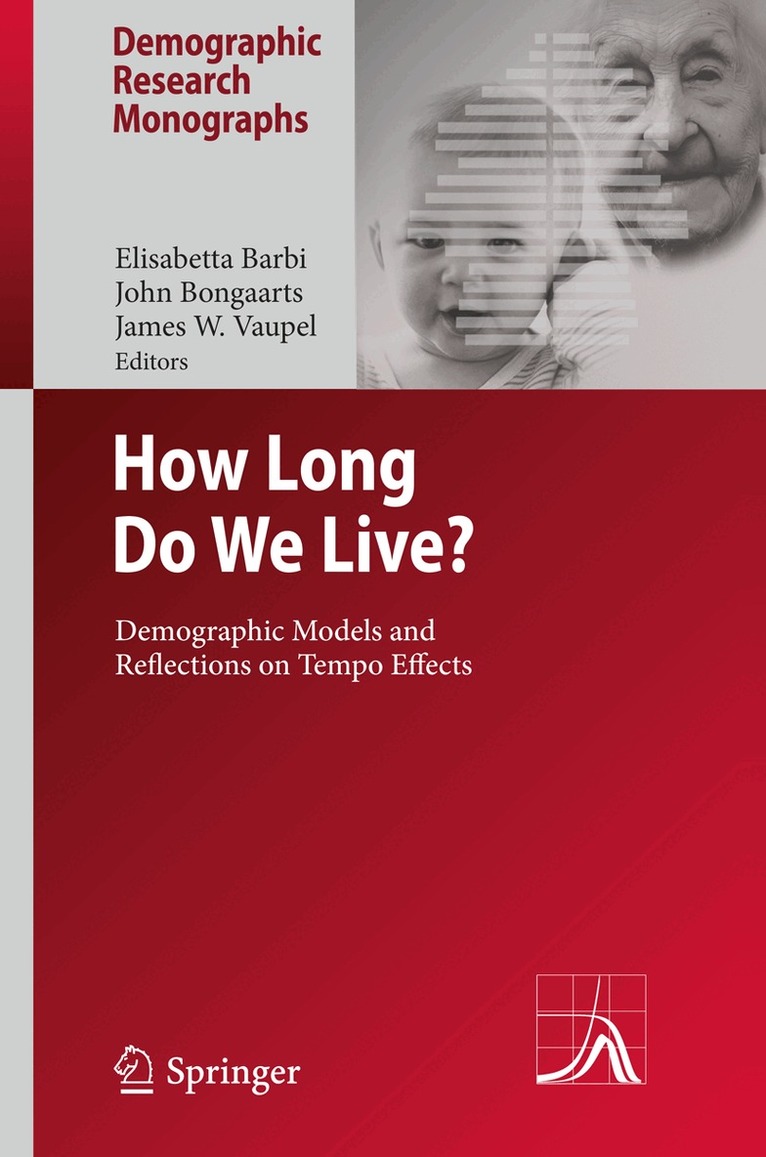
    How Long Do We Live?

    Demographic Models and Reflections on Tempo Effects

    AvElisabetta Barbi,John Bongaarts

    Häftad, Engelska, 2010

    Del i serien Demographic Research Monographs

    1 086 kr

    Beställningsvara. Skickas inom 10-15 vardagar. Fri frakt över 249 kr.

    Beskrivning

    How should life expectancy be calculated? More generally, how should life - bles be estimated? Since John Graunt's pioneering contribution, read before theRoyalSocietyofLondonat6p. m. onthe27thofFebruary1661,demog- phers have developed better and better methods. Some concerns were raised, including concerns about how to deal with heterogeneous populations p- lished in an article inDemography in 1979 that I wrote with Kenneth Manton and Eric Stallard. Yet, a few years ago nearly all demographers believed that as long as the underlying population and death counts were accurate, then lifetables could be reliably estimated. John Bongaarts and Gri? Feeney launched a revolutionary assault on this dogma. Two key contributions by them are reprinted in Part I of this mo- graph. Some very good demographers agreed, as least in part, with B- gaarts' and Feeney's radical argument that when death rates are changing, then tempo e?ects distort conventional calculations of life expectancy. Other very good demographers disagreed.So John Bongaarts and I brought some leading demographers together in a research meeting, co-sponsored by the Max Planck Institute for Demographic Research and the Population Co- cil and held in New York City on November 18 and 19, 2004. Many of the papers discussed at the workshop, generally after considerable revision, were published in Demographic Research in 2005 and 2006. Nine of these articles, in some cases somewhat revised, are published in this monograph: they are the ?rst seven chapters in Part II and the two chapters in Part III.

    Produktinformation

    • Utgivningsdatum:2010-11-30
    • Mått:155 x 235 x 17 mm
    • Vikt:458 g
    • Format:Häftad
    • Språk:Engelska
    • Serie:Demographic Research Monographs
    • Antal sidor:284
    • Förlag:Springer-Verlag Berlin and Heidelberg GmbH & Co. KG
    • ISBN:9783642097270

    Utforska kategorier

    • Sociologi inom Samhälle och politik
    • Biovetenskap inom Naturvetenskap och teknik

    Innehållsförteckning

    • How long do we live? Demographic models and reflections on tempo effects: An introduction.- How long do we live? Demographic models and reflections on tempo effects: An introduction.- Theoretical basis for the mortality tempo effect.- Estimating mean lifetime.- The quantum and tempo of life-cycle events.- Critiques, extensions and applications of the mortality tempo effect.- Demographic translation and tempo effects: An accelerated failure time perspective.- Lifesaving, lifetimes and lifetables.- Tempo and its tribulations.- Tempo effects in mortality: An appraisal.- Increments to life and mortality tempo.- Mortality tempo versus removal of causes of mortality: Opposite views leading to different estimations of life expectancy.- Tempo effect on age-specific death rates.- Mortality tempo-adjustment: Theoretical considerations and an empirical application.- Comparison of period and cohort measures of longevity.- Five period measures of longevity.- Found in translation? A cohort perspective on tempo-adjusted life expectancy.- Conclusions.- Afterthoughts on the mortality tempo effect.- Turbulence in lifetables: Demonstration by four simple examples.