• Fri frakt över 249 kr
  • •
  • Snabba leveranser
  • •
  • Billiga böcker
Kundservice

Du är på sajten för privatpersoner.

Företag, bibliotek eller offentlig verksamhet?

Du handlar på classic.bokus.com, där alla dina funktioner finns intakta.
Till classic.bokus.com
Bokus logotyp. Gå till startsidan.
  • Erbjudanden
  • Nyheter
  • Student
  • Topplistor
  • Barn & ungdom
  • Bokus Play
  • E-böcker
  • Pocketböcker
  • Spel & pussel

10% rabatt på allt med kod NYSTART10 →

Sidfot

Mina sidor

    Hjälp

    • Kundservice
    • Vanliga frågor och svar
    • Frakt och leverans
    • Retur vid ångerrätt
    • Reklamera vara
    • Betalning
    • Köpvillkor
    • Allmänna villkor
    • Information om webbplatsens tillgänglighet

    Om Bokus

    • Om oss
    • Pressrum
    • För studenter
    • För företag
    • För bibliotek och offentlig verksamhet
    • För leverantörer
    • Hållbarhet

    Populärt

    • Aktuella erbjudanden
    • Presentkort
    • Studentlitteratur
    • Nya böcker
    • Topplistor
    • Signerade böcker
    • Engelska böcker

    Inspiration

    • Boktips
    • BookTok
    • Populära bokserier
    • Barnbokskaraktärer
    • Populära författare
    Logotyp för Bokus
    Följ oss på Facebook (extern länk)Följ oss på Instagram (extern länk)Följ oss på YouTube (extern länk)Följ oss på TikTok (extern länk)
    bokus @ CookiesAnpassa cookiesIntegritetspolicyKöpvillkor
    Till Citymail hemsida (extern länk)Till Budbee hemsida (extern länk)Till Postnord hemsida (extern länk)Till Schenker hemsida (extern länk)Till Early Bird hemsida (extern länk)Till Walleys hemsida (extern länk)
    1. Samhälle och politik
    2. Samhälle och kultur
    3. Kultur och medier
    4. Referensverk och tvärvetenskap

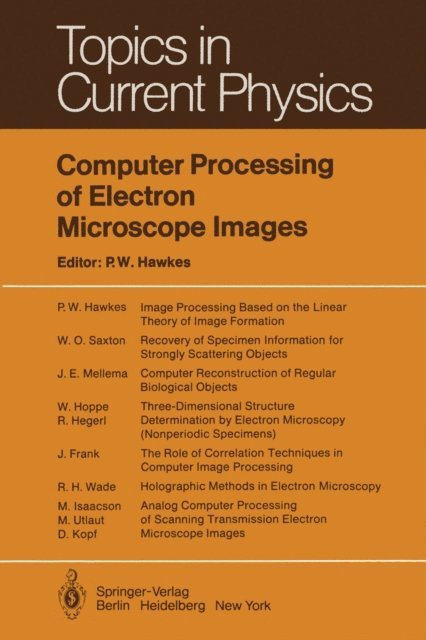
    Computer Processing of Electron Microscope Images

    AvP. W. Hawkes,P. W. Hawkes

    Häftad, Engelska, 2011

    Del 13 i serien Topics in Current Physics

    546 kr

    Beställningsvara. Skickas inom 10-15 vardagar. Fri frakt över 249 kr.

    Beskrivning

    Towards the end of the 1960s, a number of quite different circumstances combined to launch a period of intense activity in the digital processing of electron micro­ graphs. First, many years of work on correcting the resolution-limiting aberrations of electron microscope objectives had shown that these optical impediments to very high resolution could indeed be overcome, but only at the cost of immense exper­ imental difficulty; thanks largely to the theoretical work of K. -J. Hanszen and his colleagues and to the experimental work of F. Thon, the notions of transfer func­ tions were beginning to supplant or complement the concepts of geometrical optics in electron optical thinking; and finally, large fast computers, capable of manipu­ lating big image matrices in a reasonable time, were widely accessible. Thus the idea that recorded electron microscope images could be improved in some way or rendered more informative by subsequent computer processing gradually gained ground. At first, most effort was concentrated on three-dimensional reconstruction, particu­ larly of specimens with natural symmetry that could be exploited, and on linear operations on weakly scattering specimens (Chap. l). In 1973, however, R. W. Gerchberg and W. O. Saxton described an iterative algorithm that in principle yielded the phase and amplitude of the electron wave emerging from a strongly scattering speci­ men.

    Produktinformation

    • Utgivningsdatum:2011-12-27
    • Mått:170 x 244 x 18 mm
    • Vikt:548 g
    • Format:Häftad
    • Språk:Engelska
    • Serie:Topics in Current Physics
    • Antal sidor:296
    • Förlag:Springer-Verlag Berlin and Heidelberg GmbH & Co. KG
    • ISBN:9783642813832

    Utforska kategorier

    • Referensverk och tvärvetenskap inom Samhälle och politik
    • Analytisk kemi inom Naturvetenskap och teknik
    • Teknik: allmänt inom Naturvetenskap och teknik

    Innehållsförteckning

    • 1. Image Processing Based on the Linear Theory of Image Formation.- 1.1 Transfer Functions.- 1.2 Transfer Functions with Partially Coherent Illumination.- 1.3 Practical Exploitation of the Linear Relationship.- References.- 2. Recovery of Specimen Information for Strongly Scattering Objects.- 2.1 Image Formation and Interpretation.- 2.2 Methods Iterating the Linear Theory Solution.- 2.3 Methods Requiring No Special Apertures.- 2.4 Methods Using Half-Plane Apertures.- 2.5 Analytic Wave Functions and Complex Zeros.- 2.6 Holography.- 2.7 Ptychography and Related Methods.- 2.8 Bright-Field/Dark-Field Subtraction.- 2.9 Other Perspectives.- 2.10 Conclusions.- References.- 3. Computer Reconstruction of Regular Biological Objects.- 3.1 The Biological Object.- 3.2 Fourier Processing of Electron Micrographs.- 3.3 Recent Applications to Image Processing of Regular Biological Structure.- 3.4. Outlook.- References.- 4. Three-Dimensional Structure Determination by Electron Microscopy (Nonperiodic Specimens).- 4.1 History and General Discussion of the Subject.- 4.2 The Fundamental Theoretical Background.- 4.3 The Problem of Reconstruction.- 4.4 Aspects for the Future.- References.- 5. The Role of Correlation Techniques in Computer Image Processing.- 5.1 Correlation Functions.- 5.2 Computation.- 5.3 Some Important Theorems.- 5.4 Determination of Relative Positions.- 5.5 Matched Filtering.- 5.6 Characterization of Instrument Conditions.- 5.7 Signal-to-Noise Ratio Measurement.- 5.8 Conclusions.- References.- 6. Holographic Methods in Electron Microscopy.- 6.1 Historical Background.- 6.2 Holographic Schemes.- 6.3 Experimental Electron Holography.- 6.4 Contrast Transfer and Holography.- 6.5 Additional Reading.- 6.6 Conclusions.- References.- 7. Analog Computer Processing of Scanning Transmission Electron Microscope Images.- 7.1 Organization.- 7.2 Characteristics of Analog Processing.- 7.3 Types of Signals Available in the STEM.- 7.4 Instrumental Characteristics.- 7.5 Applications.- 7.6 Conclusion.- References.- Appendix: Publication Details of International and European Congresses on Electron Microscopy.- Additional References with Titles.