• Fri frakt över 249 kr
  • •
  • Snabba leveranser
  • •
  • Billiga böcker
Kundservice

Du är på sajten för privatpersoner.

Företag, bibliotek eller offentlig verksamhet?

Du handlar på classic.bokus.com, där alla dina funktioner finns intakta.
Till classic.bokus.com
Bokus logotyp. Gå till startsidan.
  • Erbjudanden
  • Student
  • Topplistor
  • Barn & ungdom
  • Bokus Play
  • E-böcker
  • Ljudböcker
  • Pocketböcker
  • Spel och pussel

Pocketfynda! Hundratals böcker för 49 kr/st →

Sidfot

Mina sidor

    Hjälp

    • Kundservice
    • Vanliga frågor och svar
    • Frakt och leverans
    • Retur vid ångerrätt
    • Reklamera vara
    • Betalning
    • Köpvillkor
    • Allmänna villkor
    • Information om webbplatsens tillgänglighet

    Om Bokus

    • Om oss
    • Pressrum
    • För studenter
    • För företag
    • För bibliotek och offentlig verksamhet
    • För leverantörer
    • Hållbarhet

    Populärt

    • Aktuella erbjudanden
    • Presentkort
    • Studentlitteratur
    • Nya böcker
    • Topplistor
    • Signerade böcker
    • Engelska böcker

    Inspiration

    • Boktips
    • BookTok
    • Barnbokskaraktärer
    • Populära författare
    Logotyp för Bokus
    Följ oss på Facebook (extern länk)Följ oss på Instagram (extern länk)Följ oss på YouTube (extern länk)Följ oss på TikTok (extern länk)
    bokus @ CookiesAnpassa cookiesIntegritetspolicyKöpvillkor
    Till Citymail hemsida (extern länk)Till Budbee hemsida (extern länk)Till Postnord hemsida (extern länk)Till Schenker hemsida (extern länk)Till Early Bird hemsida (extern länk)Till Walleys hemsida (extern länk)
    1. Ekonomi och Ledarskap
    2. Nationalekonomi
    3. Mikroekonomi

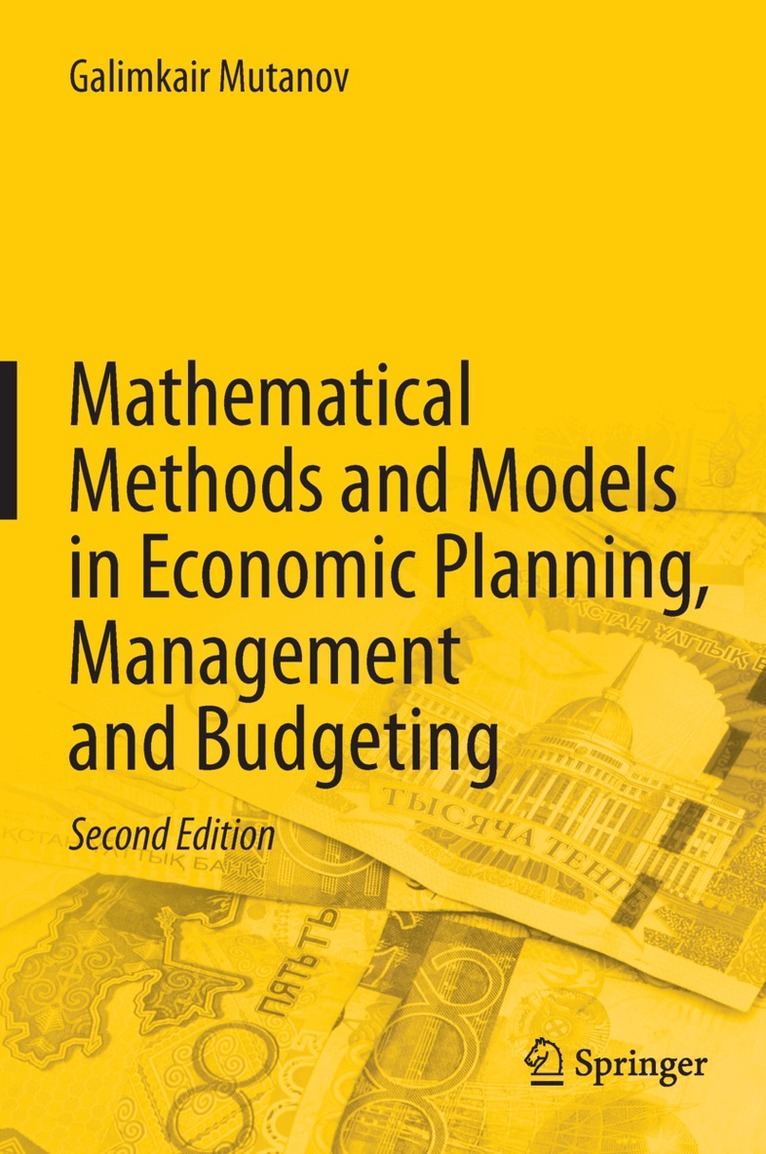
    Mathematical Methods and Models in Economic Planning, Management and Budgeting

    AvGalimkair Mutanov

    Inbunden, Engelska, 2014

    1 399 kr

    Beställningsvara. Skickas inom 10-15 vardagar. Fri frakt över 249 kr.

    Fler format och utgåvor

    E-bok

    1 851 kr

    Häftad

    1 399 kr

    Beskrivning

    This book describes a system of mathematical models and methods that can be used to analyze real economic and managerial decisions and to improve their effectiveness. Application areas include: management of development and operation budgets, assessment and management of economic systems using an energy entropy approach, equation of exchange rates and forecasting foreign exchange operations, evaluation of innovative projects, monitoring of governmental programs, risk management of investment processes, decisions on the allocation of resources, and identification of competitive industrial clusters. The proposed methods and models were tested on the example of Kazakhstan’s economy, but the generated solutions will be useful for applications at other levels and in other countries.Regarding your book "Mathematical Methods and Models in Economics", I am impressed because now it is time when "econometrics" is becoming more appreciated by economists and by schools that are the hostsor employers of modern economists. ... Your presented results really impressed me.John F. Nash, Jr., Princeton University, Nobel Memorial Prize in Economic SciencesThe book is within my scope of interest because of its novelty and practicality. First, there is a need for realistic modeling of complex systems, both natural and artificial that conclude computer and economic systems. There has been an ongoing effort in developing models dealing with complexity and incomplete knowledge. Consequently, it is clear to recognize the contribution of Mutanov to encapsulate economic modeling with emphasis on budgeting and innovation. Secondly, the method proposed by Mutanov has been verified by applying to the case of the Republic of Kazakhstan, with her vibrant emerging economy. Thirdly, Chapter 5 of the book is of particular interest for the computer technology community because it deals with innovation. In summary, the book of Mutanov should become one of the outstanding recognized pragmatic guides for dealing with innovative systems. Andrzej Rucinski, University of New HampshireThis book is unique in its theoretical findings and practical applicability. The book is an illuminating study based on an applied mathematical model which uses methods such as linear programming and input-output analysis. Moreover, this work demonstrates the author’s great insight and academic brilliance in the fields of finance, technological innovations and marketing vis-à-vis the market economy. From both theoretical and practical standpoint, this work is indeed a great achievement. Yeon Cheon Oh, President of Seoul National University

    Produktinformation

    • Utgivningsdatum:2014-11-13
    • Mått:155 x 235 x 25 mm
    • Vikt:698 g
    • Format:Inbunden
    • Språk:Engelska
    • Antal sidor:356
    • Upplaga:2
    • Förlag:Springer-Verlag Berlin and Heidelberg GmbH & Co. KG
    • ISBN:9783662451410
    • Originaltitel:Mathematical methods and models in economics

    Utforska kategorier

    • Mikroekonomi inom Ekonomi och Ledarskap
    • Optimering inom Naturvetenskap och teknik
    • Matematisk statistik inom Naturvetenskap och teknik

    Recensioner i media

    “‘Mathematical Methods and Models in Economic Planning, Management and Budgeting (Second Edition)’ is a work of great breath that describes a set of mathematical models and methods useful to analyze real economic and managerial decisions, aiming to give a great support to their effectiveness. … an outstanding work, indispensable for economists, mathematical economists, and members of the computer technology community. Important for academics, researchers, real-world professionals and policy makers.” (Manuel Alberto M. Ferreira, International Journal of Latest Trends in Finance & Economic Sciences, Vol. 7 (2), December, 2017)

    Innehållsförteckning

    • Preface.- Mathematical methods of budget modeling.- Methods and mathematical models of budget management.- Energy-entropic methods in assessment and control of economic systems.- Currency trading methods and mathematical models.- Methods and mathematical models of innovation project appraisal.- Mathematical methods for making investment decisions.- Multi-objective stochastic models for making decisions on resource allocation.- Mathematical methods and models for monitoring of government programs.- Methodology for identification of competitive industrial clusters.