• Fri frakt över 249 kr
  • •
  • Snabba leveranser
  • •
  • Billiga böcker
Kundservice

Du är på sajten för privatpersoner.

Företag, bibliotek eller offentlig verksamhet?

Du handlar på classic.bokus.com, där alla dina funktioner finns intakta.
Till classic.bokus.com
Bokus logotyp. Gå till startsidan.
  • Erbjudanden
  • Nyheter
  • Student
  • Topplistor
  • Barn & ungdom
  • Bokus Play
  • E-böcker
  • Pocketböcker
  • Spel & pussel

10% rabatt på allt med kod: NYSTART10 →

Sidfot

Mina sidor

    Hjälp

    • Kundservice
    • Vanliga frågor och svar
    • Frakt och leverans
    • Retur vid ångerrätt
    • Reklamera vara
    • Betalning
    • Köpvillkor
    • Allmänna villkor
    • Information om webbplatsens tillgänglighet

    Om Bokus

    • Om oss
    • Pressrum
    • För studenter
    • För företag
    • För bibliotek och offentlig verksamhet
    • För leverantörer
    • Hållbarhet

    Populärt

    • Aktuella erbjudanden
    • Presentkort
    • Studentlitteratur
    • Nya böcker
    • Topplistor
    • Signerade böcker
    • Engelska böcker

    Inspiration

    • Boktips
    • BookTok
    • Populära bokserier
    • Barnbokskaraktärer
    • Populära författare
    Logotyp för Bokus
    Följ oss på Facebook (extern länk)Följ oss på Instagram (extern länk)Följ oss på YouTube (extern länk)Följ oss på TikTok (extern länk)
    bokus @ CookiesAnpassa cookiesIntegritetspolicyKöpvillkor
    Till Citymail hemsida (extern länk)Till Budbee hemsida (extern länk)Till Postnord hemsida (extern länk)Till Schenker hemsida (extern länk)Till Early Bird hemsida (extern länk)Till Walleys hemsida (extern länk)
    1. Kultur
    2. Konstböcker
    3. Konsthistoria
    • Nyhet

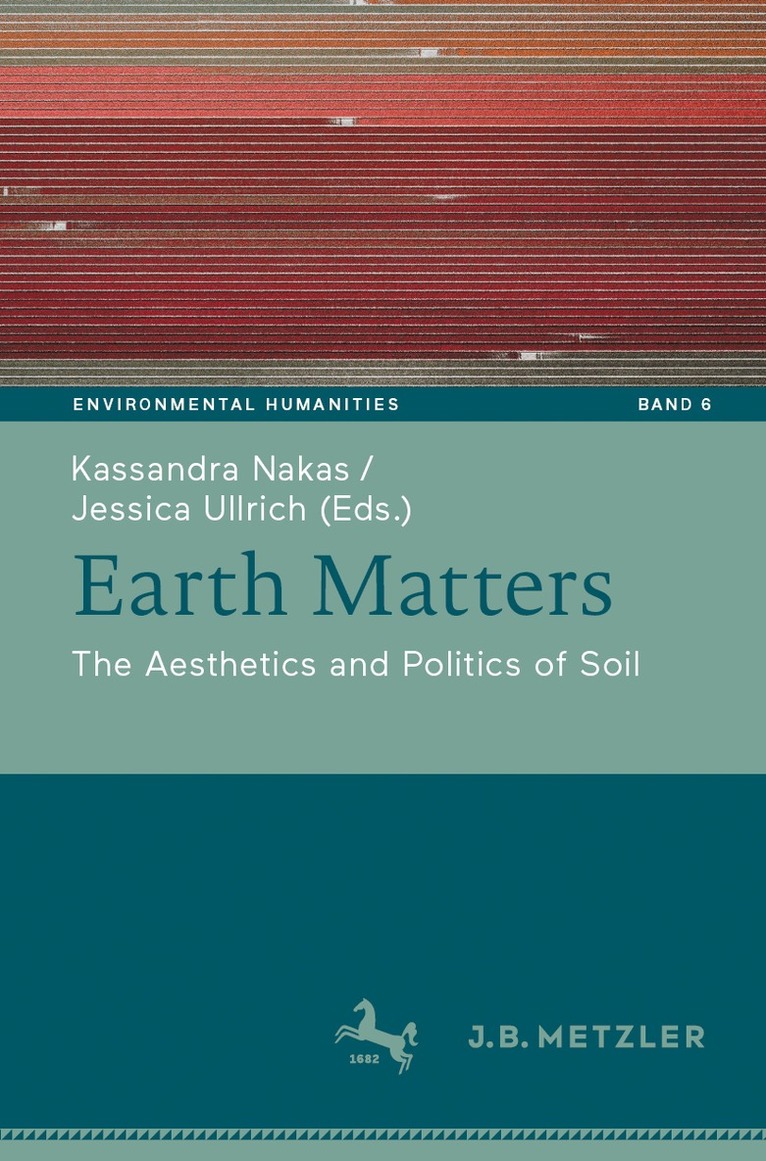
    Earth Matters

    The Aesthetics and Politics of Soil

    AvKassandra Nakas,Jessica Ullrich

    Häftad, Engelska, 2026

    Del i serien Environmental Humanities

    1 310 kr

    Skickas . Fri frakt över 249 kr.

    Beskrivning

    This book addresses the increasing social, scientific and, above all, artistic discussion of soil(s) in current cultural-societal contexts. The end of the „International Decade of Soils“ (2015-2024) marked a development that has focussed on the central importance of the earth for life, biodiversity and climate on our planet since the turn of the millennium. In addition to the political and scientific recognition of this, Earth as a material has increasingly become the centre of cultural and artistic debates. In these debates, the awareness of the earth as a living organism initiated in the social and natural science discourse was taken up and further deepened. Earth is thus understood as a carrier of history, culture and identity, as a distinct and genuinely self-sufficient ecosystem that is, however, existentially threatened by climate change, industrialised and unsustainable forms of agriculture, as well as extractivism. In art, soil has evolved from an aesthetic medium to a carrier of political, ecological and historical statements. Artists today thematise ecological crises, colonial violence, land grabbing, plant blindness and the close relationship between humans and the earth. New narrative, archival and installative forms are emerging in which the earth is not just a material but an actor - often in the sense of a ‘new materialism’ or ‘posthumanism’. Numerous exhibitions worldwide testify to the growing interest in the topic of soil in art. Historical pioneers such as Ana Mendieta, Agnes Denes and herman de vries have laid the foundations for today's positions. Current works often take up Indigenous perspectives, feminist approaches and ecological issues and call for a new relationship with the earth - as a living counterpart, not as an object to be exploited. With a number of essays ranging from Western philosophy to Indigenous epistemology, from historical examples to highly topical activist positions, this book aims to give a comprehensive insight into current theoretical and artistic discourses in ecological art studies. It brings together contributions from different continents that shed light on the topic of soil(s) in distinctive cultural contexts: as a ‘natural given’, political token, artistic matter, mythological bearer, and others. In this light, the eponymous term “soil” is being conceptualized in its pluralistic sense: There is no such thing as definitive and solitary soil, but it has different meanings in different geographical, political, historical and cultural contexts. Contributions by established scholars as well as junior researchers offer a range of methodological approaches: art historical essays weighing in on the aesthetic implications of earthen matter, eco-political and eco-feminist theories, material studies, and others.

    Produktinformation

    • Utgivningsdatum:2026-08-27
    • Mått:155 x 235 x undefined mm
    • Format:Häftad
    • Språk:Engelska
    • Serie:Environmental Humanities
    • Antal sidor:218
    • Förlag:Springer-Verlag Berlin and Heidelberg GmbH & Co. KG
    • ISBN:9783662733189

    Utforska kategorier

    • Konsthistoria inom Kultur
    • Litteraturteori inom Skönlitteratur
    • Antropologi inom Samhälle och politik

    Mer om författaren

    Kassandra Nakas received a PhD in art history from the Freie Universität Berlin and a postdoctoral qualification (Habilitation) from Leuphana Universität Lüneburg, where she is also teaching. Previously, she was a visiting professor at the University of Arts (UdK) Berlin, the Staatliche Akademie der Bildenden Künste in Karlsruhe, and the Ludwig Maximilians Universität in Munich.Jessica Ullrich is visiting professor for aesthetics and art history at the University of Fine Arts Münster. Before that she has taught art history at universities in Berlin, Frankfurt, Erlangen, Nürnberg, Münster, Flensburg, Graz and São Paulo. She publishes widely on human-animal relations in contemporary art and curated art exhibitions and video screenings on the same topic in Berlin, Utrecht, and São Paulo.

    Innehållsförteckning

    • Chapter 1. Introduction.- Part I: Into the Soil.- Chapter 2. Assembling, Metabolizing, Surfacing: Aesthetic Strategies for Knowledge Co-Creation in Contemporary Soil Art.- Chapter 3. Soil and Sound. Subterranean Soundscapes and Animal Sound Communication.- Part II: The Politics of Soil: Decolonial and Indigenous Perspectives.- Chapter 4. The Falling Sky: Shamanic Alternatives for a Wild Art History.- Chapter 5. “The Unceasing Chanting of Land”: Abigail Romanchak Recontextualises Seismographic Readings of Kīlauea.- Part III: Agropolitics and Remediaton.- Chapter 6. The Chemical Landscapes of South Tirolean Agricultural Soils: Katrin Hornek’s Plant Plant and Elena Mazzi’s Copperialities.- Chapter 7. Urban Landscape and The Hidden Architecture of Brownfields (On Soil Remediation, Plants, and The Art of SLOW Clean-up).- Part IV: Bodies and Soils.- Chapter 8. Feminist Aesthetics of Body-Territory in Chilean Visual Art.- Chapter 9. Matters of Becoming. Soils and Bodies in Contemporary Art.- Chapter 10. Becoming Soil. Queer Compos(t)ing for Earthly Survival.- Part V: Soil Imaginaries.- Chapter 11. Melting, Pouring, Unearthing. Earth in the Material Aesthetics of Gaston Bachelard.- Chapter 12. The Earth in Art: Māori and New Materialist Perspectives.