• Fri frakt över 249 kr
  • •
  • Snabba leveranser
  • •
  • Billiga böcker
Kundservice

Du är på sajten för privatpersoner.

Företag, bibliotek eller offentlig verksamhet?

Du handlar på classic.bokus.com, där alla dina funktioner finns intakta.
Till classic.bokus.com
Bokus logotyp. Gå till startsidan.
  • Erbjudanden
  • Student
  • Topplistor
  • Barn & ungdom
  • Bokus Play
  • E-böcker
  • Ljudböcker
  • Pocketböcker
  • Spel och pussel

Pocketfynda! Hundratals böcker för 49 kr/st →

Sidfot

Mina sidor

    Hjälp

    • Kundservice
    • Vanliga frågor och svar
    • Frakt och leverans
    • Retur vid ångerrätt
    • Reklamera vara
    • Betalning
    • Köpvillkor
    • Allmänna villkor
    • Information om webbplatsens tillgänglighet

    Om Bokus

    • Om oss
    • Pressrum
    • För studenter
    • För företag
    • För bibliotek och offentlig verksamhet
    • För leverantörer
    • Hållbarhet

    Populärt

    • Aktuella erbjudanden
    • Presentkort
    • Studentlitteratur
    • Nya böcker
    • Topplistor
    • Signerade böcker
    • Engelska böcker

    Inspiration

    • Boktips
    • BookTok
    • Barnbokskaraktärer
    • Populära författare
    Logotyp för Bokus
    Följ oss på Facebook (extern länk)Följ oss på Instagram (extern länk)Följ oss på YouTube (extern länk)Följ oss på TikTok (extern länk)
    bokus @ CookiesAnpassa cookiesIntegritetspolicyKöpvillkor
    Till Citymail hemsida (extern länk)Till Budbee hemsida (extern länk)Till Postnord hemsida (extern länk)Till Schenker hemsida (extern länk)Till Early Bird hemsida (extern länk)Till Walleys hemsida (extern länk)
    1. Samhälle och politik
    2. Samhälle och kultur
    3. Kultur och medier
    4. Medievetenskap

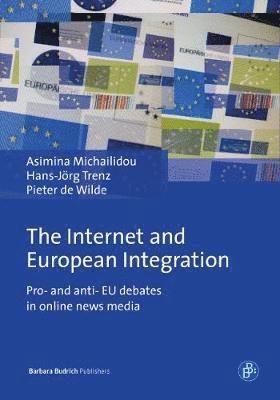
    Internet and European Integration

    Pro- and Anti-EU Debates in Online News Media

    AvAsimina Michailidou,Pieter de Wilde

    Inbunden, Engelska, 2014

    481 kr

    Tillfälligt slut

    Beskrivning

    This book offers a wealth of original empirical data on how online media shape EU contestation. Taking a public sphere perspective, the authors highlight the myths and truths about the nature of audience-driven online media content and show how public demands for legitimacy are at the heart of the much-analyzed politicization of European integration. What EU citizens most intensely debate online are the fundamental questions of what the European institutions stand for and how they can be held accountable. Drawing on innovative and rigorous analysis of online media ownership, journalistic content and online readers’ inputs, the authors piece together the components of the dynamic nature of EU contestation and the degree of convergence towards Euroscepticism across EU member states in the first years of the Eurocrisis. There is no doubt that EU citizens have strong opinions about the EU and interactive online media allow these opinions to come to the fore, to be challenged and amplified both within and beyond national public spheres. Yet, for all its potential to unite European publics, online EU contestation remains firmly anchored in offline news media frames, while citizens and journalists alike struggle to put forward a clear vision of the future EU polity.

    Produktinformation

    • Utgivningsdatum:2014-11-19
    • Mått:148 x 210 x 19 mm
    • Vikt:472 g
    • Format:Inbunden
    • Språk:Engelska
    • Antal sidor:250
    • Förlag:Verlag Barbara Budrich
    • ISBN:9783847401537

    Utforska kategorier

    • Medievetenskap inom Samhälle och politik
    • Politisk aktivism inom Samhälle och politik

    Mer om författaren

    Dr. Asimina Michailidou is a Senior Researcher at the ARENA Centre for European Studies, University of Oslo, Norway. Prof. Hans-Jörg Trenz is the Vice Chair of the Center for Modern European Studies, University of Copenhagen, Denmark. Dr. Pieter de Wilde is a Senior Researcher at the Social Science Research Center Berlin (WZB), Germany.

    Recensioner i media

    This book offers a wealth of original empirical data on how online media shape EU contestation. What EU citizens most intensely debate online are the fundamental questions of what the European institutions stand for and how they can be held accountable. There is no doubt that EU citizens have strong opinions about the EU and interactive online media allow these opinions to come to the fore, to be challenged and amplified both within and beyond national public spheres. Yet, for all its potential to unite European publics, online EU contestation remains firmly anchored in offline news media frames, while citizens and journalists alike struggle to put forward a clear vision of the future EU polity.GMK-Newsletter 4/2014