• Fri frakt över 249 kr
  • •
  • Snabba leveranser
  • •
  • Billiga böcker
Kundservice

Du är på sajten för privatpersoner.

Företag, bibliotek eller offentlig verksamhet?

Du handlar på classic.bokus.com, där alla dina funktioner finns intakta.
Till classic.bokus.com
Bokus logotyp. Gå till startsidan.
  • Erbjudanden
  • Nyheter
  • Student
  • Topplistor
  • Barn & ungdom
  • Bokus Play
  • E-böcker
  • Pocketböcker
  • Spel & pussel

10% rabatt på allt med kod: NYSTART10 →

Sidfot

Mina sidor

    Hjälp

    • Kundservice
    • Vanliga frågor och svar
    • Frakt och leverans
    • Retur vid ångerrätt
    • Reklamera vara
    • Betalning
    • Köpvillkor
    • Allmänna villkor
    • Information om webbplatsens tillgänglighet

    Om Bokus

    • Om oss
    • Pressrum
    • För studenter
    • För företag
    • För bibliotek och offentlig verksamhet
    • För leverantörer
    • Hållbarhet

    Populärt

    • Aktuella erbjudanden
    • Presentkort
    • Studentlitteratur
    • Nya böcker
    • Topplistor
    • Signerade böcker
    • Engelska böcker

    Inspiration

    • Boktips
    • BookTok
    • Populära bokserier
    • Barnbokskaraktärer
    • Populära författare
    Logotyp för Bokus
    Följ oss på Facebook (extern länk)Följ oss på Instagram (extern länk)Följ oss på YouTube (extern länk)Följ oss på TikTok (extern länk)
    bokus @ CookiesAnpassa cookiesIntegritetspolicyKöpvillkor
    Till Citymail hemsida (extern länk)Till Budbee hemsida (extern länk)Till Postnord hemsida (extern länk)Till Schenker hemsida (extern länk)Till Early Bird hemsida (extern länk)Till Walleys hemsida (extern länk)
    1. Samhälle och politik
    2. Samhälle och kultur
    3. Kultur och medier
    4. Kulturvetenskap

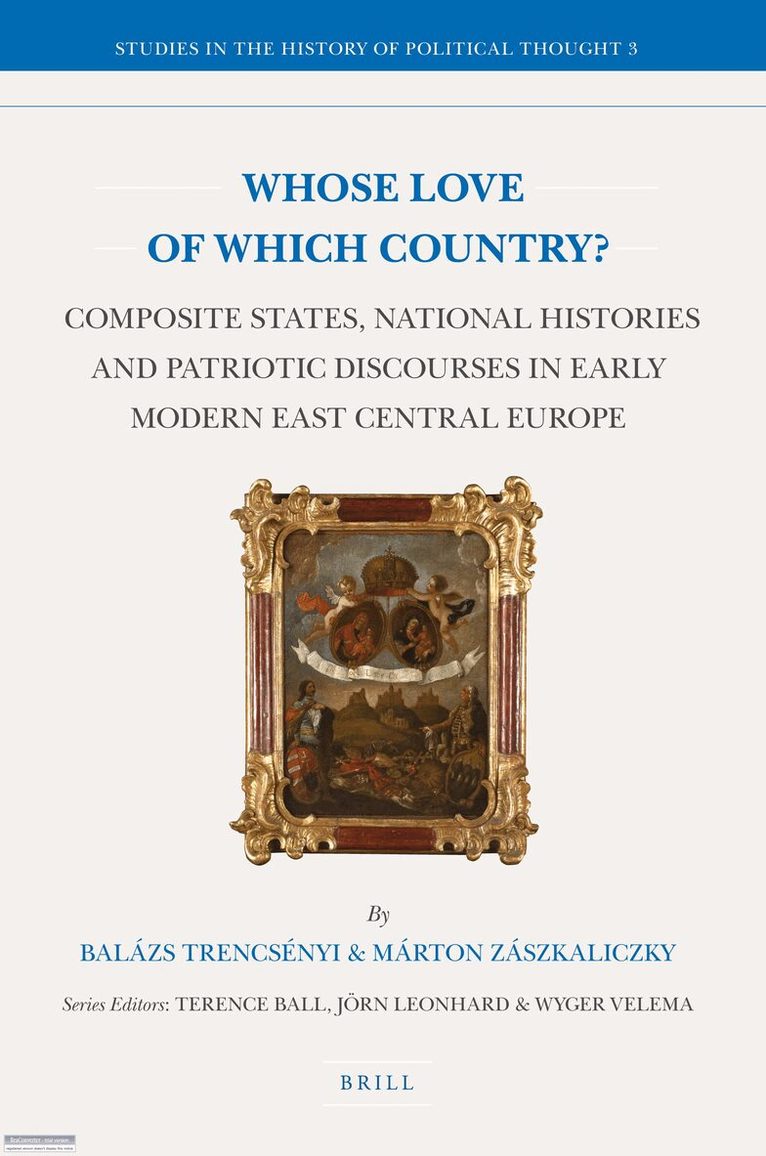
    Whose Love of Which Country?

    Composite States, National Histories and Patriotic Discourses in Early Modern East Central Europe

    Inbunden, Engelska, 2010

    Del 3 i serien Studies in the History of Political Thought

    3 052 kr

    Beställningsvara. Skickas inom 5-8 vardagar. Fri frakt över 249 kr.

    Beskrivning

    Contributors to this volume seek to reconsider the heritage of discourses of patriotism and national allegiance in East Central Europe between the sixteenth and the eighteenth centuries. It results from an international research project, “The Intellectual History of Patriotism and the Legacy of Composite States in East Central Europe,” which brought together scholars to discuss the problem of patriotism in the light of the many levels of ethnic, cultural and political allegiances characterizing East Central Europe in early modern times. The authors analyze the complex process of the formation, reception and transmission of early modern discourses of collective identity in a regional context. Along these lines, the contributors also seek to reconfigure the geographical focus of scholarship on this topic and integrate the Eastern European contexts into the broader European discussion.

    Produktinformation

    • Utgivningsdatum:2010-03-08
    • Mått:160 x 240 x 50 mm
    • Vikt:1 515 g
    • Format:Inbunden
    • Språk:Engelska, Tyska
    • Serie:Studies in the History of Political Thought
    • Antal sidor:784
    • Förlag:Brill
    • ISBN:9789004182622

    Utforska kategorier

    • Kulturvetenskap inom Samhälle och politik
    • Historia inom Historia och arkeologi
    • Filosofiska discipliner inom Filosofi och religion

    Mer om författaren

    Balázs Trencsényi Ph.D. (2004) in Comparative History, Central European University, is an Associate Professor at the History Department of CEU, Budapest, and co-director of Pasts, Inc., Center for Historical Studies at CEU. His main field of interest is the history of political thought in East Central Europe. In 2008 he received a European Research Council grant as principal investigator in the project “Negotiating Modernity”: History of Modern Political Thought in East-Central Europe. He has co-edited a number of volumes on political ideas and historiography in the region, including Nation-Building and Contested Identities: Romanian and Hungarian Case Studies (2001); Discourses of Collective Identity in Central and Southeast Europe (1775-1945): Texts and Commentaries, Vols. I-II (2006-7); and Narratives Unbound: Historical Studies in Post-Communist Eastern Europe (2007). A collection of his studies on the history of political thought, A politika nyelvei [The languages of politics], has been published in Hungarian (2007).Márton Zászkaliczky is a Ph.D. candidate at the History Department of Central European University, Budapest. His dissertation is entitled Protestant Political Theology and its Impact on Corporate Constitutionalism in 16th-17th century Hungary. His main field of interest is early modern political thought and the history of the Reformation, especially in Hungary, England and Scotland.

    Recensioner i media

    "[Whose Love of Which Country] not only maintains a high quality in the twenty-five studies which thematically cover the expanse of Central and East Central Europe from Poland, The Bohemian lands and Hungary through to the states of former Yugoslavia, Romania and Bulgaria, but also sustains a unifying theme - the perception of "nation" in the period before nineteenth-century nationalism, the time designated as the Early Modern Period. [...] [A] new foundation for future cooperation has been laid [...]." – Jiří Hrbek, Acta Comeniana, Vol. 25 (2011), pp. 306-316"The volume [...] makes an important contribution to the research into a chronological and geographical sector of the history of political ideas that until very recently has been almost completely neglected." – Iva Manova, Universa. Recensioni di filosofia, Vol. 1, No. 1 (2011)"Z pewnością znakomicie przysłuży się upowszechnianiu wiedzy o specyfice myśli środkowoeuropejskiej i jej miejscu w dorobku intelektualnym zachodniej cywilizacji…inspirujące wprowadzenie do opracowania wielu zagadnień związanych z wyobrażeniami na temat państwa i społeczeństwa.” – Patryk Sapala, Kwartalnik Historyczny, Vol. CXVIII, No. 4 (2011), pp. 743-751

    Innehållsförteckning

    • Towards an intellectual history of patriotism in East Central Europe in the early modern period, Balázs Trencsényi and Márton ZászkaliczkyPART I: HUMANIST VISIONS OF THE PATRIAThe reception of Erasmianism in Hungary and the contexts of the Erasmian program: The “cultural patriotism” of Benedek Komjáti, Pál ÁcsConstructing the Wallach “other” in the late Renaissance, Gábor AlmásiHumanist ethics and urban patriotism in Upper Hungary at the turn of the fifteenth-sixteenth centuries (Valentin Eck’s De reipublicae administratione), Farkas Gábor KissCivic and ethnic discourses of identity in a city-state context: The case of Renaissance Ragusa, Lovro KunčevićStrategies of distinction in the works of Vinko Pribojević, Domagoj MadunićIndetermi-Nation: Narrative identity and symbolic politics in early modern Illyrism, Zrinka BlaževićNation, patria and the aesthetics of existence: Late humanist national discourse and its rewriting by the modern Czech nationalist movement, Lucie StorchováCitizen, fatherland and patriotism in the political discourse of the Polish-Lithuanian Commonwealth, Anna Grzeskowiak-KrwawiczPART II: THE POLITICS OF THE ESTATES AND THE LOVE OF FATHERLANDPolitical humanism and corporate theory of state: Nation, patria and virtue in Hungarian political thought of the sixteenth century, Benedek VargaThe Hungarian roots of a Bohemian humanist: Johann Jessenius a Jessen and early modern national identity, Kees TeszelszkyPiety and Industry: Variations on patriotism in seventeenth-century Hungarian political thought, Hanna Orsolya VinczeIllyria or what you will: Luigi Ferdinando Marsigli’s and Pavao Ritter Vitezović’s “mapping” of the borderlands recaptured from the Ottomans, Sándor BenePatres Patriae or Proditores Patriae? Legitimizing and de-legitimizing the authority of the provincial estates in seventeenth-century Bohemia, Petr MaťaForms of patriotism in the early modern Polish-Lithuanian Commonwealth, Stanisław RoszakTwo patriotisms? Opinions of townsmen and soldiers on duty to the fatherland in seventeenth-century Poland, Urszula AugustyniakPART III: POLITICAL THEOLOGY AND DISCOURSES OF IDENTITYPatriotism and elect nationhood in early modern Hungarian political discourse, Balázs TrencsényiThe homiletics of political discourse: Martyrology as a (re)invented tradition in the paradigm of early modern Hungarian patriotism, Zsombor TóthDefending the Catholic enterprise: National sentiment, ethnic tensions, and the Jesuit mission in seventeenth-century Hungary, Regina PörtnerPatria Lost and Chosen People: The case of seventeenth-century Bohemian Protestant exiles, Vladimír UrbánekPatriotic and “proto-national” motives in late medieval and early modern Bulgarian literature: The contexts of Paisij Hilendarski, Alexander NikolovPART IV: ENLIGHTENMENT MODALITIES OF PATRIOTISMModalities of enlightened monarchical patriotism in the mid-eighteenth century Habsburg Monarchy, Teodora Shek-BrnardićPatriotic scholarship: The adaptation of state sciences in late eighteenth-century Transylvania, Zsuzsanna Borbála TörökReflections on patriotism in Polish literature in the second half of the eighteenth century, Teresa KostkiewiczowaRepublican and monarchical patriotism in Polish political thought during the Enlightenment, Arkadiusz Michał StasiakDas landespatriotische Programm der galizischen Stände um 1790: Von der polnischen Tradition zur Etablierung eines neuen Landespatriotismus, Miloš ŘezníkAfterword, R.J.W. EvansList of ContributorsIndex