• Fri frakt över 249 kr
  • •
  • Snabba leveranser
  • •
  • Billiga böcker
Kundservice

Du är på sajten för privatpersoner.

Företag, bibliotek eller offentlig verksamhet?

Du handlar på classic.bokus.com, där alla dina funktioner finns intakta.
Till classic.bokus.com
Bokus logotyp. Gå till startsidan.
  • Erbjudanden
  • Nyheter
  • Student
  • Topplistor
  • Barn & ungdom
  • Bokus Play
  • E-böcker
  • Pocketböcker
  • Spel & pussel

10% studentrabatt med kod TERM26

Sidfot

Mina sidor

    Hjälp

    • Kundservice
    • Vanliga frågor och svar
    • Frakt och leverans
    • Retur vid ångerrätt
    • Reklamera vara
    • Betalning
    • Köpvillkor
    • Allmänna villkor
    • Information om webbplatsens tillgänglighet

    Om Bokus

    • Om oss
    • Pressrum
    • För studenter
    • För företag
    • För bibliotek och offentlig verksamhet
    • För leverantörer
    • Hållbarhet

    Populärt

    • Aktuella erbjudanden
    • Presentkort
    • Studentlitteratur
    • Nya böcker
    • Topplistor
    • Signerade böcker
    • Engelska böcker

    Inspiration

    • Boktips
    • BookTok
    • Populära bokserier
    • Barnbokskaraktärer
    • Populära författare
    Logotyp för Bokus
    Följ oss på Facebook (extern länk)Följ oss på Instagram (extern länk)Följ oss på YouTube (extern länk)Följ oss på TikTok (extern länk)
    bokus @ CookiesAnpassa cookiesIntegritetspolicyKöpvillkor
    Till Citymail hemsida (extern länk)Till Budbee hemsida (extern länk)Till Postnord hemsida (extern länk)Till Schenker hemsida (extern länk)Till Early Bird hemsida (extern länk)Till Walleys hemsida (extern länk)
    1. Filosofi och religion
    2. Religion och tro
    3. Kristendom

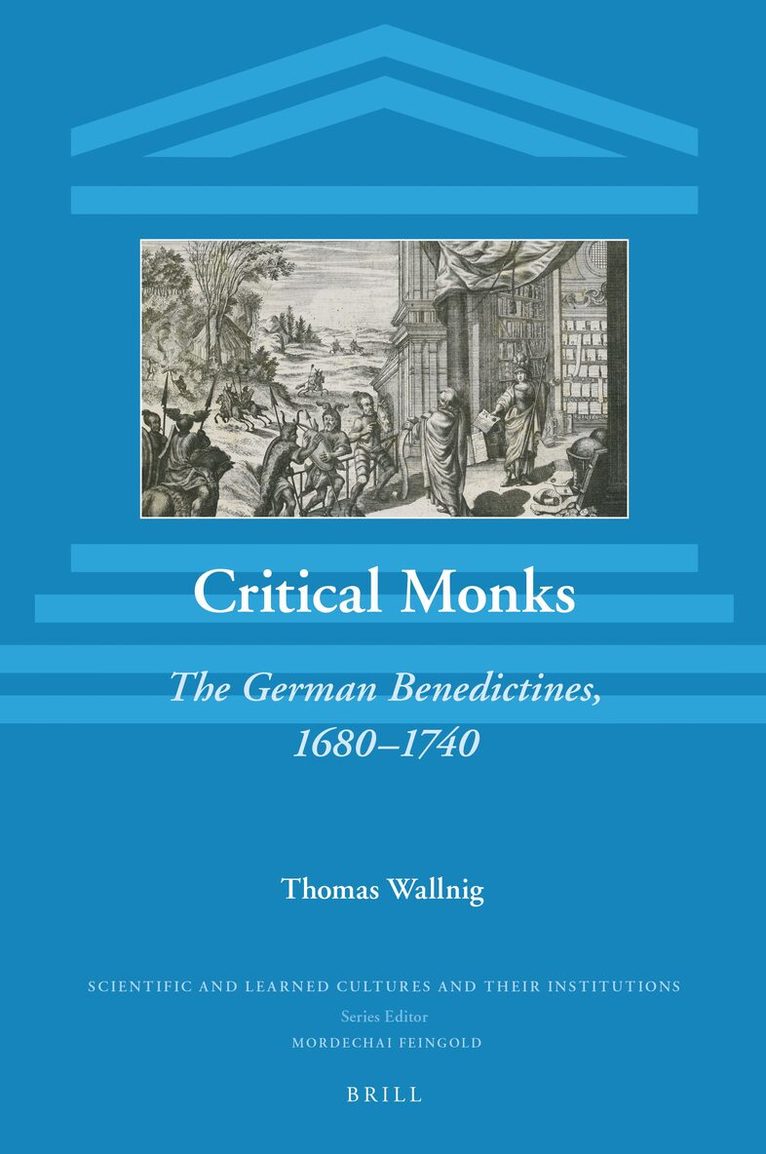
    Critical Monks

    The German Benedictines, 1680–1740

    AvThomas Wallnig

    Inbunden, Engelska, 2019

    Del 25 i serien Scientific and Learned Cultures and Their Institutions

    2 236 kr

    Beställningsvara. Skickas inom 5-8 vardagar. Fri frakt över 249 kr.

    Beskrivning

    Benedictine scholars around 1700, most prominently proponents of historical criticism, have long been regarded as the spearhead of ecclesiastical learning on the brink of Enlightenment, first in France, then in Germany and other parts of Europe.Based on unpublished sources, this book is the first to contextualize this narrative in its highly complex pre-modern setting, and thus at some distance from modernist ascriptions ex posteriori. Challenged by Protestant and Catholic anti-monasticism, Benedictine scholars strove to maintain control of their intellectual tradition. They failed thoroughly, however: in the Holy Roman Empire, their success depended on an anti-Roman and nationalized reading of their research. For them, becoming part of an Enlightenment narrative meant becoming part of a cultural project of “Germany”.

    Produktinformation

    • Utgivningsdatum:2019-01-17
    • Mått:155 x 235 x 27 mm
    • Vikt:704 g
    • Format:Inbunden
    • Språk:Engelska
    • Serie:Scientific and Learned Cultures and Their Institutions
    • Antal sidor:364
    • Förlag:Brill
    • ISBN:9789004355460

    Utforska kategorier

    • Kristendom inom Filosofi och religion
    • Religion: allmänt inom Filosofi och religion
    • Europas historia inom Historia och arkeologi

    Mer om författaren

    Dr. Thomas Wallnig (1975) is Privatdozent for Modern History, teaching and conducting research projects at the University of Vienna. He has worked on the Republic of Letters, Catholic Scholarship, the Habsburg Monarchy and Digital Humanities.

    Innehållsförteckning

    • Preface: How to Read this Book1 “Germania Benedictina”1.1 Layers of Time – Between Trent and the Enlightenment1.2 Layers of Space: “Benedictine Europe”1.3 Layers of Knowledge: Religious Communities in Early Modern Central Europe1.4 Layers of Demography: Being a Benedictine monk1.5 On Sources, Bibliography, and Terminology1.6 Summary2 Multiple Perspectives – On the Same Object?2.1 Introduction2.2 “Die Forschungszentren der deutschen Benediktiner” and the “Katholische Frühaufklärung”2.3 “Enlightened Monks” – and “Monastic Humanism”2.4 Making Monks Enlightened: The Late 19th and Early 20th Centuries2.5 Benedictine Tradition(s)2.6 Looking Ahead from 1700: The Making of “Enlightened Monasticism” in the 18th Century2.7 Looking Back from 1700: 1200 Years of Prehistories for Benedictine Scholarly Practice2.8 Summary3 Knowledge, Institution and Conflict in the Benedictine Context3.1 Introduction3.2 The Inner Circulation of Knowledge: Congregation, University, or Academy?3.3 German and French Benedictines3.4 The Protestants: Res publica literaria and Germania3.5 Knowledge, Required: The State, the Church – and the Aristocracy3.6 Diverse Publics, Diverse Censorships3.7 Conflict and Dissent in the Benedictine Context3.8 Conclusion: On the Institutional and Epistemological Implications of Knowledge Change4 Tropes and Metaphors of Monastic Knowledge 4.1 Introduction4.2 “Reform”, “Revolution”, and the “Old-New”4.3 Four Exemplary Ambiguities: “Aufklärung”, “Light”, “Learned Nuns”, “Monkish Fables”4.4 “Criticism” and “Scholasticism”4.5 Conclusion5 A Reclassification of Knowledge? 5.1 Introduction5.2 Philosophy5.2.1 Challenges, 1: Benedictine Thomism – Unsuccessfully Contested5.2.2 Challenges, 2: The Assimilation of Christian Wolff5.2.3 Trends, 1: Mathematics, Nature and Observation5.2.4 Trends, 2: Moral Philosophy5.3 History and Criticism5.3.1 Challenges, 1: (Multiple) Proof – and (Individual) Taste5.3.2 Challenges, 2: On Historicity5.3.3 Trends, 1: The “Order” as Framework5.3.4 Trends, 2: “Germany” – and “Austria” as Frameworks5.4 (Canon) Law5.4.1 Challenges: The Negotiable Status of Monastic Rules and Habits5.4.2 Trends: “Germanized”, “Naturalized” and “Historicized” Canon Law5.5 Theology5.5.1 Challenges: Scientia Media, Peccatum Philosophicum5.5.2 Trends: Positive Theology, Mystical Theology – or Practical Theology?5.6 Summary6 Conclusions, Inheritances, Limits, Confessions6.1 Introduction6.2 Should We Speak of a “Monastic Enlightenment”? And if so, What Came before It?6.3 On MethodologySources and BibliographyIndex