• Fri frakt över 249 kr
  • •
  • Snabba leveranser
  • •
  • Billiga böcker
Kundservice

Du är på sajten för privatpersoner.

Företag, bibliotek eller offentlig verksamhet?

Du handlar på classic.bokus.com, där alla dina funktioner finns intakta.
Till classic.bokus.com
Bokus logotyp. Gå till startsidan.
  • Erbjudanden
  • Nyheter
  • Student
  • Topplistor
  • Barn & ungdom
  • Bokus Play
  • E-böcker
  • Pocketböcker
  • Spel & pussel

10% rabatt på allt med kod: NYSTART10 →

Sidfot

Mina sidor

    Hjälp

    • Kundservice
    • Vanliga frågor och svar
    • Frakt och leverans
    • Retur vid ångerrätt
    • Reklamera vara
    • Betalning
    • Köpvillkor
    • Allmänna villkor
    • Information om webbplatsens tillgänglighet

    Om Bokus

    • Om oss
    • Pressrum
    • För studenter
    • För företag
    • För bibliotek och offentlig verksamhet
    • För leverantörer
    • Hållbarhet

    Populärt

    • Aktuella erbjudanden
    • Presentkort
    • Studentlitteratur
    • Nya böcker
    • Topplistor
    • Signerade böcker
    • Engelska böcker

    Inspiration

    • Boktips
    • BookTok
    • Populära bokserier
    • Barnbokskaraktärer
    • Populära författare
    Logotyp för Bokus
    Följ oss på Facebook (extern länk)Följ oss på Instagram (extern länk)Följ oss på YouTube (extern länk)Följ oss på TikTok (extern länk)
    bokus @ CookiesAnpassa cookiesIntegritetspolicyKöpvillkor
    Till Citymail hemsida (extern länk)Till Budbee hemsida (extern länk)Till Postnord hemsida (extern länk)Till Schenker hemsida (extern länk)Till Early Bird hemsida (extern länk)Till Walleys hemsida (extern länk)
    1. Historia och arkeologi
    2. Historia
    3. Historia: särskilda händelser och ämnen
    4. Socialhistoria och kulturhistoria

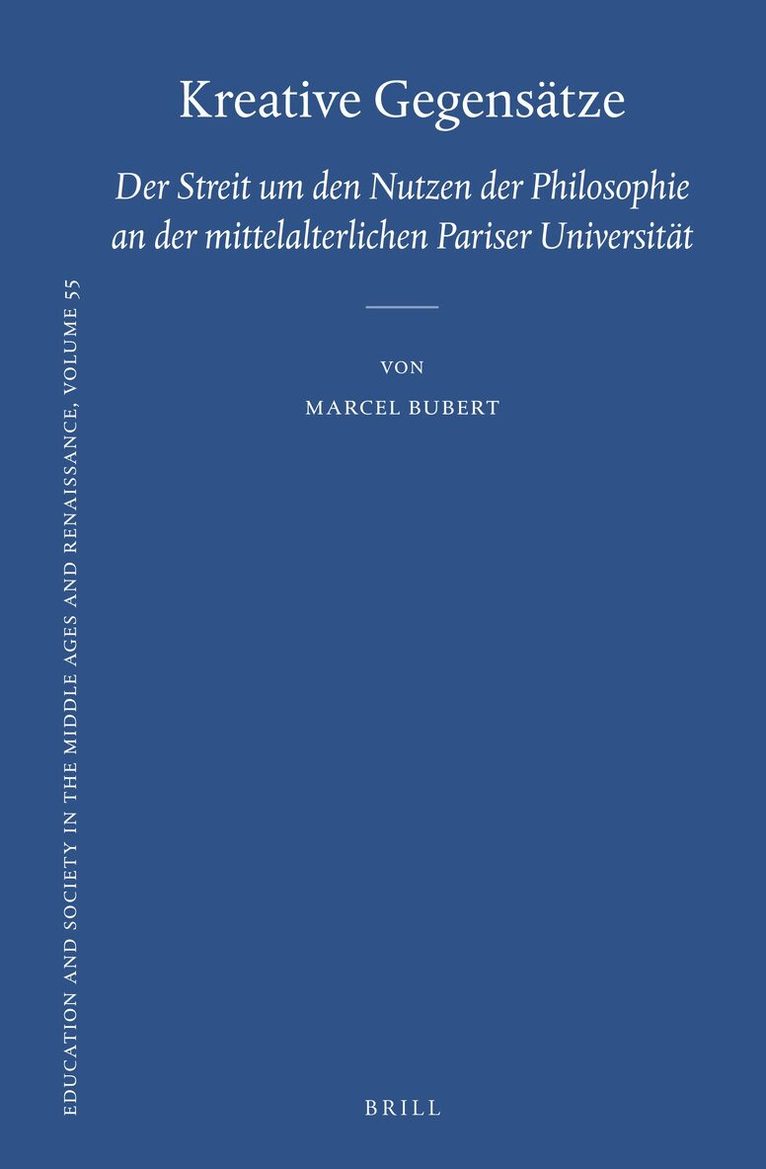
    Kreative Gegensätze

    Der Streit um den Nutzen der Philosophie an der mittelalterlichen Pariser Universität

    AvMarcel Bubert

    Inbunden, Tyska, 2019

    Del 55 i serien Education and Society in the Middle Ages and Renaissance

    2 736 kr

    Beställningsvara. Skickas inom 5-8 vardagar. Fri frakt över 249 kr.

    Beskrivning

    In Kreative Gegensätze Marcel Bubert analyses the debates among medieval scholastics on the social usefulness of learned knowledge in their specific social and cultural contexts. In particular, he shows how the skepticism towards the scholars as well as the tensions between the University of Paris, the French royal court, and the citizens of Paris had profound effects on the scientific community, and led to very different views on the utility of philosophy. Some Masters responded to the expectations of society by emphasizing the autonomy of philosophical cognition. Others departed radically from this notion of science “for its own sake”, and created decidedly “practical” concepts of knowledge. The examination of these contentious relations shows how the dynamics of mutual demarcation within this “constellation” became intellectually prolific by way of generating highly original and innovative responses to the question of the utility of philosophy.See inside the book.

    Produktinformation

    • Utgivningsdatum:2019-06-20
    • Mått:155 x 235 x 43 mm
    • Vikt:1 135 g
    • Format:Inbunden
    • Språk:Tyska
    • Serie:Education and Society in the Middle Ages and Renaissance
    • Antal sidor:642
    • Förlag:Brill
    • ISBN:9789004380417

    Utforska kategorier

    • Socialhistoria och kulturhistoria inom Historia och arkeologi
    • Kulturvetenskap inom Samhälle och politik
    • Filosofiska discipliner inom Filosofi och religion

    Mer om författaren

    Marcel Bubert is a Research Assistant at the Department of History at the University of Münster, Germany. He was a member of the Research Training Group “Expert Cultures from the Twelfth to the Eighteenth Century” at the University of Göttingen, where he earned his Ph.D. in 2016. His research interests include medieval intellectual history, medieval universities and learned cultures, as well as the history of France in the Late Middle Ages. He has also published on the theory of cultural studies and the sociology of knowledge.

    Innehållsförteckning

    • InhaltVorwort1 Einleitung1.1 Das Problem1.2 Gegenstand, Profil und Disposition1.3 Methodologische Vorbemerkungen: Mittelalterliche Wissenschaftsgeschichte2 Die Pariser Artistenfakultät im 13. und frühen 14. Jahrhundert: Sozialisation und Identität2.1 Enthusiasmus und amor sciendi2.2 Aristoteles-Rezeption? Text und Kontext2.3 Sozialisationsformen der Artes-Fakultät2.4 Interaktion und Kohäsion: Lehre als kulturelle Praxis2.5 Jenseits der Grenze: Das Fremde und das Eigene2.6 Pariser ‚Philosophen‘ vor und nach 12772.7 Der Name der Philosophen – Anmerkungen zum philosophus des Mittelalters3 Praktisches und unpraktisches Wissen, Wissensträger und Experten: Philosophie im universitären Raum3.1 Der artistische Wissensbestand im 13. Jahrhundert3.2 Praktisches Wissen?3.3 Unpraktisches Wissen?3.4 Der Kommunikationsraum der Artistenfakultät – Nichts als die Wahrheit3.5 Philosophisches Auswärtsspiel: Die Kommunikationsräume der ‚oberen‘ Fakultäten3.6 Das Gleiche nochmal anders: Gelehrte Experten an der Universität Paris4 Kreative Ambivalenzen: Das offene System und seine Feinde4.1 Magni litterati inexperti – Buchwissen zwischen Autorität und Kritik4.2 Der Kaiser und der Fürst der Philosophen4.3 Zwischenresümee: Zwei kritische Experten4.4 Urbane Dissonanzen: „Scolares artium“ und praktische Wissenskultur5 Krisis und Verwandlung: Alternative Entwürfe im 13. Jahrhundert5.1 Der Grammatiker, die Logiker und die Gesellschaft5.2 Mediale Praxis, Wissensordnung und Kritik: An Italian in Paris5.3 Methodologische Zwischenreflexion5.4 Toter Autor, Modernist, Reaktionär: Roger Bacons philosophische Sonderwege5.5 Epigonen, Propheten und Revolutionäre: Große Ereignisse werfen ihre Schatten (voraus?)5.6 Urbane Harmonien: Empirismus und Praxisdiskurs in der Musiktheorie5.7 Freiheitskämpfe und ästhetische Revolutionen. Deutungsgeschichte Johannes de Grocheios – eine Diskursanalyse6 Nutzlose, skeptische und alternative Akteure: Zwischenbetrachtung und Überleitung6.1 Pour un autre Moyen Âge? Was das bisher Gesagte über das Mittelalter sagt6.2 The End of the Story?7 Der Geist kehrt in sich zurück, oder: Die Geburt einer modernen Dialogik7.1 Praktiken der Legitimation – und ihre epistemischen Rückkopplungen7.2 Die stille Revolution: Eine neue Rolle der experientia8 Das Mittelalter ist nie modern gewesen – Rückblicke, Reflexionen und AussichtenQuellenverzeichnis Literaturverzeichnis Register