• Fri frakt över 249 kr
  • •
  • Snabba leveranser
  • •
  • Billiga böcker
Kundservice

Du är på sajten för privatpersoner.

Företag, bibliotek eller offentlig verksamhet?

Du handlar på classic.bokus.com, där alla dina funktioner finns intakta.
Till classic.bokus.com
Bokus logotyp. Gå till startsidan.
  • Erbjudanden
  • Nyheter
  • Student
  • Topplistor
  • Barn & ungdom
  • Bokus Play
  • E-böcker
  • Pocketböcker
  • Spel & pussel

Må bättre, för mindre! Upp till 50% rabatt på hälsoböcker

Sidfot

Mina sidor

    Hjälp

    • Kundservice
    • Vanliga frågor och svar
    • Frakt och leverans
    • Retur vid ångerrätt
    • Reklamera vara
    • Betalning
    • Köpvillkor
    • Allmänna villkor
    • Information om webbplatsens tillgänglighet

    Om Bokus

    • Om oss
    • Pressrum
    • För studenter
    • För företag
    • För bibliotek och offentlig verksamhet
    • För leverantörer
    • Hållbarhet

    Populärt

    • Aktuella erbjudanden
    • Presentkort
    • Studentlitteratur
    • Nya böcker
    • Topplistor
    • Signerade böcker
    • Engelska böcker

    Inspiration

    • Boktips
    • BookTok
    • Populära bokserier
    • Barnbokskaraktärer
    • Populära författare
    Logotyp för Bokus
    Följ oss på Facebook (extern länk)Följ oss på Instagram (extern länk)Följ oss på YouTube (extern länk)Följ oss på TikTok (extern länk)
    bokus @ CookiesAnpassa cookiesIntegritetspolicyKöpvillkor
    Till Citymail hemsida (extern länk)Till Budbee hemsida (extern länk)Till Postnord hemsida (extern länk)Till Schenker hemsida (extern länk)Till Early Bird hemsida (extern länk)Till Walleys hemsida (extern länk)
    1. Psykologi och pedagogik
    2. Pedagogik
    3. Pedagogisk teori och filosofi

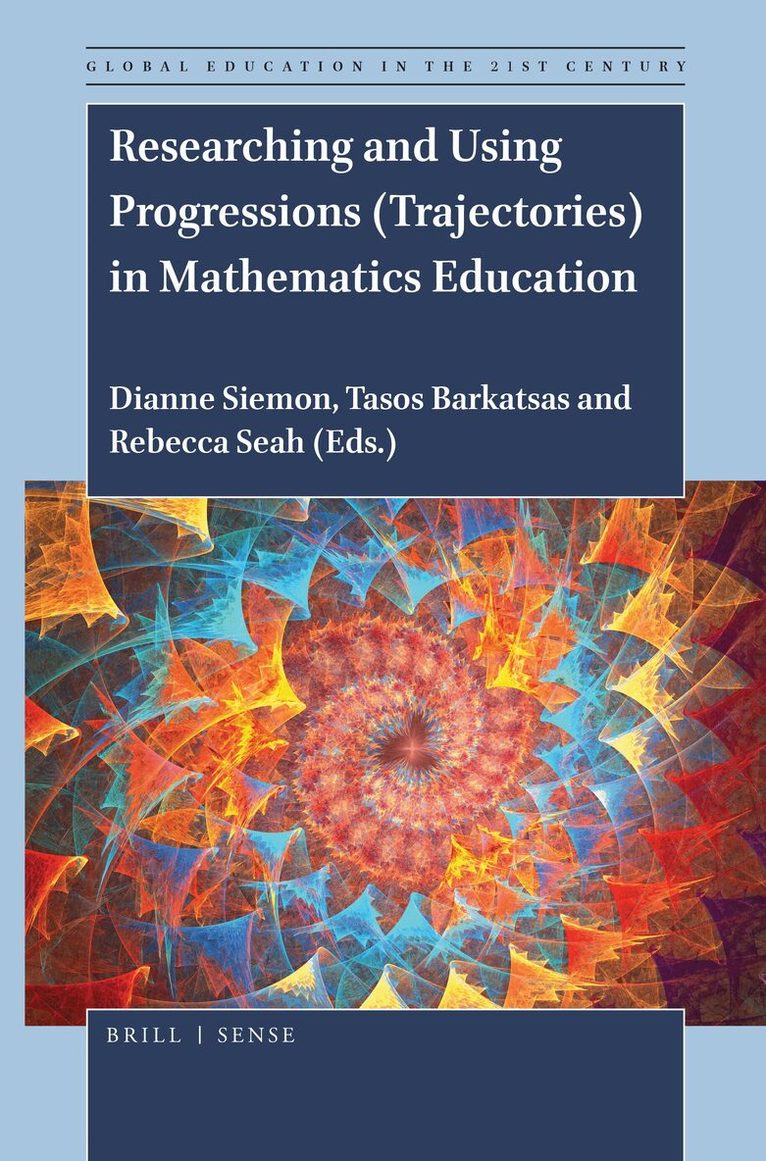
    Researching and Using Progressions (Trajectories) in Mathematics Education

    AvDianne Siemon

    Häftad, Engelska, 2019

    Del 3 i serien Global Education in the 21st Century

    924 kr

    Beställningsvara. Skickas inom 5-8 vardagar. Fri frakt över 249 kr.

    Beskrivning

    The relationship between research and practice has long been an area of interest for researchers, policy makers, and practitioners alike. One obvious arena where mathematics education research can contribute to practice is the design and implementation of school mathematics curricula. This observation holds whether we are talking about curriculum as a set of broad, measurable competencies (i.e., standards) or as a comprehensive set of resources for teaching and learning mathematics. Impacting practice in this way requires fine-grained research that is focused on individual student learning trajectories and intimate analyses of classroom pedagogical practices as well as large-scale research that explores how student populations typically engage with the big ideas of mathematics over time. Both types of research provide an empirical basis for identifying what aspects of mathematics are important and how they develop over time.This book has its origins in independent but parallel work in Australia and the United States over the last 10 to 15 years. It was prompted by a research seminar at the 2017 PME Conference in Singapore that brought the contributors to this volume together to consider the development and use of evidence-based learning progressions/trajectories in mathematics education, their basis in theory, their focus and scale, and the methods used to identify and validate them. In this volume they elaborate on their work to consider what is meant by learning progressions/trajectories and explore a range of issues associated with their development, implementation, evaluation, and on-going review. Implications for curriculum design and future research in this field are also considered.Contributors are: Michael Askew, Tasos Barkatsas, Michael Belcher, Rosemary Callingham, Doug Clements, Jere Confrey, Lorraine Day, Margaret Hennessey, Marj Horne, Alan Maloney, William McGowan, Greg Oates, Claudia Orellana, Julie Sarama, Rebecca Seah, Meetal Shah, Dianne Siemon, Max Stephens, Ron Tzur, and Jane Watson.

    Produktinformation

    • Utgivningsdatum:2019-02-14
    • Mått:155 x 235 x 14 mm
    • Vikt:404 g
    • Format:Häftad
    • Språk:Engelska
    • Serie:Global Education in the 21st Century
    • Antal sidor:240
    • Förlag:Brill
    • ISBN:9789004396432

    Utforska kategorier

    • Pedagogisk teori och filosofi inom Psykologi och pedagogik
    • Lärarutbildning inom Psykologi och pedagogik
    • Undervisning i specifika ämnen inom Psykologi och pedagogik

    Mer om författaren

    Anastasios (Tasos) Barkatsas is a Senior Academic in Mathematics and Statistics Education and a Quantitative Data Analyst at the School of Education, RMIT University, Australia and has published more than 100 refereed papers, chapters and books. Tasos is also the Series Editor of the Brill | Sense series Global Education in the 21st Century.Dianne Siemon is a Professor of Mathematics Education in the School of Education at RMIT University (Bundoora). Di has directed a number of large-scale research projects including the Scaffolding Numeracy in the Middle Years Project (2003-2006), the Researching Numeracy Teaching Approaches in Primary Schools Project (2001-2003), and the Middle Years Numeracy Research Project (1999-2001). Di is a past President of the Australian Association of Mathematics Teachers and a life member of the Mathematical Association of Victoria.Rebecca Seah is a Mathematics Education lecturer in the School of Education, RMIT University, Melbourne, Australia. She is part of the research team in the Reframing Mathematical Futures II project. Her research interests include: spatial and geometric reasoning, assessments and instructional design, numeracy and students with special needs.

    Innehållsförteckning

    • AcknowledgementsFigures and TablesNotes on ContributorsIntroductionDianne Siemon, Tasos Barkatsas and Rebecca Seah1 Knowing and Building on What Students Know: The Case of Multiplicative ThinkingDianne Siemon2 Learning Trajectories in Early Mathematics EducationJulie Sarama and Douglas H. Clements3 HLT: A Lens on Conceptual Transition between Mathematical “Markers”Ron Tzur4 Using Digital Diagnostic Classroom Assessments Based on Learning Trajectories to Drive InstructionJere Confrey, William McGowan, Meetal Shah, Michael Belcher, Margaret Hennessey and Alan Maloney5 Researching Mathematical Reasoning: Building Evidence-Based Resources to Support Targeted Teaching in the Middle YearsDianne Siemon and Rosemary Callingham6 Reframing Mathematical Futures II: Developing Students’ Algebraic Reasoning in the Middle YearsMarj Horne, Max Stephens and Lorraine Day7 A Learning Progression for Geometric ReasoningRebecca Seah and Marj Horne8 Statistics and Probability: From Research to the ClassroomRosemary Callingham, Jane Watson and Greg Oates9 Investigating Mathematics Students’ Motivations and PerceptionsTasos Barkatsas and Claudia Orellana10 Secondary Students’ Mathematics Education Goal OrientationsTasos Barkatsas and Claudia OrellanaEpilogueMike Askew