• Fri frakt över 249 kr
  • •
  • Snabba leveranser
  • •
  • Billiga böcker
Kundservice

Du är på sajten för privatpersoner.

Företag, bibliotek eller offentlig verksamhet?

Du handlar på classic.bokus.com, där alla dina funktioner finns intakta.
Till classic.bokus.com
Bokus logotyp. Gå till startsidan.
  • Erbjudanden
  • Nyheter
  • Student
  • Topplistor
  • Barn & ungdom
  • Bokus Play
  • E-böcker
  • Pocketböcker
  • Spel & pussel

10% rabatt på allt med kod: NYSTART10 →

Sidfot

Mina sidor

    Hjälp

    • Kundservice
    • Vanliga frågor och svar
    • Frakt och leverans
    • Retur vid ångerrätt
    • Reklamera vara
    • Betalning
    • Köpvillkor
    • Allmänna villkor
    • Information om webbplatsens tillgänglighet

    Om Bokus

    • Om oss
    • Pressrum
    • För studenter
    • För företag
    • För bibliotek och offentlig verksamhet
    • För leverantörer
    • Hållbarhet

    Populärt

    • Aktuella erbjudanden
    • Presentkort
    • Studentlitteratur
    • Nya böcker
    • Topplistor
    • Signerade böcker
    • Engelska böcker

    Inspiration

    • Boktips
    • BookTok
    • Populära bokserier
    • Barnbokskaraktärer
    • Populära författare
    Logotyp för Bokus
    Följ oss på Facebook (extern länk)Följ oss på Instagram (extern länk)Följ oss på YouTube (extern länk)Följ oss på TikTok (extern länk)
    bokus @ CookiesAnpassa cookiesIntegritetspolicyKöpvillkor
    Till Citymail hemsida (extern länk)Till Budbee hemsida (extern länk)Till Postnord hemsida (extern länk)Till Schenker hemsida (extern länk)Till Early Bird hemsida (extern länk)Till Walleys hemsida (extern länk)
    1. Samhälle och politik
    2. Samhälle och kultur
    3. Kultur och medier
    4. Referensverk och tvärvetenskap

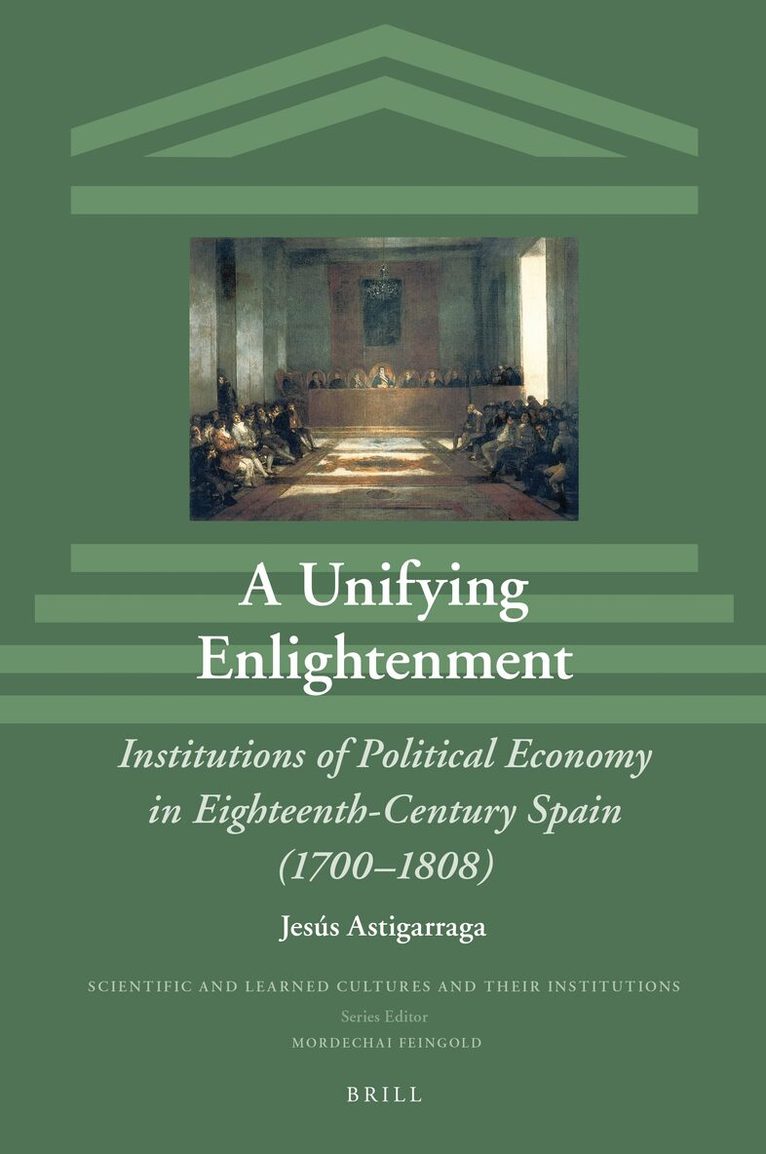
    Unifying Enlightenment

    Institutions of Political Economy in Eighteenth-Century Spain (1700–1808)

    AvJesús Astigarraga

    Inbunden, Engelska, 2020

    Del 30 i serien Scientific and Learned Cultures and Their Institutions

    2 224 kr

    Beställningsvara. Skickas inom 5-8 vardagar. Fri frakt över 249 kr.

    Beskrivning

    This book contains a systematic study of economic institutions during the Spanish Enlightenment in the areas of print culture (the press, merchants’ handbooks, teaching materials), education (university chairs in political economy and commerce) and the organisation of financial matters at state level (economic societies, trade consulates and the official statistics agency).A Unifying Enlightenment is a fresh interpretation of political economy’s contribution to the development of the European Enlightenment. Jesús Astigarraga shows that, far from being a straightforward intellectual phenomenon, this new science played a crucial role in both the circulating and institutionalisation of Enlightenment culture and the process of political unification and articulation undergone by the Spanish monarchy, which culminated in a constitutional culture.

    Produktinformation

    • Utgivningsdatum:2020-11-26
    • Mått:155 x 235 x 27 mm
    • Vikt:692 g
    • Format:Inbunden
    • Språk:Engelska
    • Serie:Scientific and Learned Cultures and Their Institutions
    • Antal sidor:326
    • Förlag:Brill
    • ISBN:9789004442382

    Utforska kategorier

    • Referensverk och tvärvetenskap inom Samhälle och politik
    • Filosofiska discipliner inom Filosofi och religion
    • Ekonomisk historia inom Ekonomi och Ledarskap

    Mer om författaren

    Jesús Astigarraga, Ph.D. in Economics and in History (1991, 2015), University of Zaragoza (Spain), is Professor of Political Economy at that university. He has published monographs and many chapters and articles on the Spanish Enlightenment, including, as editor, The Spanish Enlightenment Revisited (Oxford, Voltaire Foundation, 2015).

    Recensioner i media

    "Astigarraga’s analysis is at its finest when it focuses on the circulation of translations and the transmission of economic ideas. Scholars interested in the growth of institutions that aimed to host and furnish debates about European political-economic ideas will find a rich resource in this book and, in particular, in its extensive bibliography, since the work features a collection of sources which have remained understudied to this day." - E. Jones Corredera, Bulletin of Spanish Studies, Vol. 98, Nº 10, 2021, pags. 1723-1724.

    Innehållsförteckning

    • Preliminary NoteIntroduction1 Merchants’ Handbooks (1699–1759): Educate, Inform, Reform1 Introduction2 From Pérez de Moya to Corachán3 From Corachán to Bordázar4 The Financiers’ Revolt5 Other Channels of Mercantile Information6 Final Remarks2 Graef’s Discursos Mercuriales (1752–1756) and the Origins of the Economics Press in Spain1 Introduction: Graef and the Discursos Mercuriales2 The 1755 Discurso Preliminar3 The Chief Source of the Discursos: The Journal Oeconomique4 Oikonomia in the Discursos Mercuriales5 From Oikonomia to the “Science of Commerce:” The Discourse on Commerce in General (1755–1756)6 Final Remarks3 Political Economy in the Spectators Era of the Spanish Press (1758–1771)1 Introduction2 Nifo and the Estafeta de Londres (1762)3 Nifo and the Correo General de Europa (1763)4 The Miscelánea Política (1763) by Barberi5 The Saura´s Semanario Económico (1765–1767)6 Final Remarks4 Decentralising the Ilustración, Disseminating the Political Economy1 Introduction2 The Trade Consulates and Economic Societies3 The Memorias of the Economic Societies4 Going beyond the Memorias of the Economic Societies5 Economic Societies and the Promotion of the Economic Press6 Final Remarks5 Commerce and Political Economy Dictionaries1 Introduction2 Oikonomia and Commerce in the Encyclopaedic Literature of Eighteenth Century Europe3 A Commerce Dictionary in Spain: The Project Phase4 A Commerce Dictionary in Spain: The Creation Phase5 Encyclopaedic Literature: The Encyclopédies Compiled by Diderot and D’Alembert and Panckoucke6 Final Remarks6 In Support of the Enligthened Reforms: The Memorial Literario (1784–1808)1 Introduction: The Press in the “Golden Age”2 Political Economy in the Press: Diverse Channels3 The Memorial Literario3.1 The Memorial Literario in Spain’s Territorial Pluralism3.2 The Journalism Power of Controversies3.3 Agriculture, Industry and Trade4 Final Remarks7 The Critical Press and Public Opinion: El Correo de Madrid(1786–1791) and the Espíritu de Los Mejores Diarios (1787–1791)1 Introduction2 El Correo de Madrid o de los ciegos (1786–1791)3 The Espíritu de los Mejores Diarios (1787–1791)4 Final Remarks8 Training the New Bureaucrats: The Political Economy Chairs (1784–1808)1 Introduction2 Maturing the Projects, Shaping “Opinion”3 The Saragossa Chair: An Official and Experimental Experience4 The Forgotten Natural Law and Moral Philosophy Chairs5 Beyond Saragossa: Madrid, Majorca and Salamanca6 The Counter-Enlightenment Reaction7 Final Remarks9 Merchants’ Handbooks (1760–1808): From Office Desks to Chairs of Commerce1 Introduction: An Overview (1699–1808)2 The Strengthening of Local Genealogies (1760–1790)3 Bails and Enlightened Reformism Handbooks4 The Correo Mercantil and the Modernisation of Trading Culture5 The Purpose of Drafting a Code of Commerce6 The Chairs of Commerce and Their Handbooks7 Final Remarks10 The Specialised Economics Press: The Correo Mercantil (1792–1808) and the Semanario de Agricultura (1797–1808)1 Introduction: Board of Trade and the Official Statistics Agency2 The Correo Mercantil de España y sus Indias (1792–1808)3 The Semanario de Agricultura y Artes dirigido a los párrocos (1797–1808)4 Final RemarksEpilogueAppendixBibliography, Sources and AbbreviationsIndex