• Fri frakt över 249 kr
  • •
  • Snabba leveranser
  • •
  • Billiga böcker
Kundservice

Du är på sajten för privatpersoner.

Företag, bibliotek eller offentlig verksamhet?

Du handlar på classic.bokus.com, där alla dina funktioner finns intakta.
Till classic.bokus.com
Bokus logotyp. Gå till startsidan.
  • Erbjudanden
  • Nyheter
  • Student
  • Topplistor
  • Barn & ungdom
  • Bokus Play
  • E-böcker
  • Pocketböcker
  • Spel & pussel

10% rabatt på allt med kod NYSTART10 →

Sidfot

Mina sidor

    Hjälp

    • Kundservice
    • Vanliga frågor och svar
    • Frakt och leverans
    • Retur vid ångerrätt
    • Reklamera vara
    • Betalning
    • Köpvillkor
    • Allmänna villkor
    • Information om webbplatsens tillgänglighet

    Om Bokus

    • Om oss
    • Pressrum
    • För studenter
    • För företag
    • För bibliotek och offentlig verksamhet
    • För leverantörer
    • Hållbarhet

    Populärt

    • Aktuella erbjudanden
    • Presentkort
    • Studentlitteratur
    • Nya böcker
    • Topplistor
    • Signerade böcker
    • Engelska böcker

    Inspiration

    • Boktips
    • BookTok
    • Populära bokserier
    • Barnbokskaraktärer
    • Populära författare
    Logotyp för Bokus
    Följ oss på Facebook (extern länk)Följ oss på Instagram (extern länk)Följ oss på YouTube (extern länk)Följ oss på TikTok (extern länk)
    bokus @ CookiesAnpassa cookiesIntegritetspolicyKöpvillkor
    Till Citymail hemsida (extern länk)Till Budbee hemsida (extern länk)Till Postnord hemsida (extern länk)Till Schenker hemsida (extern länk)Till Early Bird hemsida (extern länk)Till Walleys hemsida (extern länk)
    1. Data och IT
    2. Systemvetenskap och AI

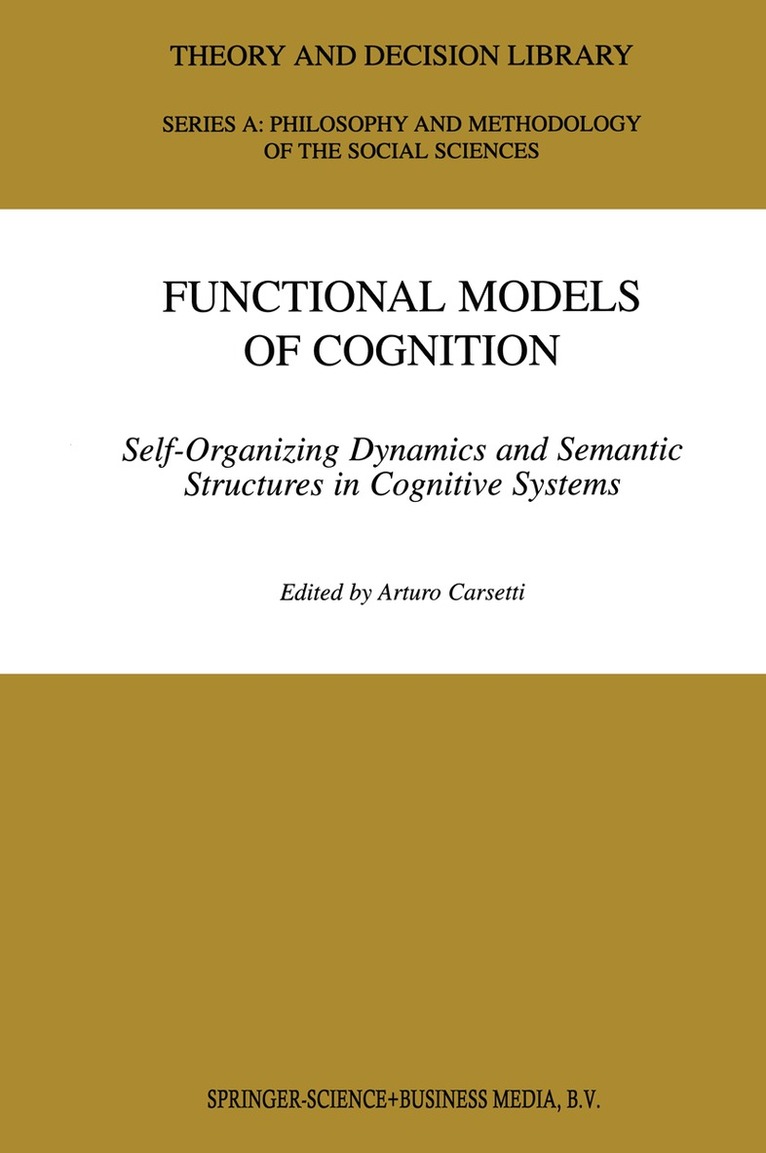
    Functional Models of Cognition

    Self-Organizing Dynamics and Semantic Structures in Cognitive Systems

    AvA. Carsetti

    Häftad, Engelska, 2010

    Del 27 i serien Theory and Decision Library A:

    1 578 kr

    Beställningsvara. Skickas inom 10-15 vardagar. Fri frakt över 249 kr.

    Beskrivning

    Our ontology as well as our grammar are, as Quine affirms, ineliminable parts of our conceptual contribution to our theory of the world. It seems impossible to think of enti­ ties, individuals and events without specifying and constructing, in advance, a specific language that must be used in order to speak about these same entities. We really know only insofar as we regiment our system of the world in a consistent and adequate way. At the level of proper nouns and existence functions we have, for instance, a standard form of a regimented language whose complementary apparatus consists of predicates, variables, quantifiers and truth functions. If, for instance, the discoveries in the field of Quantum Mechanics should oblige us, in the future, to abandon the traditional logic of truth functions, the very notion of existence, as established until now, will be chal­ lenged. These considerations, as developed by Quine, introduce us to a conceptual perspective like the "internal realist" perspective advocated by Putnam whose principal aim is, for cer­ tain aspects, to link the philosophical approaches developed respectively by Quine and Wittgenstein. Actually, Putnam conservatively extends the approach to the problem of ref­ erence outlined by Quine: in his opinion, to talk of "facts" without specifying the language to be used is to talk of nothing.

    Produktinformation

    • Utgivningsdatum:2010-12-05
    • Mått:160 x 240 x 17 mm
    • Vikt:476 g
    • Format:Häftad
    • Språk:Engelska
    • Serie:Theory and Decision Library A:
    • Antal sidor:312
    • Förlag:Springer
    • ISBN:9789048153602

    Utforska kategorier

    • Systemvetenskap och AI inom Data och IT
    • Referensverk och tvärvetenskap inom Samhälle och politik
    • Artificiell intelligens inom Data och IT

    Innehållsförteckning

    • Acknowledgements. Introduction; A. Carsetti. Part I: Models of Cognition. Functional Realism; F.M. Wuketits. Complexity and Cognition; D. Parisi. From Visual Perception to Decision Making: A Synergetic Approach; H. Haken. Connectionist Psychology and the Synergetics of Cognition; E. Pessa. Self-Organization in Perception. The Case of Motion; R. Luccio. Part II: Self-Organization, Complexity and Truth. Expressiveness and Complexity of Formal Systems; G. Ausiello, L. Cabibbo. Imposing Polynomial Time Complexity in Functional Programming; C. Böhm. Self-Organizing Networks: Weak, Strong and Intentional, the Role of Their Underdetermination; H. Atlan. Self-Organization: Epistemological and Methodological Aspects of the Unity of Reality; J. Götschl. How Science Approaches the World: Risky Truths vs. Misleading Certitudes; F.T. Arecchi. On Self-Reference and Self-Description; K. Svozil. Part III: Methods of Formal Analysis in the Cognitive Sciences. Self-Organization and Computability; M. Koppel, H. Atlan. The Difference Between Clocks and Turing Machines; G. Longo. Sheaf Mereology and Space Cognition; J. Petitot. Linguistic Structures, Cognitive Functions and Algebraic Semantics; A. Carsetti. Name Index. Subject Index.