• Fri frakt över 249 kr
  • •
  • Snabba leveranser
  • •
  • Billiga böcker
Kundservice

Du är på sajten för privatpersoner.

Företag, bibliotek eller offentlig verksamhet?

Du handlar på classic.bokus.com, där alla dina funktioner finns intakta.
Till classic.bokus.com
Bokus logotyp. Gå till startsidan.
  • Erbjudanden
  • Nyheter
  • Student
  • Topplistor
  • Barn & ungdom
  • Bokus Play
  • E-böcker
  • Pocketböcker
  • Spel & pussel

10% rabatt på allt med kod NYSTART10 →

Sidfot

Mina sidor

    Hjälp

    • Kundservice
    • Vanliga frågor och svar
    • Frakt och leverans
    • Retur vid ångerrätt
    • Reklamera vara
    • Betalning
    • Köpvillkor
    • Allmänna villkor
    • Information om webbplatsens tillgänglighet

    Om Bokus

    • Om oss
    • Pressrum
    • För studenter
    • För företag
    • För bibliotek och offentlig verksamhet
    • För leverantörer
    • Hållbarhet

    Populärt

    • Aktuella erbjudanden
    • Presentkort
    • Studentlitteratur
    • Nya böcker
    • Topplistor
    • Signerade böcker
    • Engelska böcker

    Inspiration

    • Boktips
    • BookTok
    • Populära bokserier
    • Barnbokskaraktärer
    • Populära författare
    Logotyp för Bokus
    Följ oss på Facebook (extern länk)Följ oss på Instagram (extern länk)Följ oss på YouTube (extern länk)Följ oss på TikTok (extern länk)
    bokus @ CookiesAnpassa cookiesIntegritetspolicyKöpvillkor
    Till Citymail hemsida (extern länk)Till Budbee hemsida (extern länk)Till Postnord hemsida (extern länk)Till Schenker hemsida (extern länk)Till Early Bird hemsida (extern länk)Till Walleys hemsida (extern länk)
    1. Samhälle och politik
    2. Samhälle och kultur

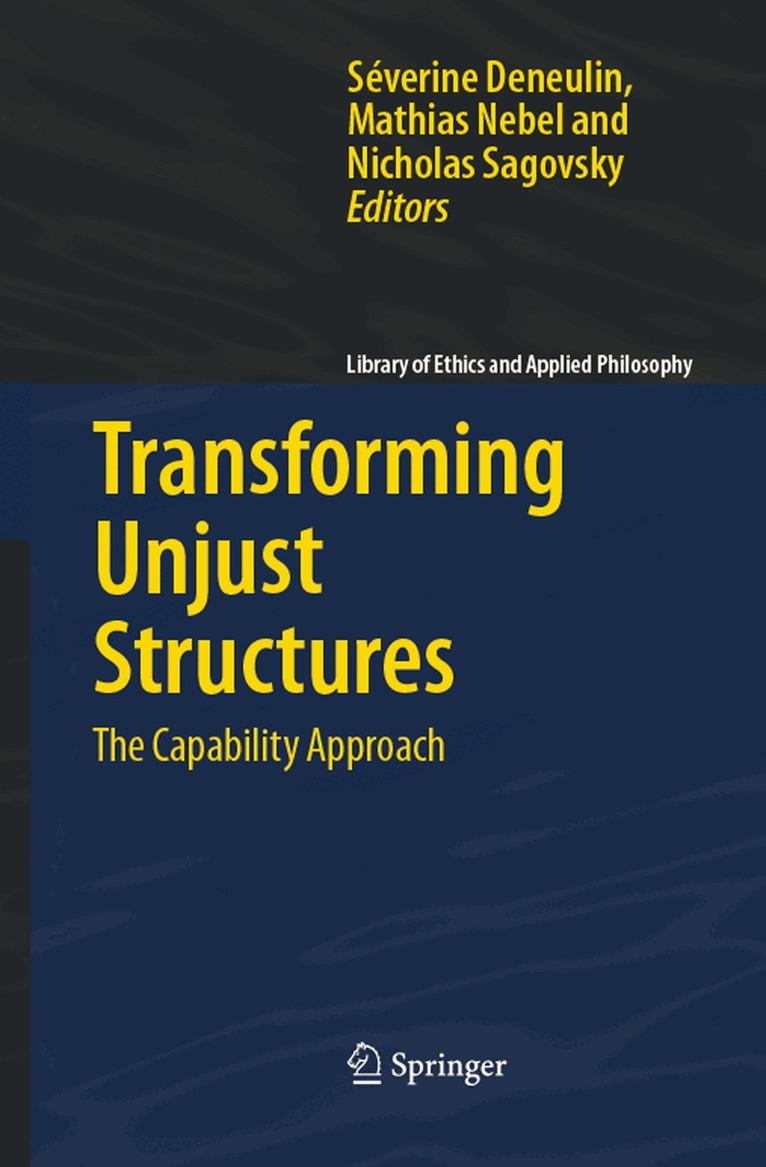
    Transforming Unjust Structures

    The Capability Approach

    AvSeverine Deneulin,Mathias Nebel

    Häftad, Engelska, 2010

    Del 19 i serien Library of Ethics and Applied Philosophy

    1 085 kr

    Beställningsvara. Skickas inom 10-15 vardagar. Fri frakt över 249 kr.

    Beskrivning

    SÉVERINE DENEULIN, MATHIAS NEBEL AND NICHOLAS SAGOVSKY TRANSFORMING UNJUST STRUCTURES The Capability Approach THE CAPABILITY APPROACH Structural injustice has traditionally been the concern of two major academic disciplines: economics and philosophy. The dominant model of economics has long been that of neo-classical economics. For neo-classical economists, human we- being is to be assessed by the availability of disposable income or according to goods consumed; it is measured by the levels of utility achieved in the consumption of commodities. Social order is fashioned by the ways consumers maximise their 1 well-being and enterprises maximise their profits. A core assumption is that all 2 commodities are commensurable: they can all be measured according to a single 3 numerical covering value, which is their price. Within this neo-classical paradigm, justice is achieved when the utility level of someone cannot be increased without 4 another person seeing his or her utility level decrease. The dominant paradigm of neo-classical economics was strongly challenged when development and welfare economist Amartya Sen received the Nobel Prize for Economics in 1998. His work offered an alternative to the neo-classical evaluation of human well-being in the utility/commodity space. The underlining philosophical intuition behind Sen’s work is that the standard of living lies in the living and not in the consumption of commodities. In searching for an alternative measure of human well-being, Sen devised his capability approach.

    Produktinformation

    • Utgivningsdatum:2010-11-19
    • Mått:160 x 240 x 12 mm
    • Vikt:324 g
    • Format:Häftad
    • Språk:Engelska
    • Serie:Library of Ethics and Applied Philosophy
    • Antal sidor:196
    • Förlag:Springer
    • ISBN:9789048171279

    Utforska kategorier

    • Samhälle och kultur inom Samhälle och politik
    • Sociologi inom Samhälle och politik
    • Filosofiska discipliner inom Filosofi och religion

    Innehållsförteckning

    • The Capability Approach: Theoretical Discussion.- Capabilities and Rights.- “Necessary Thickening”: Ricoeur's Ethic of Justice as a Complement to Sen's Capability Approach.- Structural Injustice and Democratic Practice: The Trajectory in Sen's Writings.- “Capable Individuals” and Just Institutions: Sen and Rawls.- Justice for Women: Martha Nussbaum and Catholic Social Teaching.- Transforming Unjust Structures: Five Case Studies.- Narrative Capability: Telling Stories in the Search for Justice.- Promoting Capability for Work: The Role of Local Actors.- Enhancing Students' Capabilities?: UK Higher Education and the Widening Participation Agenda.- Enter the Poor: American Welfare Reform, Solidarity and the Capability of Human Flourishing.- “Patent Injustice”: Applying Sen's Capability Approach to Biotechnologies.