• Fri frakt över 249 kr
  • •
  • Snabba leveranser
  • •
  • Billiga böcker
Kundservice

Du är på sajten för privatpersoner.

Företag, bibliotek eller offentlig verksamhet?

Du handlar på classic.bokus.com, där alla dina funktioner finns intakta.
Till classic.bokus.com
Bokus logotyp. Gå till startsidan.
  • Erbjudanden
  • Nyheter
  • Student
  • Topplistor
  • Barn & ungdom
  • Bokus Play
  • E-böcker
  • Pocketböcker
  • Spel & pussel

10% rabatt på allt med kod: NYSTART10 →

Sidfot

Mina sidor

    Hjälp

    • Kundservice
    • Vanliga frågor och svar
    • Frakt och leverans
    • Retur vid ångerrätt
    • Reklamera vara
    • Betalning
    • Köpvillkor
    • Allmänna villkor
    • Information om webbplatsens tillgänglighet

    Om Bokus

    • Om oss
    • Pressrum
    • För studenter
    • För företag
    • För bibliotek och offentlig verksamhet
    • För leverantörer
    • Hållbarhet

    Populärt

    • Aktuella erbjudanden
    • Presentkort
    • Studentlitteratur
    • Nya böcker
    • Topplistor
    • Signerade böcker
    • Engelska böcker

    Inspiration

    • Boktips
    • BookTok
    • Populära bokserier
    • Barnbokskaraktärer
    • Populära författare
    Logotyp för Bokus
    Följ oss på Facebook (extern länk)Följ oss på Instagram (extern länk)Följ oss på YouTube (extern länk)Följ oss på TikTok (extern länk)
    bokus @ CookiesAnpassa cookiesIntegritetspolicyKöpvillkor
    Till Citymail hemsida (extern länk)Till Budbee hemsida (extern länk)Till Postnord hemsida (extern länk)Till Schenker hemsida (extern länk)Till Early Bird hemsida (extern länk)Till Walleys hemsida (extern länk)
    1. Samhälle och politik
    2. Sociologi och antropologi
    3. Antropologi

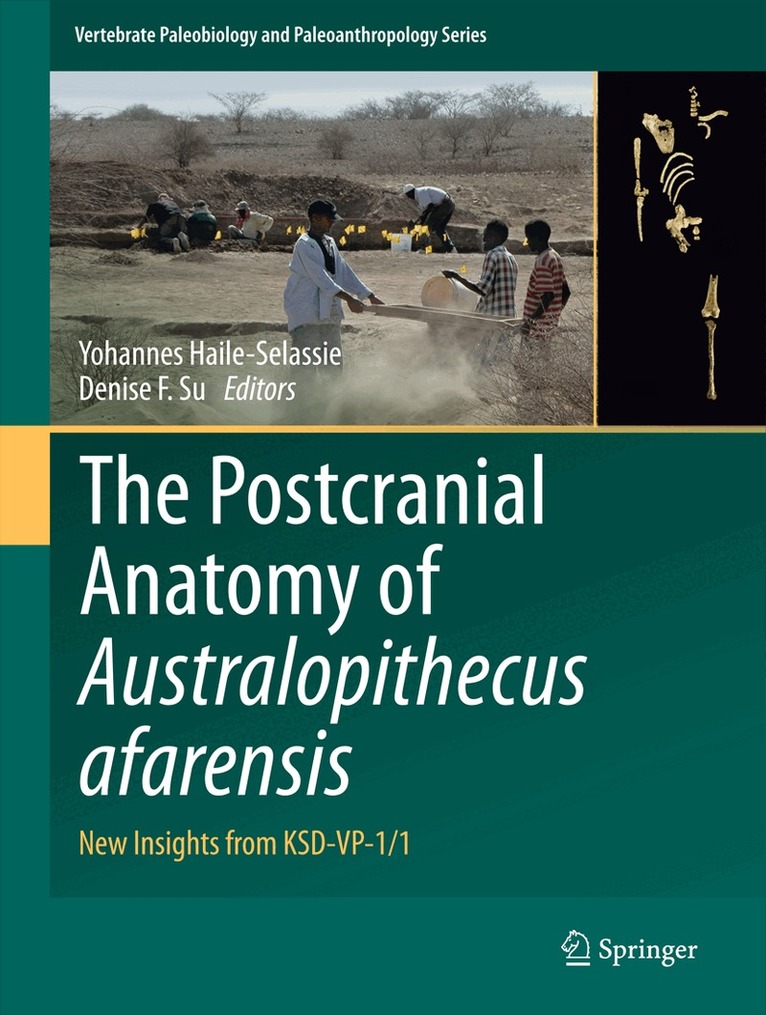
    Postcranial Anatomy of Australopithecus afarensis

    New Insights from KSD-VP-1/1

    AvYohannes Haile-Selassie,Denise F. Su

    Inbunden, Engelska, 2016

    Del i serien Vertebrate Paleobiology and Paleoanthropology

    1 194 kr

    Beställningsvara. Skickas inom 10-15 vardagar. Fri frakt över 249 kr.

    Beskrivning

    This volume describes a 3.6 million-years-old partial skeleton of Australopithecus afarensis from the Woranso-Mille, central Afar, Ethiopia. This specimen is the first adult partial skeleton to be recovered since Lucy’s (A.L. 288-1) discovery in 1974. It is older than Lucy by 400,000 years and sheds light on the paleobiology of early Australopithecus afarensis, particularly the morphology of the shoulder girdle and thoracic shape, which are thus far poorly understood and actively debated. The fauna associated with the partial skeleton tells us enormously about Au. afarensis paleoecology and give us another piece of the puzzle regarding habitat availability and use for Au. afarensis outside the Hadar region where it has been well-known for the last four decades.

    Produktinformation

    • Utgivningsdatum:2016-01-06
    • Mått:210 x 279 x 16 mm
    • Vikt:764 g
    • Format:Inbunden
    • Språk:Engelska
    • Serie:Vertebrate Paleobiology and Paleoanthropology
    • Antal sidor:191
    • Upplaga:16001
    • Förlag:Springer
    • ISBN:9789401774277

    Utforska kategorier

    • Antropologi inom Samhälle och politik
    • Paleontologi inom Naturvetenskap och teknik
    • Människans biologi inom Naturvetenskap och teknik

    Mer om författaren

    Dr. Yohannes Haile-Selassie is curator and head of Physical Anthropology at The Cleveland Museum of Natural History. His main area of research is Plio-Miocene mammalian evolution with a focus on the origin of the earliest hominins and the evolutionary history of early Australopithecus. He is also principal investigator of an active fieldwork project in Ethiopia, the Woranso-Mille paleontological project. Scientists from Ethiopia, Europe, and various institutions in the United States collaborate on a variety of subdisciplines of geology and paleontology. His collaborative fieldwork is shedding new light on the diversity and relationships among the earliest Australopithecus species and evolution of numerous extinct and extant mammalian taxa. As a member of the Middle Awash project (1993 – 2007), Haile-Selassie has discovered some of the most important hominin fossils known to science. Among these are the holotype of the 2.5 million-year-old Australopithecus garhi, the first pieces of the 4.4 million-year-old Ardipithecus ramidus partial skeleton, nicknamed "Ardi," and fossil remains of the 5.8 million-year-old Ardipithecus kadabba. He has recently co-edited a monograph on the latter species, which he named in 2001. Haile-Selassie is a fellow of the American Association for the Advancement of Science, and fellow of the Institute for the Science of Origins at Case Western Reserve University. He is also adjunct professor in the Departments of Anthropology, Anatomy, and Cognitive Sciences at Case Western Reserve University, where he teaches human evolution course.Dr. Denise Su is the Curator of Paleobotany and Paleoecology at the Cleveland Museum of Natural History. Her main area of research is the paleoecology of early hominins; she seeks to better understand the environmental context in which early hominins evolved to better address origination, extinction and adaptation events in our lineage. She conducts fieldwork at Laetoli, Tanzania, an important Pliocene hominin site where footprint trails of Australopithecus afarensis was discovered in 1976 and has reconstructed its paleoecological conditions using multi-evidential approach. She has also studied the paleoecology of other key early hominin localities, such as Aramis and West Margin of the Middle Awash, where Ardipithecus ramidus and Ardipithecus kadabba were recovered, respectively.

    Innehållsförteckning

    • Introduction to KSD-VP-1/1: The earliest partial skeleton of Australopithecus afarensis.- The Geologic Context of Korsi Dora and the Partial Skeleton KSD-VP-1/1.- The Taphonomy and Paleoecology of Korsi Dora Vertebrate Locality 1, Woranso-Mille Study Area, Ethiopia.- KSD-VP-1/1: Analysis of the Postcranial Skeleton Using High-Resolution Computed Tomography.- The Cervical Vertebrae of KSD-VP-1/1.- The Shoulder Girdle of KSD-VP-1/1.- The Thoracic Cage of KSD-VP-1/1.- The Pelvic Girdle and Limb Bones of KSD-VP-1/1.- Conclusion: Implications of KSD-VP-1/1 for Early Hominin Paleobiology and Insights into the Chimpanzee/Human Last Common Ancestor.