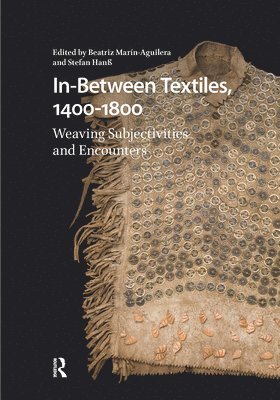
In-Between Textiles, 1400-1800
Weaving Subjectivities and Encounters
AvBeatriz Marín-Aguilera,Stefan Hanß
Del 44 i serien Visual and Material Culture, 1300-1700
2 535 kr
Beställningsvara. Skickas inom 5-8 vardagar. Fri frakt över 249 kr.
Du är på sajten för privatpersoner.
AvBeatriz Marín-Aguilera,Stefan Hanß
Del 44 i serien Visual and Material Culture, 1300-1700
2 535 kr
Beställningsvara. Skickas inom 5-8 vardagar. Fri frakt över 249 kr.
Beatriz Marín-Aguilera is a Derby Fellow at The University of Liverpool working on the archaeology of Indigenous slavery in the early modern Americas, and the Caribbean and Chile in particular. Until 2022, she has been a Renfrew Fellow at the McDonald Institute for Archaeological Research and Teaching Associate at the Centre of Latin American Studies at the University of Cambridge (UK). Her research straddles and connects the fields of postcolonial theory, social anthropology, and material culture studies, while contributing to Critical Indigenous and Subaltern Studies. She was trained in textile archaeology in Leiden (Textile Research Centre) and Cambridge. Her research focuses on the archaeology of colonialism and frontiers centring on clothing, body adornment, and body politics, for which she was also awarded a José Amor y Vázquez fellowship at the John Carter Brown Library in 2019. Stefan Hanß is Senior Lecturer in Early Modern History at The University of Manchester and the winner of a British Academy Rising Star Engagement Award (2019) as well as a Philip Leverhulme Prize in History (2020). Hanß works on cultural encounters and global material culture, currently with a focus on the history of hair, featherwork, and microscopic records. His research has been widely published, among others, in Current Anthropology, History Workshop Journal, Past and Present, Renaissance Quarterly, and The Historical Journal.
‘Shortlisted for the Association of Dress Historians (ADH), Book of the Year Award 2024’ 'Shortlisted for the RL Shep Memorial Book Award for 2023 books' “At a time when the fabric of democracy is rent by xenophobic zealotry, this outstanding volume provides us with the warp and woof of historical exchange and cultural co-existence. These enthralling essays engage with material practices of weaving across genres and geographies, displaying the travelling world of textiles as they record the shifting global communities of a ‘woven imaginary.’ Reading In-Between Textiles, brought to life the migratory memory of my mother’s Parsi garas: a traditional sari, commissioned in Bombay from Chinese sailors who offered her a range of silks and motifs, and brought her the sari, months later, when they docked again in Bombay harbor. Set out on this wondrous voyage of the woven world.” Homi K. Bhabha, Harvard University. “Ranging across five centuries, six continents, and an impressive range of fields, from chemistry-based technologies to ethnographic fieldwork, this broad collection of textile studies recovers the place of subalterns in history, and the varying meanings that early modern textiles took on depending on the communities that used them. Employing the concept of ‘in-betweenness,’ this volume includes the agency of the excluded and allows historians to move away from glorifying metropolitan ‘culture’ without a clear consciousness that it is a culture of imperialism.” Suraiya Faroqhi, Ibn Haldun University. “What happens when a material methodology is used to investigate subjectivities? This remarkable collection of sixteen essays considers the ways in which textiles and clothing serve to unlock the space ‘in-between,’ one of negotiation, translation, and sometimes subversion of identities. In this book early modern cloth, but also dress, embroideries, and carpets are interrogated to create a new conceptualization of the global. Here material exchange, cultural connections, and the encounters of ideas are woven together in a rich tapestry traversing the entire world.” Giorgio Riello, European University Institute Florence. “This pioneering volume offers sixteen case studies that consistently cross-fertilize Homi Bhabha’s postcolonial theory with the new history of material practices to show how dress and textiles produced difference and mimicry in cultural struggles that remade subjectivities in the early modern world. A remarkable feat and excellent read. Beautifully illustrated, incisive, and original, this book presents cutting-edge scholarship.” Ulinka Rublack, University of Cambridge.
Beatriz Marín-Aguilera
Häftad, 2018
238 kr
Andrea Babbi, Frederike Bubenheimer-Erhart, Beatriz Marín-Aguilera, Simone Mühl
Häftad, 2015
574 kr
Christopher D. Bahl, Stefan Hanß
Häftad, 2023
1 479 kr
Stefan Hanß
Inbunden, 2023
2 625 kr
Stefan Hanß
Häftad, 2024
677 kr
Du är på sajten för privatpersoner.
AvBeatriz Marín-Aguilera,Stefan Hanß
Del 44 i serien Visual and Material Culture, 1300-1700
2 535 kr
Beställningsvara. Skickas inom 5-8 vardagar. Fri frakt över 249 kr.
Beatriz Marín-Aguilera is a Derby Fellow at The University of Liverpool working on the archaeology of Indigenous slavery in the early modern Americas, and the Caribbean and Chile in particular. Until 2022, she has been a Renfrew Fellow at the McDonald Institute for Archaeological Research and Teaching Associate at the Centre of Latin American Studies at the University of Cambridge (UK). Her research straddles and connects the fields of postcolonial theory, social anthropology, and material culture studies, while contributing to Critical Indigenous and Subaltern Studies. She was trained in textile archaeology in Leiden (Textile Research Centre) and Cambridge. Her research focuses on the archaeology of colonialism and frontiers centring on clothing, body adornment, and body politics, for which she was also awarded a José Amor y Vázquez fellowship at the John Carter Brown Library in 2019. Stefan Hanß is Senior Lecturer in Early Modern History at The University of Manchester and the winner of a British Academy Rising Star Engagement Award (2019) as well as a Philip Leverhulme Prize in History (2020). Hanß works on cultural encounters and global material culture, currently with a focus on the history of hair, featherwork, and microscopic records. His research has been widely published, among others, in Current Anthropology, History Workshop Journal, Past and Present, Renaissance Quarterly, and The Historical Journal.
‘Shortlisted for the Association of Dress Historians (ADH), Book of the Year Award 2024’ 'Shortlisted for the RL Shep Memorial Book Award for 2023 books' “At a time when the fabric of democracy is rent by xenophobic zealotry, this outstanding volume provides us with the warp and woof of historical exchange and cultural co-existence. These enthralling essays engage with material practices of weaving across genres and geographies, displaying the travelling world of textiles as they record the shifting global communities of a ‘woven imaginary.’ Reading In-Between Textiles, brought to life the migratory memory of my mother’s Parsi garas: a traditional sari, commissioned in Bombay from Chinese sailors who offered her a range of silks and motifs, and brought her the sari, months later, when they docked again in Bombay harbor. Set out on this wondrous voyage of the woven world.” Homi K. Bhabha, Harvard University. “Ranging across five centuries, six continents, and an impressive range of fields, from chemistry-based technologies to ethnographic fieldwork, this broad collection of textile studies recovers the place of subalterns in history, and the varying meanings that early modern textiles took on depending on the communities that used them. Employing the concept of ‘in-betweenness,’ this volume includes the agency of the excluded and allows historians to move away from glorifying metropolitan ‘culture’ without a clear consciousness that it is a culture of imperialism.” Suraiya Faroqhi, Ibn Haldun University. “What happens when a material methodology is used to investigate subjectivities? This remarkable collection of sixteen essays considers the ways in which textiles and clothing serve to unlock the space ‘in-between,’ one of negotiation, translation, and sometimes subversion of identities. In this book early modern cloth, but also dress, embroideries, and carpets are interrogated to create a new conceptualization of the global. Here material exchange, cultural connections, and the encounters of ideas are woven together in a rich tapestry traversing the entire world.” Giorgio Riello, European University Institute Florence. “This pioneering volume offers sixteen case studies that consistently cross-fertilize Homi Bhabha’s postcolonial theory with the new history of material practices to show how dress and textiles produced difference and mimicry in cultural struggles that remade subjectivities in the early modern world. A remarkable feat and excellent read. Beautifully illustrated, incisive, and original, this book presents cutting-edge scholarship.” Ulinka Rublack, University of Cambridge.
Beatriz Marín-Aguilera
Häftad, 2018
238 kr
Andrea Babbi, Frederike Bubenheimer-Erhart, Beatriz Marín-Aguilera, Simone Mühl
Häftad, 2015
574 kr
Christopher D. Bahl, Stefan Hanß
Häftad, 2023
1 479 kr
Stefan Hanß
Inbunden, 2023
2 625 kr
Stefan Hanß
Häftad, 2024
677 kr