• Fri frakt över 249 kr
  • •
  • Snabba leveranser
  • •
  • Billiga böcker
Kundservice

Du är på sajten för privatpersoner.

Företag, bibliotek eller offentlig verksamhet?

Du handlar på classic.bokus.com, där alla dina funktioner finns intakta.
Till classic.bokus.com
Bokus logotyp. Gå till startsidan.
  • Erbjudanden
  • Nyheter
  • Student
  • Topplistor
  • Barn & ungdom
  • Bokus Play
  • E-böcker
  • Pocketböcker
  • Spel & pussel

10% rabatt på allt med kod NYSTART10 →

Sidfot

Mina sidor

    Hjälp

    • Kundservice
    • Vanliga frågor och svar
    • Frakt och leverans
    • Retur vid ångerrätt
    • Reklamera vara
    • Betalning
    • Köpvillkor
    • Allmänna villkor
    • Information om webbplatsens tillgänglighet

    Om Bokus

    • Om oss
    • Pressrum
    • För studenter
    • För företag
    • För bibliotek och offentlig verksamhet
    • För leverantörer
    • Hållbarhet

    Populärt

    • Aktuella erbjudanden
    • Presentkort
    • Studentlitteratur
    • Nya böcker
    • Topplistor
    • Signerade böcker
    • Engelska böcker

    Inspiration

    • Boktips
    • BookTok
    • Populära bokserier
    • Barnbokskaraktärer
    • Populära författare
    Logotyp för Bokus
    Följ oss på Facebook (extern länk)Följ oss på Instagram (extern länk)Följ oss på YouTube (extern länk)Följ oss på TikTok (extern länk)
    bokus @ CookiesAnpassa cookiesIntegritetspolicyKöpvillkor
    Till Citymail hemsida (extern länk)Till Budbee hemsida (extern länk)Till Postnord hemsida (extern länk)Till Schenker hemsida (extern länk)Till Early Bird hemsida (extern länk)Till Walleys hemsida (extern länk)
    1. Samhälle och politik
    2. Samhälle och kultur
    3. Kultur och medier
    4. Medievetenskap

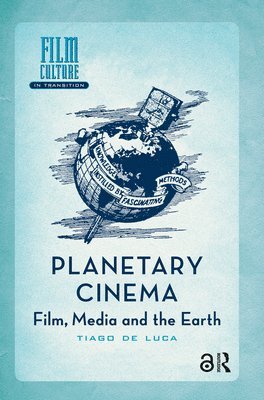
    Planetary Cinema

    Film, Media and the Earth

    AvTiago de Luca

    Inbunden, Engelska, 2021

    Del i serien Film Culture in Transition

    2 058 kr

    Beställningsvara. Skickas inom 10-15 vardagar. Fri frakt över 249 kr.

    Fler format och utgåvor

    Häftad

    681 kr

    Beskrivning

    The story is now familiar. In the late 1960s humanity finally saw photographic evidence of the Earth in space for the first time. According to this narrative, the impact of such images in the consolidation of a planetary consciousness is yet to be matched. This book tells a different story. It argues that this narrative has failed to account for the vertiginous global imagination underpinning the media and film culture of the late nineteenth century and beyond. Panoramas, giant globes, world exhibitions, photography and stereography: all promoted and hinged on the idea of a world made whole and newly visible. When it emerged, cinema did not simply contribute to this effervescent globalism so much as become its most significant and enduring manifestation. Planetary Cinema proposes that an exploration of that media culture can help us understand contemporary planetary imaginaries in times of environmental collapse. Engaging with a variety of media, genres and texts, the book sits at the intersection of film/media history and theory/ philosophy, and it claims that we need this combined approach and expansive textual focus in order to understand the way we see the world.

    Produktinformation

    • Utgivningsdatum:2021-12-20
    • Mått:156 x 234 x 18 mm
    • Vikt:660 g
    • Format:Inbunden
    • Språk:Engelska
    • Serie:Film Culture in Transition
    • Antal sidor:330
    • Förlag:Amsterdam University Press
    • ISBN:9789463729628

    Utforska kategorier

    • Medievetenskap inom Samhälle och politik
    • Film inom Kultur

    Mer om författaren

    Tiago de Luca is Reader in Film Studies at the University of Warwick. He is the author of Realism of the Senses in World Cinema: The Experience of Physical Reality (2014), and the editor (with Nuno Barradas Jorge) of Slow Cinema (2016) and (with Lúcia Nagib and Luciana Corrêa de Araújo) Towards an Intermedial History of Brazilian Cinema (2022). He is the editor, with Lúcia Nagib, of the Film Thinks series.

    Recensioner i media

    "This timely book traces a history of universalizing whole-Earth images from panoramas, world exhibitions, stereographs, and silent-era cinema to IMAX and BBC nature documentaries, showing the problems and promise of such universalizing visualizations for our current moment of ecological crisis."- Jennifer Lynn Peterson, Woodbury University, Los Angeles "At our current critical juncture in which new thinking about the planet has never been more urgent, Tiago de Luca’s Planetary Cinema reminds us of media’s long history of reflecting, shaping, and questioning planetary consciousness. This work offers a fascinating interdisciplinary exploration of how the figure and image of the world have been constructed and challenged through film and related media. Combining an innovative conceptual approach with illuminating case studies across history from panoramas and early cinema to experimental film and tv documentaries, Planetary Cinema makes important contributions to the growing field of ecocinema. A philosophically-informed and historically sensitive study of how media have made us feel at home, or not, in the world and its remaking."- Paula Amad, University of Iowa "This fascinating study shows how cinema has both bolstered and challenged our planetary imaginaries, from 19th-century imperialism to the current ecological crisis. With deep historical knowledge, De Luca brings past and present media practices into a productive dialogue, where each transforms our understanding of the other."- Michael Cowan, University of Iowa

    Innehållsförteckning

    • List of Figures Acknowledgements Introduction The (Whole) World in Motion Earth • World • Globe • Planet Multiple Media Worlds Towards the Planetary The Chapters 1 Sublime Earth Humboldt’s Panoramas Humboldt’s Globes IMAX Whole-Earth Who Does the Earth Think It Is? Unearthing the Earth 2 The Unseen World Across the World Unseen Worlds Never Before Seen Never Before Seen (Again) Never to Be Seen Again 3 The Universal Equality of Things The Encyclopedia, or ‘The Sun is No Respecter of Persons or of Things’ The Integrated Whole, or ‘An Instantaneous Survey of the World’ The Database, or ‘YouTube is the World Stage’ 4 The Face of the World The Inter-Face Death’s Head ‘Don’t Blink!’ The Face in the Crowd 5 A Networked Humanity ‘One Common Flood of Humanity’ A World of Strangers Networking the Earth 6 A Disappearing Planet A Human Planet An Inhuman Planet A Nonhuman Planet A Non-Planet Bibliography Index