• Fri frakt över 249 kr
  • •
  • Snabba leveranser
  • •
  • Billiga böcker
Kundservice

Du är på sajten för privatpersoner.

Företag, bibliotek eller offentlig verksamhet?

Du handlar på classic.bokus.com, där alla dina funktioner finns intakta.
Till classic.bokus.com
Bokus logotyp. Gå till startsidan.
  • Erbjudanden
  • Nyheter
  • Student
  • Topplistor
  • Barn & ungdom
  • Bokus Play
  • E-böcker
  • Pocketböcker
  • Spel & pussel

10% rabatt på allt med kod: NYSTART10 →

Sidfot

Mina sidor

    Hjälp

    • Kundservice
    • Vanliga frågor och svar
    • Frakt och leverans
    • Retur vid ångerrätt
    • Reklamera vara
    • Betalning
    • Köpvillkor
    • Allmänna villkor
    • Information om webbplatsens tillgänglighet

    Om Bokus

    • Om oss
    • Pressrum
    • För studenter
    • För företag
    • För bibliotek och offentlig verksamhet
    • För leverantörer
    • Hållbarhet

    Populärt

    • Aktuella erbjudanden
    • Presentkort
    • Studentlitteratur
    • Nya böcker
    • Topplistor
    • Signerade böcker
    • Engelska böcker

    Inspiration

    • Boktips
    • BookTok
    • Populära bokserier
    • Barnbokskaraktärer
    • Populära författare
    Logotyp för Bokus
    Följ oss på Facebook (extern länk)Följ oss på Instagram (extern länk)Följ oss på YouTube (extern länk)Följ oss på TikTok (extern länk)
    bokus @ CookiesAnpassa cookiesIntegritetspolicyKöpvillkor
    Till Citymail hemsida (extern länk)Till Budbee hemsida (extern länk)Till Postnord hemsida (extern länk)Till Schenker hemsida (extern länk)Till Early Bird hemsida (extern länk)Till Walleys hemsida (extern länk)
    1. Naturvetenskap och teknik
    2. Geovetenskap
    3. Miljövetenskap och miljöpolitik

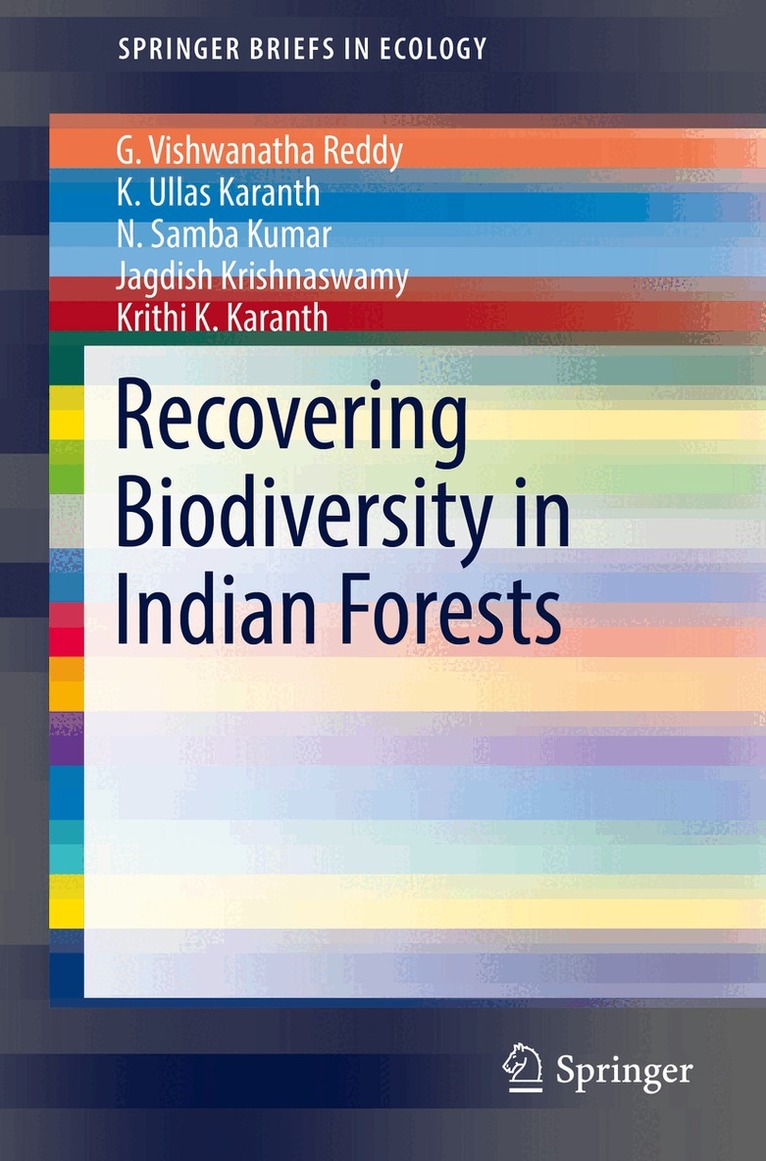
    Recovering Biodiversity in Indian Forests

    AvG. Vishwanatha Reddy,K. Ullas Karanth

    Häftad, Engelska, 2016

    Del i serien SpringerBriefs in Ecology

    546 kr

    Beställningsvara. Skickas inom 10-15 vardagar. Fri frakt över 249 kr.

    Beskrivning

    This book demonstrates how varying levels of human disturbance manifested through different management regimes influence composition, richness, diversity and abundance of key mammal, bird and plant species, even within ecologically similar habitats. Based on our results, we show the critical importance of the ‘wildlife preservation’ approach for effective biodiversity conservation. The study also provides examples of a practical application of rigorous methods of quantitative sampling of different plant and animal taxa as well as human influences, thus serving as a useful manual for protected area managers. Protectedareas of various kinds have been established in India with the goal ofarresting decline in, and to provide for, recovery of biodiversity andecosystem services. A model that targets ‘wildlife preservation’ under stateownership is practiced across the country. However, forests in India are underintensive human pressure and varying levels of protection; therefore,protectedareas may also experience open-access resource use, a model that is beingaggressively advocated as a viable alternative to ‘preservationism’. We haveevaluated the conservation efficacy of alternative forest management models byquantifying levels of biodiversity under varied levels of access, resourceextraction and degree of state-sponsored protection in the Nagarahole forestlandscape of southwestern India.

    Produktinformation

    • Utgivningsdatum:2016-09-02
    • Mått:155 x 235 x 10 mm
    • Vikt:231 g
    • Format:Häftad
    • Språk:Engelska
    • Serie:SpringerBriefs in Ecology
    • Antal sidor:111
    • Upplaga:2016
    • Förlag:Springer Verlag, Singapore
    • ISBN:9789811009099

    Utforska kategorier

    • Miljövetenskap och miljöpolitik inom Naturvetenskap och teknik
    • Biovetenskap inom Naturvetenskap och teknik

    Mer om författaren

    G. ViswanathaReddy is theAdditional Principal Conservator of Forests and Chief Wildlife Warden,Department of Forest, Government of Rajasthan. He has more than 25 years ofexperience in protected area management and conservation of wildlife. He isalso one of those rare park managers who is deeply interested and encouragingof research on wildlife. Dr. Reddy received his doctoral degree from ManipalUniversity, in 2011, and has multiple peer-reviewed scientific publications. Dr.Reddy also has international experience in managing parks, having served as anEcosystem Manager in Indonesia, as part of the World Bank-funded Aceh Forestsand Environment Project. He is also well renowned for his efforts to improveprotection in Ranthambhore Tiger Reserve, where he served as a DeputyConservator of Forests and Deputy Field Director between 1997 and 2002, and subsequentlyas Field Director (2002-2003). In this capacity, he improved the management ofthe park, augmented its eco-tourism capability through engagement of localresidents, stopped destructive mining practices within the park, and facilitatedvoluntary resettlement of families living within the park. He has beenrecognized for his hard work and effective conservation through various awards,including the Carl Zeiss Wildlife Conservation Award, Eco-Warrier Award, fromEarth Foundation Matters, and a Merit Award from the Government of Rajasthan.He has also participated in multiple international conferences and workshops onconservation of tigers and other wildlife.K.Ullas Karanth is the Director of Science – Asia,Wildlife Conservation Society, and a globally renowned expert on tiger ecologyandconservation. He has over two decades of experience in implementing successfulresearch and conservation programs in the Western Ghats. He has more than 100scientific publications, and has served as an expert on a number of wildlifeboards. His pioneering work on using camera trapsto monitor tiger populationabundance has been adopted worldwide for a number of species, includingjaguars, and nationally, for counting tigers within major source populations inthe country. Dr. Karanth has also penned a number of popular articles aimed atmaking science and the complexities of wildlife conservation accessible to thelayman. He serves as an editor on a number of scientific journals ofinternational repute, and is a Fellow at the Indian Academy of Sciences. Dr.Karanth is an Adjunct Professor at the University of Florida, University ofMinnesota, Tata Institute of Fundamental Research-National Centre forBiological Sciences, and Manipal University. He has received numerous awards,including the prestigious Padmashree, a National Civilian Honour conferred bythe President of India, and the Rajyothsava Award for environmental andwildlife conservation by the Government of Karnataka.N.Samba Kumar is the Additional Director – Scienceand Training, Wildlife Conservation Society, India Program. With over 40scientific publications, Dr. Kumar is an acclaimed scientists specializing inungulate biology and conservation. His knowledge of sampling protocols forassessing population status of large mammals is unrivalled, while his doctoralthesis, submitted to Manipal University, involves the development of advancedmethods that are sure to change our ability to understand the dynamics ofungulate populations in a number of landscapes throughout India. Dr. Kumar hasmentored and trained a number of amateur wildlife enthusiasts, a number of whomhave gone on to embrace the field of wildlife conservation; some of them areworking professionals in the field today. He has also trained a number offorest department staff, and interacted with park managers to a large extent,working towards integration of science and park management. Dr. Kumar hasreceived a number of awards, including the Carl Zeiss Wildlife ConservationAward and has attended numerous international and national conferences andworkshops on wildlife research and conservation.JagdishKrishnaswamy is the Convenorand Senior Fellow at the SuriSeghal Centre for Biodiversity and Conservation,Ashoka Trust for Research in Ecology and the Environment. After completing hisdoctorate from the Duke University in 1999, Dr. Krishnaswamy has successfullyimplemented a number of research programs throughout India, and in addition, hasadvised numerous scientists in the field. As an affiliate faculty at theNational Centre for Biological Sciences, Dr. Krishnaswamy has taughtstatistics, landscape ecology and hydrology, at the post-graduate level. Healso teaches courses at the National Institute of Advanced Studies and the AshokaTrust for Research in Ecology and the Environment. He has published over 50scientific peer-reviewed articles, and has served on the editorial board ofinternational journals. Dr. Krishnaswamy’s in the field of hydrology, asrelated to wildlife conservation, is path-breaking, and his contributions haveled to various on-ground conservation actions. He is a member of the GharialConservation Alliance, which is an international alliance dedicated to savingthe species.Krithi K. Karanth is an AssociateConservation Scientist with the Global Conservation Program, WildlifeConservation Society, New York. She is also a recipient of the RamanujanFellowship offered by the Department of Science and Technology, Government ofIndia. Dr. Karanth’s interests span issues involving conservation of wildlifeoutside protected areas, tourism initiatives for conservation, and voluntaryresettlement of people from forest interiors. She is aprolific writer with over 30 peer-reviewed scientific publications, and morethan 30 popular articles and blogs. She is the 10,000th grantee andexplorer of the National Geographic Society, and was recognized for herachievements as the Young Global Leader and one of 15 women changing the world,at the World Economic Forum in 2015, an INK fellow in 2013, and DistinguishedAlumna at both the Yale Tropical Resources Institute and University of Florida.She is an Adjunct Assistant Professor at the Duke University and AffiliateTeaching Faculty at the National Centre for Biological Sciences. She has alsomentored a number of graduate students and young professionals in the field.

    Innehållsförteckning

    • Chapter 1 RoleOf Wildlife Protected Areas In India.- Chapter 2 Study Species, Habitats AndHypotheses.- Chapter 3 SurveyDesign, Field and Analytical Methods.- Chapter 4 Results and Findings.- Chapter 5 Synthesis,Discussion and Conclusions.