• Fri frakt över 249 kr
  • •
  • Snabba leveranser
  • •
  • Billiga böcker
Kundservice

Du är på sajten för privatpersoner.

Företag, bibliotek eller offentlig verksamhet?

Du handlar på classic.bokus.com, där alla dina funktioner finns intakta.
Till classic.bokus.com
Bokus logotyp. Gå till startsidan.
  • Erbjudanden
  • Student
  • Topplistor
  • Barn & ungdom
  • Bokus Play
  • E-böcker
  • Ljudböcker
  • Pocketböcker
  • Spel och pussel

5% studentrabatt – använd koden KURSBOK27 →

Sidfot

Mina sidor

    Hjälp

    • Kundservice
    • Vanliga frågor och svar
    • Frakt och leverans
    • Retur vid ångerrätt
    • Reklamera vara
    • Betalning
    • Köpvillkor
    • Allmänna villkor
    • Information om webbplatsens tillgänglighet

    Om Bokus

    • Om oss
    • Pressrum
    • För studenter
    • För företag
    • För bibliotek och offentlig verksamhet
    • För leverantörer
    • Hållbarhet

    Populärt

    • Aktuella erbjudanden
    • Presentkort
    • Studentlitteratur
    • Nya böcker
    • Topplistor
    • Signerade böcker
    • Engelska böcker

    Inspiration

    • Boktips
    • BookTok
    • Barnbokskaraktärer
    • Populära författare
    Logotyp för Bokus
    Följ oss på Facebook (extern länk)Följ oss på Instagram (extern länk)Följ oss på YouTube (extern länk)Följ oss på TikTok (extern länk)
    bokus @ CookiesAnpassa cookiesIntegritetspolicyKöpvillkor
    Till Citymail hemsida (extern länk)Till Budbee hemsida (extern länk)Till Postnord hemsida (extern länk)Till Schenker hemsida (extern länk)Till Early Bird hemsida (extern länk)Till Walleys hemsida (extern länk)
    1. Psykologi och pedagogik
    2. Pedagogik
    3. Högskola och universitet

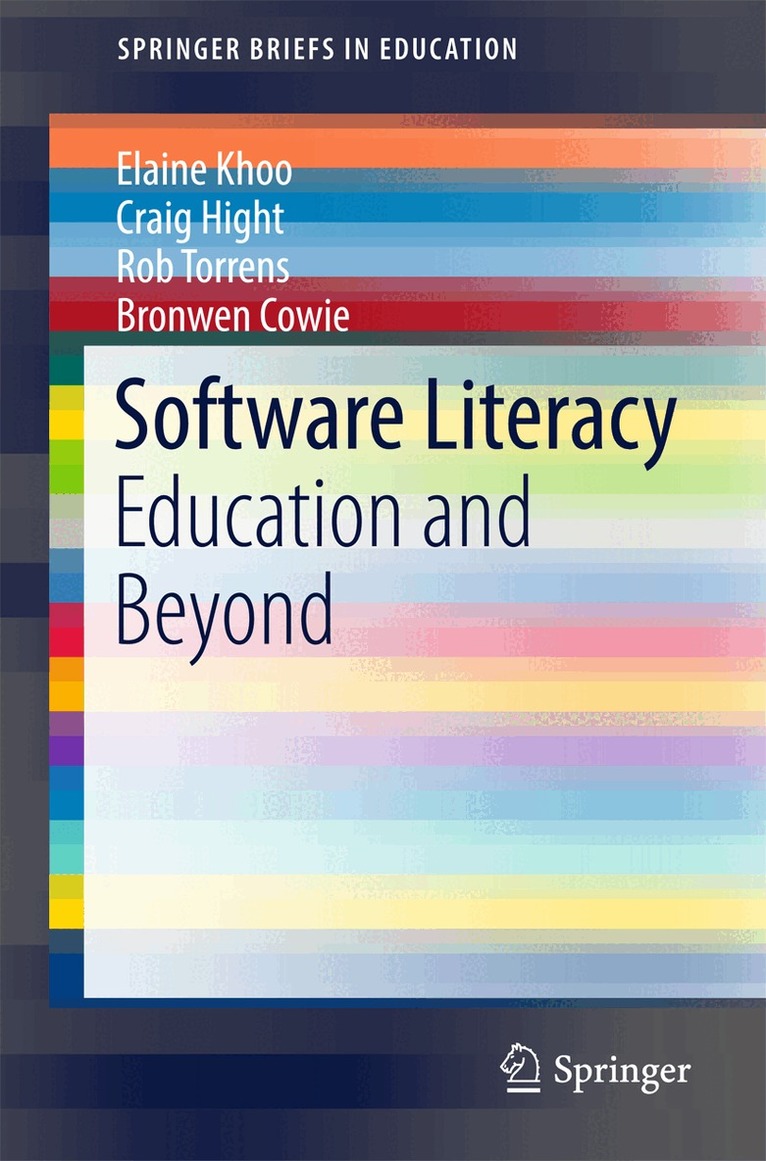
    Software Literacy

    Education and Beyond

    AvElaine Khoo,Craig Hight

    Häftad, Engelska, 2017

    Del i serien SpringerBriefs in Education

    543 kr

    Beställningsvara. Skickas inom 10-15 vardagar. Fri frakt över 249 kr.

    Beskrivning

    This book explores the notion of software literacy, a key part of digital literacy which all contemporary students and citizens need to understand. Software literacy involves a critical understanding of how the affordances and conceptual approaches of everything from operating systems, creative apps and media editors, to software-based platforms and infrastructures work to inform and shape the ways we think and act. As a cultural artefact, programing code plays a role in reproducing, reinforcing, and augmenting existing cultural practices, as well as generating completely new coded practices. A proposed three-tier framework for software literacy is the focus for a two-year empirical investigation into how tertiary students become more literate about the nature and implications of software they encounter as part of their tertiary studies. Two case studies of software learning and use in university-level engineering and screen & media studies courses are presented, investigating the mapping of students’ trajectory of the learning of desktop applications against this framework for software literacy. Though the book’s focus is primarily educational, its content also has implications for any field that makes use of software and information & communication technology systems and applications. As such, the book will be of interest to all readers whose work involves the challenges and opportunities presented by software-based teaching and learning; and to those interested in how software impacts the workplace and leisure activities that make up our day-to-day lives.

    Produktinformation

    • Utgivningsdatum:2017-12-04
    • Mått:155 x 235 x 9 mm
    • Vikt:198 g
    • Format:Häftad
    • Språk:Engelska
    • Serie:SpringerBriefs in Education
    • Antal sidor:101
    • Förlag:Springer Verlag, Singapore
    • ISBN:9789811070587

    Utforska kategorier

    • Högskola och universitet inom Psykologi och pedagogik
    • Teknik: allmänt inom Naturvetenskap och teknik
    • Material och digital teknik i undervisningen inom Psykologi och pedagogik

    Mer om författaren

    Dr Elaine Khoo is a senior research fellow at the Wilf Malcolm Institute of Educational Research (WMIER) at the University of Waikato, New Zealand. Elaine’s research interests include information and communication technology (ICT) and digital pedagogies, online learning communities, participatory learning cultures and collaborative research contexts. She has published works on the flipped classroom, online learning, mobile learning, and ICT use across the compulsory schooling sector and tertiary level. More details at: http://www.waikato.ac.nz/wmier/about-us/people/elaine-khooDr Craig Hight is an Associate Professor of Creative Industries at the University of Newcastle, Australia. His current research focuses on the relationships between digital media technologies and documentary practice, especially the variety of factors shaping online documentary cultures. He has published broadly on audience research, digital media and documentary theory. More details at: https://www.newcastle.edu.au/profile/craig-hightDr Rob Torrens is a lecturer at the University of Waikato. His engineering education interests focus on the transition from high school; the first-year experience; and improving student engagement and performance. More details at: http://sci.waikato.ac.nz/about-us/people/torrensProfessor Bronwen Cowie is Director of the Wilf Malcolm Institute of Educational Research at the University of Waikato. Her research interests include assessment for learning, student voice, the role of ICTs in teaching and learning, and curriculum implementation. She has published extensively on a number of national evaluation projects, as well as research projects that have investigated the nuances of classroom interactions. More details at: http://www.waikato.ac.nz/wmier/about-us/people/bronwen-cowie

    Innehållsförteckning

    • Chapter 1 Introduction: Software and other literacies.- Chapter 2 A genealogy of software applications.- Chapter 3 The learning, use and critical understanding of software in Media Studies.- Chapter 4 The learning, use and critical understanding of software in Engineering.- Chapter 5 Comparing the cases: What do they tell us about Software Literacy?.- Chapter 6 Software Literacy: Education and beyond.