• Fri frakt över 249 kr
  • •
  • Snabba leveranser
  • •
  • Billiga böcker
Kundservice

Du är på sajten för privatpersoner.

Företag, bibliotek eller offentlig verksamhet?

Du handlar på classic.bokus.com, där alla dina funktioner finns intakta.
Till classic.bokus.com
Bokus logotyp. Gå till startsidan.
  • Erbjudanden
  • Nyheter
  • Student
  • Topplistor
  • Barn & ungdom
  • Bokus Play
  • E-böcker
  • Pocketböcker
  • Spel & pussel

10% rabatt på allt med kod: NYSTART10 →

Sidfot

Mina sidor

    Hjälp

    • Kundservice
    • Vanliga frågor och svar
    • Frakt och leverans
    • Retur vid ångerrätt
    • Reklamera vara
    • Betalning
    • Köpvillkor
    • Allmänna villkor
    • Information om webbplatsens tillgänglighet

    Om Bokus

    • Om oss
    • Pressrum
    • För studenter
    • För företag
    • För bibliotek och offentlig verksamhet
    • För leverantörer
    • Hållbarhet

    Populärt

    • Aktuella erbjudanden
    • Presentkort
    • Studentlitteratur
    • Nya böcker
    • Topplistor
    • Signerade böcker
    • Engelska böcker

    Inspiration

    • Boktips
    • BookTok
    • Populära bokserier
    • Barnbokskaraktärer
    • Populära författare
    Logotyp för Bokus
    Följ oss på Facebook (extern länk)Följ oss på Instagram (extern länk)Följ oss på YouTube (extern länk)Följ oss på TikTok (extern länk)
    bokus @ CookiesAnpassa cookiesIntegritetspolicyKöpvillkor
    Till Citymail hemsida (extern länk)Till Budbee hemsida (extern länk)Till Postnord hemsida (extern länk)Till Schenker hemsida (extern länk)Till Early Bird hemsida (extern länk)Till Walleys hemsida (extern länk)
    1. Naturvetenskap och teknik
    2. Geovetenskap
    3. Miljövetenskap och miljöpolitik

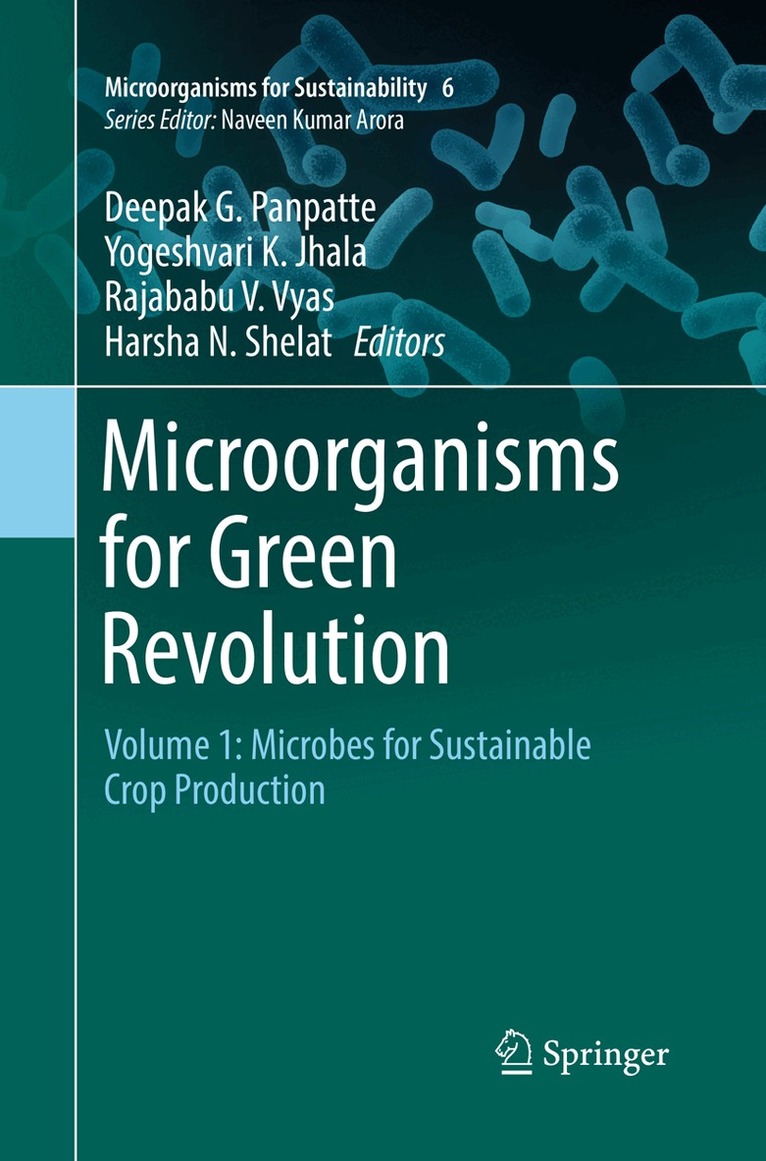
    Microorganisms for Green Revolution

    Volume 1: Microbes for Sustainable Crop Production

    AvDeepak G. Panpatte,Yogeshvari K. Jhala

    Häftad, Engelska, 2018

    Del 6 i serien Microorganisms for Sustainability

    2 165 kr

    Beställningsvara. Skickas inom 10-15 vardagar. Fri frakt över 249 kr.

    Beskrivning

    This book addresses basic and applied aspects of two nexus points of microorganisms in agro-ecosystems, namely their functional role as bio-fertilizers and bio-pesticides.  Readers will find detailed information on all of the aspects that are required to make a microbe “agriculturally beneficial.” A healthy, balanced soil ecosystem provides a habitat for crops to grow without the need for interventions such as agro-chemicals. No organism in an agro-ecosystem can flourish individually, which is why research on the interaction of microorganisms with higher forms of life has increasingly gained momentum in the last 10-15 years. In fact, most of plants’ life processes only become possible through interactions with microorganisms. Using these “little helpers” as a biological alternative to agro-chemicals is a highly contemporary field of research.The information presented here is based on the authors’ extensive experience in the subject area, gathered in the course of their careers in the field of agricultural microbiology. The book offers a valuable resource for all readers who are actively involved in research on agriculturally beneficial microorganisms. In addition, it will help prepare readers for the future challenges that climate change will pose for agriculture and will help to bridge the current gaps between different scientific communities.

    Produktinformation

    • Utgivningsdatum:2018-12-12
    • Mått:155 x 235 x 24 mm
    • Vikt:775 g
    • Format:Häftad
    • Språk:Engelska
    • Serie:Microorganisms for Sustainability
    • Antal sidor:443
    • Förlag:Springer Verlag, Singapore
    • ISBN:9789811348365

    Utforska kategorier

    • Miljövetenskap och miljöpolitik inom Naturvetenskap och teknik
    • Biovetenskap inom Naturvetenskap och teknik
    • Biologi inom Naturvetenskap och teknik

    Mer om författaren

    Dr. Deepak G. Panpatte is a Research Scholar working for the past 7 years. His research interests include agriculturally beneficial microorganism viz. biofertilizers, biopesticides and biodegraders. Done pioneering work for development of fortified biocontrol bacterial consortium with phyto-extracts for management of phytopathogenic nematodes and fungi. He has received 2 awards for presentation of research outcomes in International conferences and Rastiya Gaurav Award for outstanding contribution in agriculture. His publication profile includes, 13 research papers, 4 book chapter with springer publishing house, 1 practical manual, 24 popular articles and 2 editorial pages.Dr. Yogeshvari K. Jhala is an Assistant professor having 10 years of teaching and research experience. Her field of interest is agriculturally beneficial microorganisms’ viz. biofertilizers, biopesticides and biodegraders. She had world over first time reported 5 unique strains of methanotrophic bacteria. For her outstanding research work of methanotrophic bacteria she was honored with All India Best Research Award and Young Faculty Award. Her publications includes 17 research papers, 6 book chapters, 2 teaching manuals, 18 popular articles, 2 editorial pages.Prof. Rajababu V. Vyas, M. Sc. (Micro), Ph D., serving as Research Scientist & Head, Dept. of Agril. Microbiology, AAU, Anand. Working on Agriculturally beneficial microorganisms on isolation and characterization, development of mass production technique, laboratory and field testing of biofertilizers for crop production, developed native microbial agents for biological control of insect pests and plant parasitic nematodes for crop protection and  PGPR for bioremediation of methane and agro-waste, to support organic farming approach, since 31 years. Publication assortment includes research publications 112; review papers 2; books and manuals 4; training manuals 5; book chapters 8, two in CAB international and Michigan State University Press, USA publications. Recipient of six prestigious awards. Instrumental for technology patenting, commercialization, licensing and services.Mrs. Harsha N. Shelat is a Associate Research Scientist and award winning researcher at Anand Agricultural University, Anand, India. She has professional skill of 33 years in the field of agriculturally advantageous microbes chiefly bio fertilizers, bio degraders and microbial pesticides.  Her contribution in society is development and dissemination of Liquid Biofertilizer Technology for the benefit of farming community.  Written books (2) and book chapter (5) published more than 35 research papers in national as well as international journals.

    Innehållsförteckning

    • Chapter 1. Wonders of Microbes in Agriculture- For Sustainability and Productivity.- Chapter 2. Microbial Biofertilizer: A Potential Tool for Sustainable Agriculture.- Chapter 3. Potentials of Microbial Inoculants in Soil Productivity: An Outlook on African Legumes.- Chapter 4. Endophytic Microorganisms- Promising Candidate as Biofertilizer.- Chapter 5. Azotobacter -A Potential Bio-Fertilizer and Bio Inoculants for Sustainable    Agriculture.- Chapter 6. Rhizobacterial Phosphate Solubilizers in Sustainable Agriculture - Concepts and Prospects.- Chapter 7. Potassium Solubilizing Microbes: Diversity, Distribution and Role in Plant Growth Promotion.- Chapter 8. Bacterial Volatile Organic Compounds – A New Insight for Sustainable Agriculture.- Chapter 9. Perspectives of Plant-Methylotrophic Interactions in Organic Farming.- Chapter 10. Trichoderma as a plant growth promoting rhizosphere microorganism with biocontrol activity.- Chapter 11. Biofertilizer Application in Horticultural Crops.- Chapter 12. Fermentation - A Process for Biofertilizers Production.- Chapter 13. Cyanobacteria - A Source of Organic Fertilizers for Plant Growth.- Chapter 14. Application of Bioinoculants for Seed Quality Improvement.- Chapter 15. Role of Biofertilizers in Sustainable Agriculture under Abiotic Stresses.- Chapter 16. Endophyte Microbes- A Weapon for Plant Health Management.- Chapter 17. Efficacy of Entomopathogenic Fungi as Green Pesticides: Current and Future Prospects.- Chapter 18. Premier biocontrol Traits of Pseudomonads: Siderophores, Phenazines or what else?.- Chapter 19. Rhizosphere Microorganisms: Application of Plant Beneficial Microbes in Biological Control of Weeds.- Chapter 20. Biological Nitrogen Fixation:The Role of Underutilised Leguminous Plants.