• Fri frakt över 249 kr
  • •
  • Snabba leveranser
  • •
  • Billiga böcker
Kundservice

Du är på sajten för privatpersoner.

Företag, bibliotek eller offentlig verksamhet?

Du handlar på classic.bokus.com, där alla dina funktioner finns intakta.
Till classic.bokus.com
Bokus logotyp. Gå till startsidan.
  • Erbjudanden
  • Student
  • Topplistor
  • Barn & ungdom
  • Bokus Play
  • E-böcker
  • Ljudböcker
  • Pocketböcker
  • Spel & pussel

Upp till 25% på utvalda nyheter →

Sidfot

Mina sidor

    Hjälp

    • Kundservice
    • Vanliga frågor och svar
    • Frakt och leverans
    • Retur vid ångerrätt
    • Reklamera vara
    • Betalning
    • Köpvillkor
    • Allmänna villkor
    • Information om webbplatsens tillgänglighet

    Om Bokus

    • Om oss
    • Pressrum
    • För studenter
    • För företag
    • För bibliotek och offentlig verksamhet
    • För leverantörer
    • Hållbarhet

    Populärt

    • Aktuella erbjudanden
    • Presentkort
    • Studentlitteratur
    • Nya böcker
    • Topplistor
    • Signerade böcker
    • Engelska böcker

    Inspiration

    • Boktips
    • BookTok
    • Populära bokserier
    • Barnbokskaraktärer
    • Populära författare
    Logotyp för Bokus
    Följ oss på Facebook (extern länk)Följ oss på Instagram (extern länk)Följ oss på YouTube (extern länk)Följ oss på TikTok (extern länk)
    bokus @ CookiesAnpassa cookiesIntegritetspolicyKöpvillkor
    Till Citymail hemsida (extern länk)Till Budbee hemsida (extern länk)Till Postnord hemsida (extern länk)Till Schenker hemsida (extern länk)Till Early Bird hemsida (extern länk)Till Walleys hemsida (extern länk)
    1. Psykologi och pedagogik
    2. Pedagogik
    3. Material och digital teknik i undervisningen

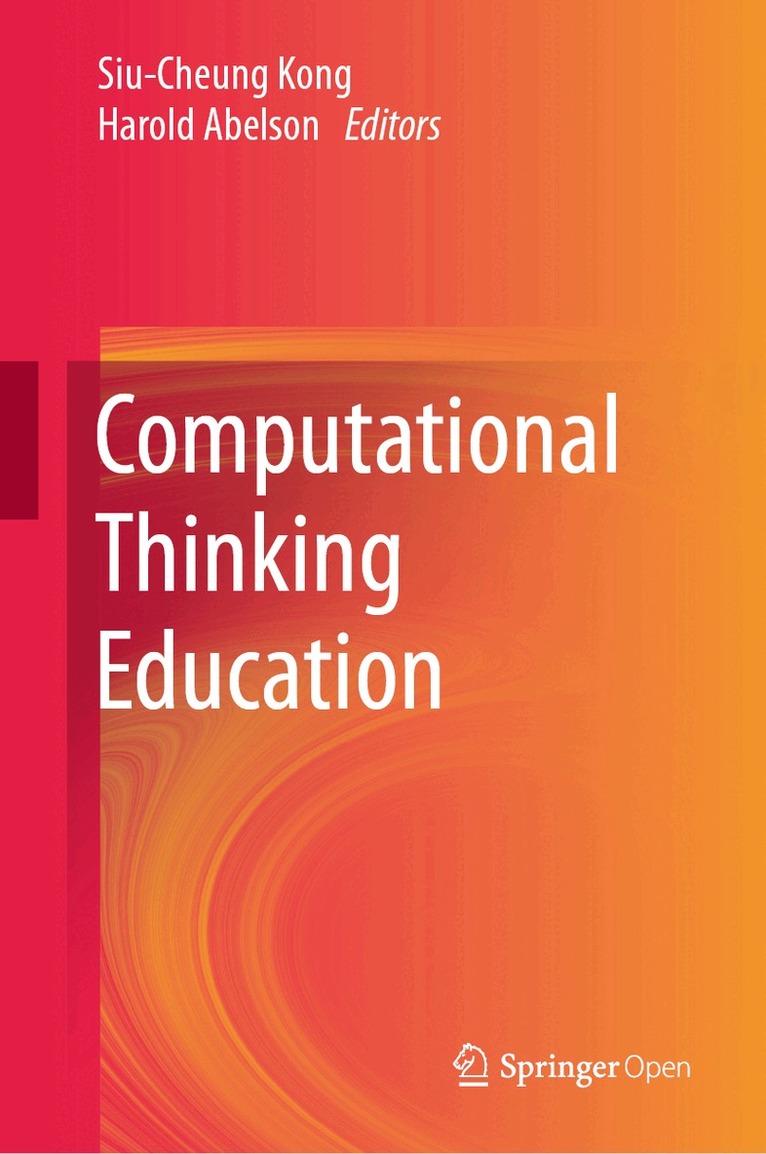
    Computational Thinking Education

    AvSiu-Cheung Kong,Harold Abelson

    Inbunden, Engelska, 2019

    531 kr

    Beställningsvara. Skickas inom 10-15 vardagar. Fri frakt över 249 kr.

    Beskrivning

    This This book is open access under a CC BY 4.0 license.This book offers a comprehensive guide, covering every important aspect of computational thinking education. It provides an in-depth discussion of computational thinking, including the notion of perceiving computational thinking practices as ways of mapping models from the abstraction of data and process structures to natural phenomena. Further, it explores how computational thinking education is implemented in different regions, and how computational thinking is being integrated into subject learning in K-12 education. In closing, it discusses computational thinking from the perspective of STEM education, the use of video games to teach computational thinking, and how computational thinking is helping to transform the quality of the workforce in the textile and apparel industry.

    Produktinformation

    • Utgivningsdatum:2019-08-08
    • Mått:155 x 235 x 27 mm
    • Vikt:752 g
    • Format:Inbunden
    • Språk:Engelska
    • Antal sidor:382
    • Förlag:Springer Verlag, Singapore
    • ISBN:9789811365270

    Utforska kategorier

    • Material och digital teknik i undervisningen inom Psykologi och pedagogik
    • Lärarutbildning inom Psykologi och pedagogik
    • Pedagogisk metodik inom Psykologi och pedagogik

    Mer om författaren

    Kong Siu-Cheung is currently a Professor at the Department of Mathematics and Information Technology, and Director of the Centre for Learning, Teaching and Technology at the Education University of Hong Kong. Prof. Kong holds a doctorate from the City University of Hong Kong and served as President of the Asia-Pacific Society for Computers in Education (2016-2017), following previous terms as President-Elect (2012-2013) and President (2014-2015). He is currently Editor-in-Chief of the international journal Research and Practice in Technology Enhanced Learning, and of the Journal of Computers in Education. In addition, Prof. Kong is currently leading a four-year project (2016 to 2020) on computational thinking education in K-12.  Hal Abelson is a Professor of Electrical Engineering and Computer Science at Massachusetts Institute of Technology, USA. Abelson has a longstanding interest in using computation as a conceptual framework in teaching. He is director of the MIT Appinventor project, used by 8 million people a year, which brings the power of mobile app development to beginners in computing. He directed the first implementation of the Logo computer language for the Apple Computer, which made programming for children widely available on personal computers beginning in 1981. Together with Gerald Sussman, Abelson developed MIT’s introductory computer science subject, Structure and Interpretation of Computer Programs, which is based on the notion that a computer language is primarily a formal medium for expressing ideas about methodology, rather than just a way to get a computer to perform operations. This work, with the help of a popular computer science textbook and video lectures, has since had a global impact on university-level computer science education. Abelson is a founding director of the Free Software Foundation and Public Knowledge, as well as a founding director of Creative Commons.

    Innehållsförteckning

    • 1 Introduction to Computational Thinking Education.- Part I Computational Thinking and Tool Development.- 2 Computational Thinking: More than a Variant of Scientific Inquiry!.- 3 MIT App Inventor: Objectives, Design, and Development.- Part II Student Competency and Assessment.- 4 Measuring Secondary School Students' Competence in Computational Thinking in ICILS 2018: Challenges, Concepts and Potential Implications for School Systems around the World.- 5 Computational Thinking Processes and their Congruence with Problem-Solving and Information-Processing.- 6 Combining Assessment Tools for a Comprehensive Evaluation of Computational Thinking Interventions.- 7 Introducing and Assessing Computational Thinking in the Secondary Science Classroom.- 8 Components and Methods of Evaluating Computational Thinking for Fostering Creative Problem-Solvers in Senior Primary School Education.- Part III Computational Thinking and Programming Education in K-12.- 9 Learning Composite and Prime Numbers through Developing an App: An Example of Computational Thinking Development through Primary Mathematics Learning.- 10 Teaching Computational Thinking using Mathematics Gamification in Computer Science Game Tournaments.- 11 Mathematics Learning: Perceptions towards the Design of a Website based on a Fun Computational Thinking-based Knowledge Management Framework.- Part IV Computational Thinking in K-12 STEM Education and Non-formal Learning.- 12 Defining and Assessing Students' Computational Thinking in a Learning by Modeling Environment.- 13 Roles, Collaboration, and the Development of Computational Thinking in a Robotics Learning Environment.- 14 Video Games: A Potential Vehicle for Teaching Computational Thinking.- 15 Transforming the Quality of Workforce in the Textile and Apparel Industry through Computational Thinking Education.- Part V Teacher and Mentor Development in K-12 Education.- 16 Teaching Computational Thinking with Electronic Textiles: Modeling Iterative Practices and Supporting Personal Projects in Exploring Computer Science.- 17 A Study of Readiness of Implementing Computational Thinking in Compulsory Education in Taiwan.- 18 Self-development through Service-oriented Stress-Adaptation-Growth (SOSAG) Process in the Engagement of Computational Thinking Co-teaching Education.- Part VI Computational Thinking in Educational Policy and Implementation.- 19 Educational Policy and Implementation of Computational Thinking and Programming: Case Study of Singapore.- 20 Teaching-Learning of Computational Thinking in K-12 Schools in India.