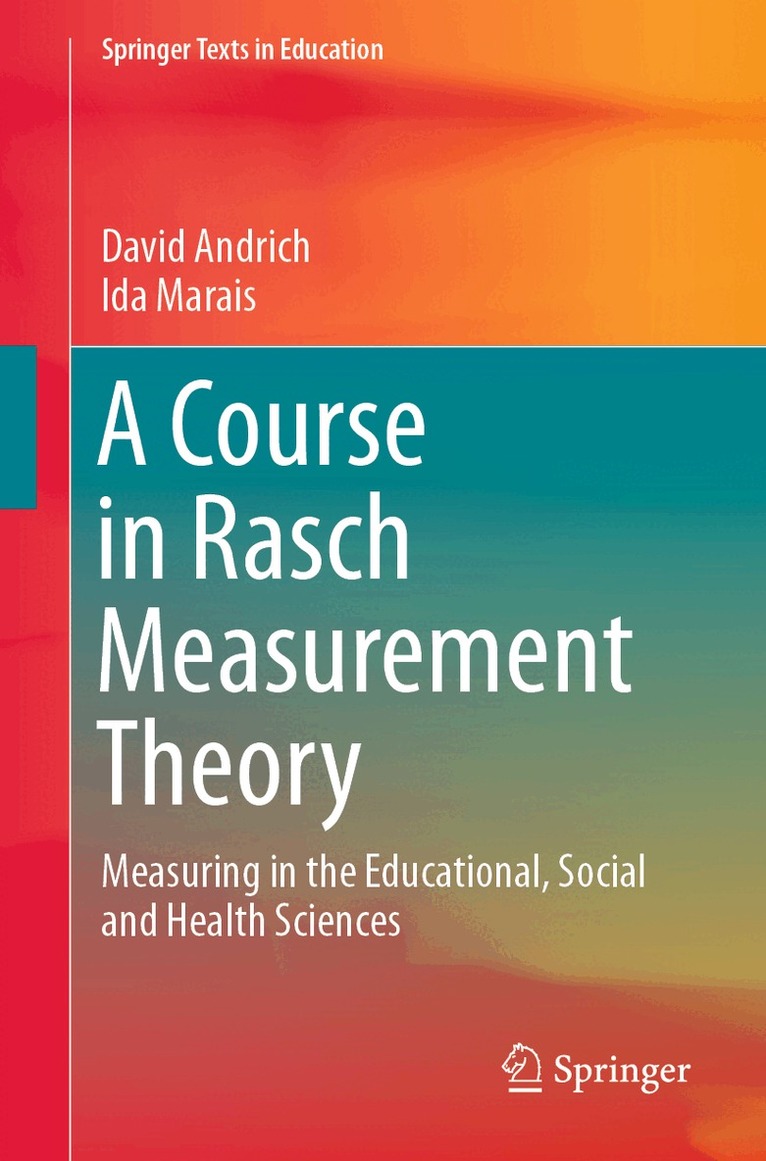
Course in Rasch Measurement Theory
Measuring in the Educational, Social and Health Sciences
Del i serien Springer Texts in Education
616 kr
Beställningsvara. Skickas inom 5-8 vardagar. Fri frakt över 249 kr.
Beskrivning
Produktinformation
- Utgivningsdatum:2019-07-24
- Mått:155 x 235 x 155 mm
- Vikt:765 g
- Format:Häftad
- Språk:Engelska
- Serie:Springer Texts in Education
- Antal sidor:482
- Förlag:Springer Verlag, Singapore
- ISBN:9789811374951
Utforska kategorier
Mer om författaren
David Andrich BSc, BEd (Hons.), MEd (UWA), PhD (Chic) FASSA completed degrees in Mathematics and Education before receiving a Fulbright Award for PhD study at the University of Chicago, USA, where his dissertation earned the Susan Colver Rosenberger prize for Social Sciences in 1973. He took on a position at The University of Western Australia, and in 1985 was appointed a Professor of Education at Murdoch University in Western Australia, where he also served as Dean for two terms. In 2007 he returned to The University of Western Australia as the Chapple Professor of Education. He is currently a Visiting Professor of Educational Assessment at the University of Oxford. He has held research grants from the Australian Research Council continuously since 1985 and has conducted commissioned research at the national and state levels. He was elected a Fellow of the Academy of Social Sciences of Australia for his contributions to social measurement. He is especially known for his contributions to Rasch measurement theory, where his work has ranged from the philosophy of measurement, through model exposition and interpretation, to software development. He is the author of Rasch Models for Measurement (Sage).Ida Marais BSc, (North-West), MSc, PhD (Auckland) is a Senior Research Fellow at the Graduate School of Education’s Psychometric Laboratory at The University of Western Australia. After graduating with a degree in Computer Science and Psychology, she worked as a computer analyst / programmer for a number of years before being awarded a University of Auckland doctoral scholarship and completing her MSc and PhD in Cognitive Psychology. Since then she has been a researcher and lecturer in the fields of Psychology, Health and Education in New Zealand and Australia. Her research activities focus on psychological and educational measurement, especially the measurement of change over time. Using simulation software she developed, she also studies the effects on estimates of data that violate the Rasch model.
Innehållsförteckning
- PART A: General principles and the dichotomous Rasch model.- Chapter 1: The idea of measurement.- Chapter 2: Constructing instruments to achieve measurement.- Chapter 3: Classical test theory (CTT).- Chapter 4: Reliability and validity in CTT.- Chapter 5: The Guttman structure and analysis of responses.- Chapter 6: The dichotomous Rasch model - The simplest modern test theory model.- Chapter 7: Invariance of comparisons - Separation of person and item parameters.- Chapter 8: Sufficiency - The significance of total scores.- Chapter 9: Estimating item difficulty.- Chapter 10: Estimating person proficiency and person separation.- Chapter 11: Equating - Linking instruments through common items.- Chapter 12: Comparisons and contrasts between CTT and Rasch measurement theory (RMT).- PART B: The dichotomous Rasch model: Fit of responses to the model.- Chapter 13: Fit of responses to the model I - Item characteristic curve and Chi-square tests of fit.- Chapter 14: Violations of the assumption of independence I - Multidimensionality and response dependence.- Chapter 15: Fit of responses to the model II - Analysis of residuals and general principles.- Chapter 16: Fit of responses to the model III - Differential item functioning.- Chapter 17: Fit of responses to the model IV - Guessing.- Chapter 18: Other models of modern test theory for dichotomous responses.- Chapter 19: Comparisons and contrasts between item response theory (IRT) and RMT.- PART C: Extending the dichotomous Rasch model: The polytomous Rasch model.- Chapter 20: The polytomous Rasch model I.- Chapter 21: The polytomous Rasch model II.- Chapter 21: The polytomous Rasch model II.- Chapter 21: The polytomous Rasch model II.- Chapter 24: Violations of the assumption of independence II – The polytomous Rasch model.- Part D: Theoretical justifications and further elaborations.- Chapter 25: Derivation of CTT equations and coefficient α.- Chapter 26: Analysis of more than two facets and repeated measures.- Chapter 27: Derivation of the threshold form of the polytomous Rasch model.- Chapter 28: Non-Rasch measurement models for ordered response categories.- Chapter 29: Review of principles of test analysis using Rasch measurement theory.- Part E: RUMM2030 Exercises.- Exercise 1: Interpretation of RUMM2030 printout.- Exercise 2: Basic analysis of dichotomous and polytomous responses.- Exercise 3: Advanced analysis of dichotomous responses.- Exercise 4: Advanced analysis of polytomous responses.- Exercise 5: Analysis of data with differential item functioning.- Exercise 6: Analysis of data with dependence.- Exercise 7: Analysis of more than two facets and repeated measurements.- Exercise 8: Writing up a Rasch model analysis.- Part F: Statistics Reviews.- Statistics Review 1: Sigma notation, mean, and variance.- Statistics Review 2: Normal distribution.- Statistics Review 3: Covariance and the variance of the sum of two variables.- Statistics Review 4: Regression and correlation.- Statistics Review 5: Probability.- Statistics Review 6: Indices.- Statistics Review 7: Logarithms.- Statistics Review 8: Conditional probability.- Statistics Review 9: Independence.- Statistics Review 10: Bernoulli and Binomial variables.- Statistics Review 11: The Chi-square distribution and test.- Statistics Review 12: Analysis of variance (ANOVA).- Statistics Review 13: Distribution theory.- Statistics Review 14: Basic distributions for tests of fit.- Statistics Review 15: Odds and ratios.
Mer från samma författare
Rasch Meta-Metres of Growth for Some Intelligence and Attainment Tests
David Andrich, Ida Marais, Sonia Sappl
1 484 kr
Rasch Meta-Metres of Growth for Some Intelligence and Attainment Tests
David Andrich, Ida Marais, Sonia Sappl
1 484 kr
Mer från samma serie
Understanding Analysis and its Connections to Secondary Mathematics Teaching
Nicholas H. Wasserman, Timothy Fukawa-Connelly, Keith Weber, Juan Pablo Mejía Ramos, Stephen Abbott
776 kr
Mathematical Modelling for Teachers
Jürgen Maaß, Niamh O’Meara, Patrick Johnson, John O’Donoghue
798 kr
Collaboration in Designing a Pedagogical Approach in Information Literacy
Ane Landøy, Daniela Popa, Angela Repanovici
519 kr
Developing Deep Knowledge in Middle School Mathematics
Sergei Abramovich, Michael L. Connell
1 032 kr
Research Questions in Language Education and Applied Linguistics
Hassan Mohebbi, Christine Coombe
827 kr
Disciplinary Literacy and Gamified Learning in Elementary Classrooms
Leslie Haas, Michelle Metzger, Jill T. Tussey
622 kr
Du kanske också är intresserad av
Rasch Meta-Metres of Growth for Some Intelligence and Attainment Tests
David Andrich, Ida Marais, Sonia Sappl
1 484 kr
Rasch Meta-Metres of Growth for Some Intelligence and Attainment Tests
David Andrich, Ida Marais, Sonia Sappl
1 484 kr
- Signerad!
- Nyhet
Hjärnans akilleshälar : hur din hjärna lurar dig, och vad du kan göra åt det
Anders Hansen
289 kr
- -30%
- Signerad!
- Signerad!
- Nyhet
- Nyhet