
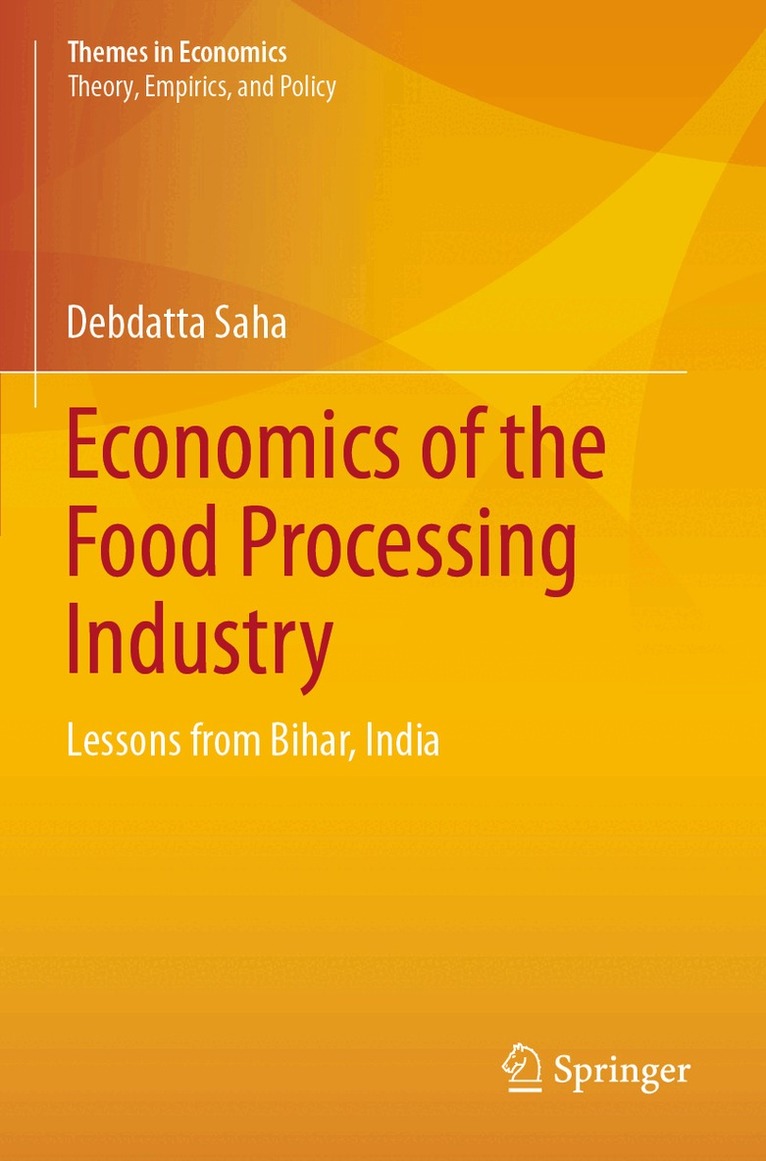
Economics of the Food Processing Industry
Lessons from Bihar, India
E-bok
Engelska, 20201 427 kr
Läs direkt i Bokus Reader – eller ladda ned till din enhet
Fler format och utgåvor
Beskrivning
This book presents a wealth of perspectives on studying the manufacturing end of food processing industries, with a special focus on regions with a low industrial base and multiple missing markets, institutional finance being the most prominent example. Positioning food processing within the industrial ecosystem, which includes entrepreneurs, policymakers, business consultants and associations, the study first considers three different trajectories: for developed economies, for national territories like India, and for sub-national regions like Bihar. In turn, it shows how these trajectories intertwine in two dimensions: the region and the sub-sector. Successfully completing food-processing projects in any of these trajectories requires the identification and development of appropriate product networks that link basic processed items with advanced ones through a chain of value addition.
Moreover, the supply-side narrative presented here identifies two types of costs: physical and non-physical costs of operation. For trajectories with skewed firm sizes (“missing middle”) and missing markets, which can be found in Bihar, the latter costs matter just as much as the former in terms of entrepreneurship. While efficiency in operations is studied for selected sub-sectors in Bihar’s food processing to assess the main sources of inefficiency in minimizing the physical costs of operations, non-physical costs are studied using the construct of region-based counterfactual thinking (rCFT) and its relationship with the perception of risk for entrepreneurs. rCFT offers a new concept for understanding the mindset of the entrepreneur, in which the regional identity plays a significant role.
The empirical content is based on a primary survey of food processing in Bihar. Additional policy questions, such as the choice between spatial collocation of food parks or cluster-based development of unique sub-sectors, are explored through an analysis of the policy network that supports entrepreneurship. Issues arising from the government’s policy choices, particularly vertically targeted industrial policies, can influence industrial outcomes and are particularly relevant for regions like Bihar. While policy evaluation for Bihar’s processed food industry yields insights on policy targeting for decision-makers in the government, examples of parallel narratives from global experiences in comparable regions shed new light on industrial development in processed food, which should be of interest to business practitioners, academic researchers and policymakers alike.
Produktinformation
Utforska kategorier
Hoppa över listan








Du kanske också är intresserad av
- Signerad!
Del 3
- Nyhet
Del 11
- Nyhet
- Nyhet
- -30%
- Nyhet
- -15%
Domino : Dåren, domaren och den välkammade mannen från pirayaministeriet
Håkan Nesser
Inbunden, 2026
220 kr259 kr