• Fri frakt över 249 kr
  • •
  • Snabba leveranser
  • •
  • Billiga böcker
Kundservice

Du är på sajten för privatpersoner.

Företag, bibliotek eller offentlig verksamhet?

Du handlar på classic.bokus.com, där alla dina funktioner finns intakta.
Till classic.bokus.com
Bokus logotyp. Gå till startsidan.
  • Erbjudanden
  • Nyheter
  • Student
  • Topplistor
  • Barn & ungdom
  • Bokus Play
  • E-böcker
  • Pocketböcker
  • Spel & pussel

Må bättre, för mindre! Upp till 50% rabatt på hälsoböcker

Sidfot

Mina sidor

    Hjälp

    • Kundservice
    • Vanliga frågor och svar
    • Frakt och leverans
    • Retur vid ångerrätt
    • Reklamera vara
    • Betalning
    • Köpvillkor
    • Allmänna villkor
    • Information om webbplatsens tillgänglighet

    Om Bokus

    • Om oss
    • Pressrum
    • För studenter
    • För företag
    • För bibliotek och offentlig verksamhet
    • För leverantörer
    • Hållbarhet

    Populärt

    • Aktuella erbjudanden
    • Presentkort
    • Studentlitteratur
    • Nya böcker
    • Topplistor
    • Signerade böcker
    • Engelska böcker

    Inspiration

    • Boktips
    • BookTok
    • Populära bokserier
    • Barnbokskaraktärer
    • Populära författare
    Logotyp för Bokus
    Följ oss på Facebook (extern länk)Följ oss på Instagram (extern länk)Följ oss på YouTube (extern länk)Följ oss på TikTok (extern länk)
    bokus @ CookiesAnpassa cookiesIntegritetspolicyKöpvillkor
    Till Citymail hemsida (extern länk)Till Budbee hemsida (extern länk)Till Postnord hemsida (extern länk)Till Schenker hemsida (extern länk)Till Early Bird hemsida (extern länk)Till Walleys hemsida (extern länk)
    1. Samhälle och politik
    2. Samhälle och kultur
    3. Kultur och medier
    4. Referensverk och tvärvetenskap

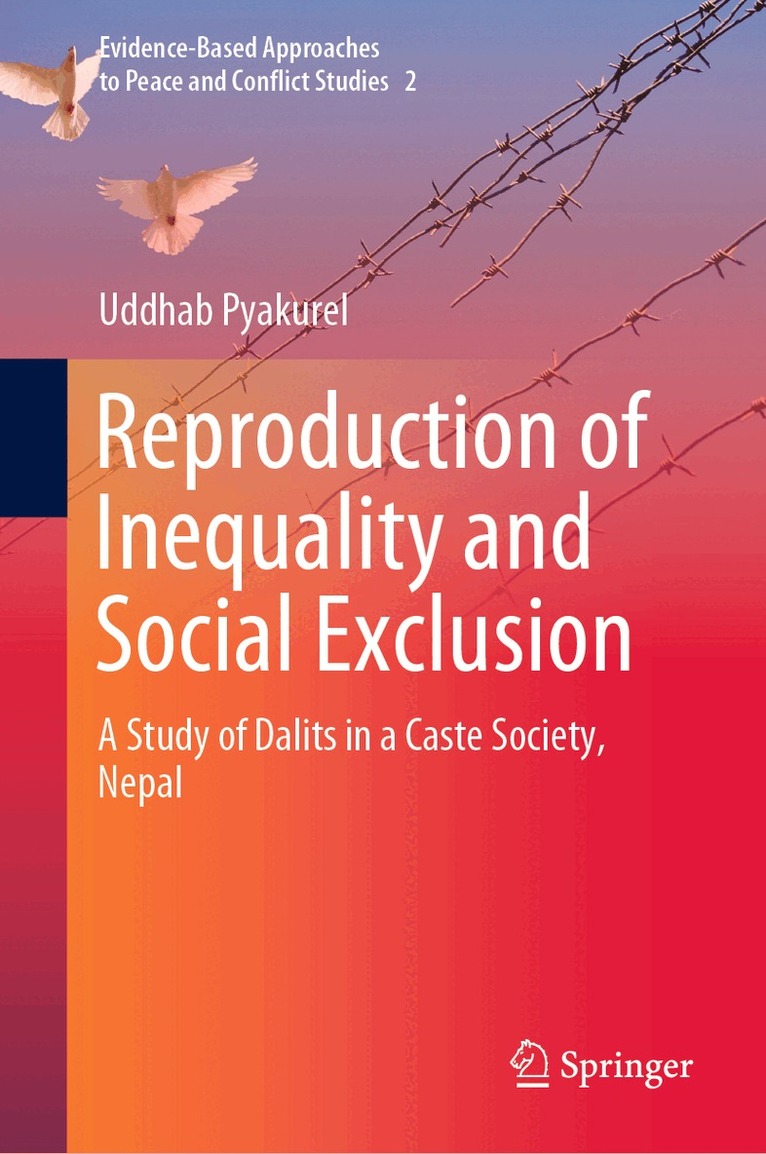
    Reproduction of Inequality and Social Exclusion

    A Study of Dalits in a Caste Society, Nepal

    AvUddhab Pyakurel

    Inbunden, Engelska, 2021

    Del 2 i serien Evidence-Based Approaches to Peace and Conflict Studies

    1 119 kr

    Beställningsvara. Skickas inom 10-15 vardagar. Fri frakt över 249 kr.

    Fler format och utgåvor

    E-bok

    1 455 kr

    Häftad

    1 119 kr

    Beskrivning

    This book is a detailed account of how hierarchy has been maintained historically by the Nepali state, affirming the uniqueness of a caste-based social order by bringing outsiders, especially ethnic groups and religious minorities, into the caste fold. Focusing on the contemporary state of Dalits, the community that was and is put at the bottom of a very hierarchical social order in Nepal, the author argues that the traditional caste-based social order is still prevalent in the “new” Nepal even after the recent socio-political and constitutional changes. Illustrated by scientifically employed and interpreted data mainly in the three sectors of  education, politics and employment, the book postulates that people who were and are born into the “high caste” still have more access to the resources and opportunities available in society in comparison with those born into the “lower” caste. It further argues that although reservation policies are in place to address social exclusion, these could not bring expected outcomes mainly due to the lack of engagement, if not ignorance, of both dominant groups and the community in the margin. The absence of clarity among political actors on the positive discrimination and affirmative actions has contributed to backtracking the recently created space in line with “inclusive Nepal”.

    Produktinformation

    • Utgivningsdatum:2021-01-06
    • Mått:155 x 235 x 19 mm
    • Vikt:448 g
    • Format:Inbunden
    • Språk:Engelska
    • Serie:Evidence-Based Approaches to Peace and Conflict Studies
    • Antal sidor:183
    • Förlag:Springer Verlag, Singapore
    • ISBN:9789811589072

    Utforska kategorier

    • Referensverk och tvärvetenskap inom Samhälle och politik
    • Asiens historia inom Historia och arkeologi
    • Sociala grupper och identitet inom Samhälle och politik

    Mer om författaren

    Uddhab Pyakurel currently teaches political sociology while heading the Department of Development Studies at the School of Arts, Kathmandu University, Nepal. He completed his master’s degree in political science and sociology from Tribhuvan University, joined the Delhi School of Economics (University of Delhi) to pursue an M. Phil, and earned a Ph.D. from Jawaharlal Nehru University, New Delhi. Pyakurel, who has been an adjunct fellow at the School of Social Sciences and Psychology, Western Sydney University of Australia, is also associated with various democracy forums including South Asian Dialogues on Ecological Democracy (SADED), Vasudhaiva Kutumbakam (VK), and the Network Institute for Global Democratization (NIGD). He often writes op-ed articles for local newspapers as part of his campaign for ‘public sociology’ and also engages in general academic articles and book chapters on poverty, people’s participation, social inclusion/exclusion, conflict, identity, democracy, elections, Nepal's foreign relations and other socio-political issues of Nepal and Asia. In addition, he is the author of the book Maoist Movement in Nepal: A Sociological Perspective (New Delhi: Adroit Publishers, 2007); co-author of three books: Nepal–India Open Border: Problems and Prospects (New Delhi: Vij Books, 2016), Dalit Representation in National Politics of Nepal (Kathmandu: NNDSWO, 2012) and State of Conflict and Democratic Movement in Nepal (New Delhi: Vij Books, 2013). Additionally, he is the editor of three books: Contemporary Nepal (Delhi: Kalinga Publications, 2012), Higher Education in Nepal: Inclusive Policy Guidelines (Lalitpur: School of Arts, Kathmandu University and SNV-Nepal, 2014), and Samajbad, Sambridhi Ra Bikas (Socialism, Prosperity and Development) (Kathmandu: Sangri-la Books, 2020). He also serves as the editor of the Nepali Journal of Contemporary Studies.

    Innehållsförteckning

    • Preface.- Chapter 1 Defining Dalits in a Nepali Context.- Chapter 2 Dalits and Exclusion in Education.- Chapter 3 Work, Employment and Social Exclusion of Dalits.- Chapter 4 Politics, Decision-Making and Dalits in Nepal.- Chapter 5 Conclusion.- References.- Index.