• Fri frakt över 249 kr
  • •
  • Snabba leveranser
  • •
  • Billiga böcker
Kundservice

Du är på sajten för privatpersoner.

Företag, bibliotek eller offentlig verksamhet?

Du handlar på classic.bokus.com, där alla dina funktioner finns intakta.
Till classic.bokus.com
Bokus logotyp. Gå till startsidan.
  • Erbjudanden
  • Student
  • Topplistor
  • Barn & ungdom
  • Bokus Play
  • E-böcker
  • Ljudböcker
  • Pocketböcker
  • Spel och pussel

5% studentrabatt – använd koden KURSBOK27 →

Sidfot

Mina sidor

    Hjälp

    • Kundservice
    • Vanliga frågor och svar
    • Frakt och leverans
    • Retur vid ångerrätt
    • Reklamera vara
    • Betalning
    • Köpvillkor
    • Allmänna villkor
    • Information om webbplatsens tillgänglighet

    Om Bokus

    • Om oss
    • Pressrum
    • För studenter
    • För företag
    • För bibliotek och offentlig verksamhet
    • För leverantörer
    • Hållbarhet

    Populärt

    • Aktuella erbjudanden
    • Presentkort
    • Studentlitteratur
    • Nya böcker
    • Topplistor
    • Signerade böcker
    • Engelska böcker

    Inspiration

    • Boktips
    • BookTok
    • Barnbokskaraktärer
    • Populära författare
    Logotyp för Bokus
    Följ oss på Facebook (extern länk)Följ oss på Instagram (extern länk)Följ oss på YouTube (extern länk)Följ oss på TikTok (extern länk)
    bokus @ CookiesAnpassa cookiesIntegritetspolicyKöpvillkor
    Till Citymail hemsida (extern länk)Till Budbee hemsida (extern länk)Till Postnord hemsida (extern länk)Till Schenker hemsida (extern länk)Till Early Bird hemsida (extern länk)Till Walleys hemsida (extern länk)
    1. Naturvetenskap och teknik
    2. Geovetenskap
    3. Miljövetenskap och miljöpolitik

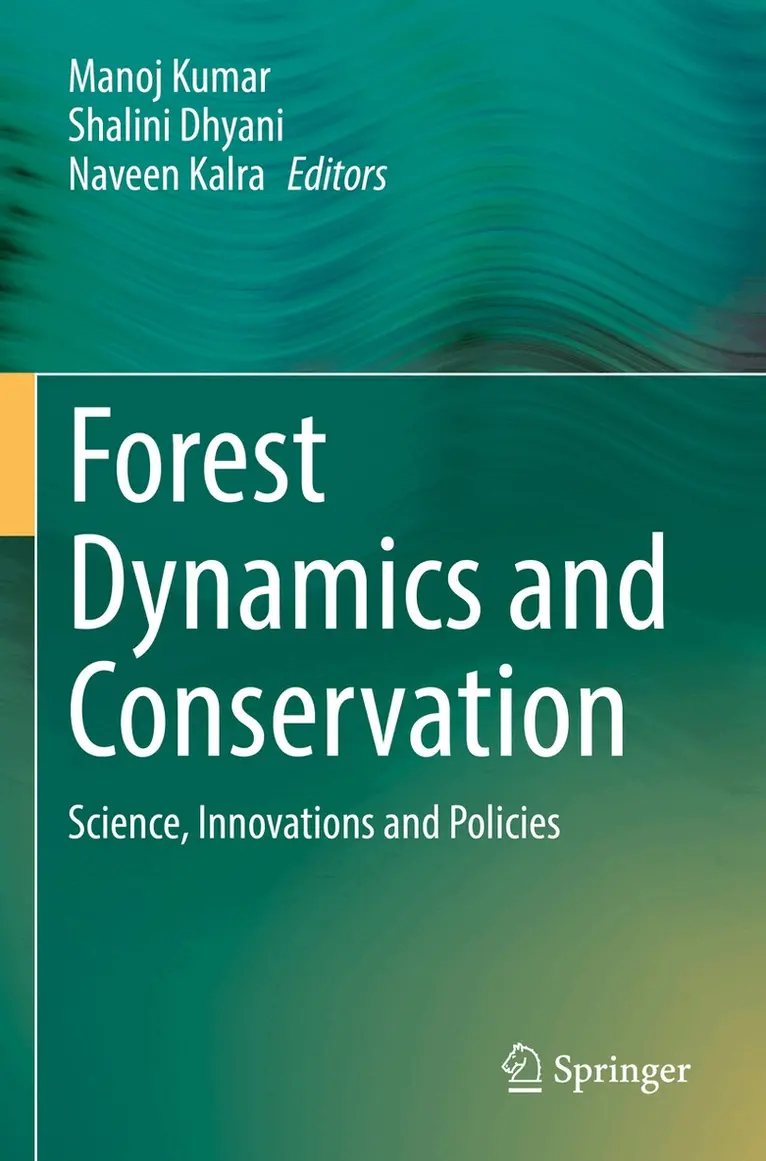
    Forest Dynamics and Conservation

    Science, Innovations and Policies

    AvManoj Kumar,Shalini Dhyani

    Häftad, Engelska, 2023

    1 404 kr

    Beställningsvara. Skickas inom 10-15 vardagar. Fri frakt över 249 kr.

    Beskrivning

    This book unveils forestry science and its policy and management that connect past and present understanding of forests. The aggregated knowledge is presented to cover the approaches adopted in studying forest structure, its growth, functioning, and degradation, especially in the context of the surrounding environment. The application of advance computation, instrumentation, and modelling has been elaborated in various chapters.Forest ecosystems are rapidly changing due to forest fires, deforestation, urbanization, climate change, and other natural and anthropogenic drivers. Understanding the dynamics of forest ecosystems requires contemporary methods and measures, utilizing modern tools and big data for developing effective conservation plans. The book also covers discussion on policies for sustainable forestry, agroforestry, environmental governance, socio-ecology, nature-based solutions, and management implication.  It is suitable for a wide range of readers working in the field of scientific forestry, policy making, and forest management. In addition, it is a useful material for postgraduate and research students of forestry sciences.

    Produktinformation

    • Utgivningsdatum:2023-05-18
    • Mått:155 x 235 x 28 mm
    • Vikt:762 g
    • Format:Häftad
    • Språk:Engelska
    • Antal sidor:480
    • Förlag:Springer Verlag, Singapore
    • ISBN:9789811900730

    Utforska kategorier

    • Miljövetenskap och miljöpolitik inom Naturvetenskap och teknik
    • Biovetenskap inom Naturvetenskap och teknik
    • Skogsbruk inom Naturvetenskap och teknik

    Mer om författaren

    Dr. Manoj KumarDr. Manoj Kumar is scientist and Incharge of the GIS center at Forest Research Institute (FRI), Dehradun, India. Dr. Kumar primarily works in the field of forestry, environment, climate change, and related interdisciplinary fields with wider applications of information technology, remote sensing, and GIS tools. He has research experience of more than 15 years. He has initiated work on developing forest growth simulation models to study the functional relationship of forests with the surrounding environment, which could be used for climate change impact studies. He has successfully implemented more than 20 research projects funded by national and international agencies.Dr. Shalini DhyaniDr. Shalini Dhyani is a senior scientist with the Critical Zone Research Group of Water Technology and Management Division at CSIR-NEERI, India. She is the South Asia regional chair for IUCN CEM (Commission on Ecosystems Management) and alsoserves as the lead author for IPBES assessment on Sustainable Use of Wild Species (2018–21). She is a skilled ecologist with more than 17 years of strong experience in forest ecology, climate change impact on forests, nature-based solutions, and eco-restoration. She received the first “IUCN-CEM Chair Young Professional Award” for her excellent research and publications on forests of the Himalayas. Dr. Naveen Kalra Dr. Naveen Kalra worked as a Scientist with the Indian Agricultural Research Institute (IARI), Delhi, for almost 40 years. He is now actively engaged in developing growth models for yield forecasting in the California growing region working with the University of Waterloo, Ontario, Canada. He was instrumental in initiating simulation and advance computing for the agriculture and forestry sector in India. He primarily works in the broader domains of soil physics, soil and water conservation, climate change and its variability, climate change impact assessment for agriculture and forestry sectors, simulation modelling, and machine learning applications.

    Innehållsförteckning

    • Chapter 1. Protecting forest structure and functions for resilience and sustainability concerns in the changing world.- Chapter 2. Understanding the drivers of forest degradation.- Chapter 3. The so-called modern ‘sustainable forestry’ destroys wilderness, old-growth forest landscapes and ecological services world-wide: A short first-hand review and global narrative on the use of ‘growth-and-yield’ as a destructive and even impossible goal.- Chapter 4. Gangetic Plains of India: High on the water and air pollution map.- Chapter 5. Understanding wildfires and designing a sustainable future by solutions based on forest-society relationships.- Chapter 6. Is the gender agenda of Nepal’s Community Forestry at risk due to commercial transitions.- Chapter 7. Diversity of forest genes: Impacts on the structure and function of soil ecosystems under changing climate.- Chapter 8. Plant-herbivorous insect interactions in forest ecosystems: overview and perspectives to mitigate losses.- Chapter 9. Beyond the biophysical: contribution of community forestry in building socio-ecological resilience.- Chapter 10. Biodiversity and Biomass Carbon Dynamics: Insights from Long-Term Monitoring in the Western Ghats.- Chapter 11. Peri-urban protected forests in peril: Insights from case studies in two Indian megacities.- Chapter 12. Mapping the extent of invasive species – An assessment based on high-resolution data for selected species in parts of Eastern Himalaya in Sikkim.- Chapter 13. Groundwater Dependent Vegetation to address the loss of ecosystems dependent on groundwater resources.- Chapter 14. Groundwater Dependent Vegetation to address the loss of ecosystems dependent on groundwater resources.- Chapter 15. Application of dynamic vegetation models for climate change impact studies.- Chapter 16. Agroforestry approaches in the restoration of peatland landscapes in Central Kalimantan, Indonesia.- Chapter 17. SmarteR approach for the mapping of invasive plant species.- Chapter 18. Mapping and identification of trees using semantic segmentation deep learning neural network.- Chapter 19. Application of biophysical, soil, and vegetation indices to better understand forest dynamics and develop strategies for forest conservation.- Chapter 20. Emission Reductions Program for Addressing Drivers of Deforestation and Forest Degradation: An insight from the Terai Arc Landscape in Southern Nepal.- Chapter 21. Public Interests and Private Incentives in Designing an Ecological Payment Systems.- Chapter 22. Awareness and conservation program at an ecotourism site in Langkawi Island, Malaysia.