• Fri frakt över 249 kr
  • •
  • Snabba leveranser
  • •
  • Billiga böcker
Kundservice

Du är på sajten för privatpersoner.

Företag, bibliotek eller offentlig verksamhet?

Du handlar på classic.bokus.com, där alla dina funktioner finns intakta.
Till classic.bokus.com
Bokus logotyp. Gå till startsidan.
  • Erbjudanden
  • Nyheter
  • Student
  • Topplistor
  • Barn & ungdom
  • Bokus Play
  • E-böcker
  • Pocketböcker
  • Spel & pussel

10% rabatt på allt med kod: NYSTART10 →

Sidfot

Mina sidor

    Hjälp

    • Kundservice
    • Vanliga frågor och svar
    • Frakt och leverans
    • Retur vid ångerrätt
    • Reklamera vara
    • Betalning
    • Köpvillkor
    • Allmänna villkor
    • Information om webbplatsens tillgänglighet

    Om Bokus

    • Om oss
    • Pressrum
    • För studenter
    • För företag
    • För bibliotek och offentlig verksamhet
    • För leverantörer
    • Hållbarhet

    Populärt

    • Aktuella erbjudanden
    • Presentkort
    • Studentlitteratur
    • Nya böcker
    • Topplistor
    • Signerade böcker
    • Engelska böcker

    Inspiration

    • Boktips
    • BookTok
    • Populära bokserier
    • Barnbokskaraktärer
    • Populära författare
    Logotyp för Bokus
    Följ oss på Facebook (extern länk)Följ oss på Instagram (extern länk)Följ oss på YouTube (extern länk)Följ oss på TikTok (extern länk)
    bokus @ CookiesAnpassa cookiesIntegritetspolicyKöpvillkor
    Till Citymail hemsida (extern länk)Till Budbee hemsida (extern länk)Till Postnord hemsida (extern länk)Till Schenker hemsida (extern länk)Till Early Bird hemsida (extern länk)Till Walleys hemsida (extern länk)
    1. Naturvetenskap och teknik
    2. Matematik och naturvetenskap
    3. Biologi
    4. Biovetenskap

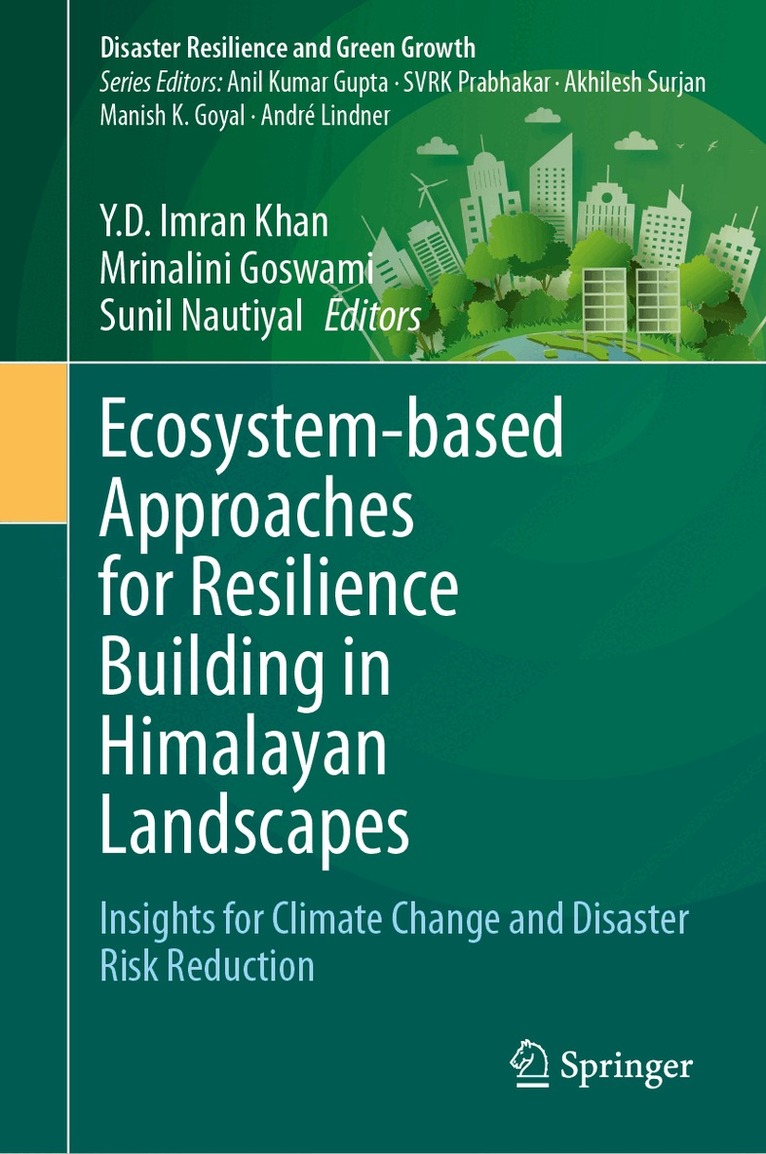
    Ecosystem-based Approaches for Resilience Building in Himalayan Landscapes

    Insights for Climate Change and Disaster Risk Reduction

    AvY.D. Imran Khan,Mrinalini Goswami

    Inbunden, Engelska, 2025

    Del i serien Disaster Resilience and Green Growth

    2 165 kr

    Beställningsvara. Skickas inom 5-8 vardagar. Fri frakt över 249 kr.

    Beskrivning

    This contributed volume offers a comprehensive exploration of ecosystem-based approach for resilience building in the ecosystems of the Himalayan landscape in the context of climate change and disaster risk reduction.The Himalayan region is highly susceptible to the adverse impacts of climate change, including melting glaciers, unpredictable weather patterns, and increased natural disasters, which pose a significant threat to both the environment and the communities residing in these sensitive landscapes. In this book, we delve into the critical topics of Ecosystem-based Adaptation (EbA) and its importance in addressing these climate-related challenges. By bridging the gap between climate change mitigation and disaster risk reduction, this book provides innovative strategies, case studies, and solutions that empower policymakers, researchers, environmentalists, and practitioners in the region. It offers a roadmap for sustainable, ecosystem-focused approaches to tackle the increasing risks and vulnerabilities faced by the Himalayan communities.The book is an interesting read for researchers and practitioners committed to mitigating the effects of climate change, conserving biodiversity, and reducing disaster risks in the Himalayan region. This book is going to serve as indispensable resource for professionals and enthusiasts alike who are dedicated to safeguarding the unique and important Himalayan ecosystems, and the well-being of the communities residing in this magnificent landscape.

    Produktinformation

    • Utgivningsdatum:2025-11-05
    • Mått:155 x 235 x 31 mm
    • Vikt:861 g
    • Format:Inbunden
    • Språk:Engelska
    • Serie:Disaster Resilience and Green Growth
    • Antal sidor:436
    • Förlag:Springer Verlag, Singapore
    • ISBN:9789819520060

    Utforska kategorier

    • Biovetenskap inom Naturvetenskap och teknik
    • Meteorologi och klimatologi inom Naturvetenskap och teknik
    • Miljövetenskap och miljöpolitik inom Naturvetenskap och teknik

    Mer om författaren

    Dr. Y.D. Imran KhanY.D. Imran Khan is a Programme Manager and Thematic Lead (Ecology) at the WOTR-Centre for Resilience Studies (W-CReS), Watershed Organisation Trust (WOTR) in Pune, India. He holds a Ph.D. in Zoology (with a specialisation in Ecology) from Bangalore University, Bengaluru, and an M.Sc. in Zoology from Sri Krishnadevaraya University, Anantapur. Before joining WOTR, Dr. Khan worked at the Institute for Social and Economic Change (ISEC) in Bengaluru, the National Institute of Rural Development and Panchayati Raj (NIRD&PR) in Hyderabad, and the Tata Institute of Social Sciences (TISS) in Mumbai. His areas of interest include conservation biology, socio-ecology, rural livelihoods, and watershed Ecology. Dr. Khan collaborates with interdisciplinary and transdisciplinary teams of scholars from various national and international organisations to integrate ecological and social science approaches in assessing the impact of policy and behavioural changes.Dr. Mrinalini GoswamiMrinalini Goswami is a researcher in Sustainability Science. She received her Ph.D. in Environmental Science for her research on sustainability of ecosystem-based livelihoods in peri-urban landscapes. She has been engaged in research on varied topics, including environmental sustainability, climate change, natural resource management, water management, and urban development. Dr. Goswami has published scientific papers/articles and books in the field of socio-ecology, environment and ecology. Dr. Goswami also has substantial work experience in the development sector, which has motivated her towards interdisciplinary approach in environmental research.Prof. Sunil NautiyalSunil Nautiyal (AvHF, JSPSF, ZF, FNIE) is a Professor at the Centre for Ecological Economics and Natural Resources (CEENR) at the Institute for Social and Economic Change (ISEC) in Bengaluru. He is also an Honorary Professor at the University of Ladakh. Previously, Dr. Nautiyal served as the Director of the GB Pant National Institute of Himalayan Environment (NIHE) in Almora, Uttarakhand, India.  His areas of specialization include Natural Resource Management and Conservation, Socioeconomic and Ecological Approaches for Sustainable Development, Production System Analysis, Protected Area Management and Human-Wildlife Conflict, Land Use and Land Cover Change Analysis, Sustainable Livelihood Development, Ecological Modelling, GIS and Remote Sensing for Landscape Research, Urban-Rural Interface and Sustainability, Climate Change, and Socio-Ecological Development (as a Socio-Ecologist). Dr. Nautiyal has published over 250 scientific papers and articles, as well as 15 books. He has received several prestigious national and international fellowships and awards. Additionally, he serves on the editorial board of the journals and is a reviewer for more than 70 national and international journals.

    Innehållsförteckning

    • Part I. Climate Change Impacts and Ecosystem Dynamics.- Chapter 1. Cryosphere response to climate change and disaster risk reduction in the arid Northwestern Ladakh Himalaya.- Chapter 2. Climate Change Impacts on Himalayan Agriculture.- Chapter 3. Ecology and Economy of Himalayan Pastoralism: Evidence from Changpa Community from Changthang Region, Ladakh.- Chapter 4. Landscape dynamics and expansion of Himalayan birch (Betula utilis D.Don) in timberline ecotone of Nanda Devi Biosphere Reserve, western Himalaya.- Chapter 5. Landslide susceptibility analysis of the Chhota Rangit river basin of Darjeeling Himalaya by using the Analytical hierarchy process (AHP) model.- Chapter 6. Assessment of Spatio-temporal Variation of Vegetation and Its Relationship with Precipitation and Temperature in a Changing Climate in Nepal Mountain Ecosystems.- Chapter 7. Current and Future possible potentiality of Rauvolfia serpentina an IUCN listed endangered species using Maxent modeling.- PART II. Traditional Practices, Local Knowledge and Adaptation Strategies.- Chapter 8. People’s Perceptions, Practices, and Traditional Knowledge on Climate Change in Meghalaya.- Chapter 9. Jhum Practices for Livelihood in North Eastern Himalayan Regions of India: Current Status, Challenges and Future Direction.- Chapter 10. Cultural Wisdom in Environmental Stewardship: Kashmir’s Traditional Practices.- Chapter 11. Livelihood sustainability and pastoralism: Challenges and adaptation of Gaddis of Himalayas.- Chapter 12. An ecosystem-based assessment of resilient traditional restoration practices towards biodiversity conservation and ecosystem restoration in High altitudes of Darma Valley in Uttarakhand Himalayan region.- PART III. Ecosystem-based Approaches and Resilience Building.- Chapter 13. Ecosystem-based Adaptation: Concepts, Principles and Case Studies from Mountainous and Hilly Ecosystems of the World.- Chapter 14. Translational Dynamics of social-ecological Management System of Community Forestry: prospects for ecosystem-based Adaptation in community-managed Forests of Uttarakhand.- Chapter 15. Computing Payment of water as an ecosystem service – Valuation and management practices in Western Himalaya, Uttarakhand, India.- Chapter 16. Protected areas and Ecotourism in the Transboundary Landscape of Khangchendzonga: Needs, Opportunities, and Impacts.- Chapter 17. Evaluating the Relationship of Ecosystem Provisioning Services with the Socioeconomic Attributes Along an Altitudinal Gradient in the Western Himalayas, India.- Chapter 18. Strengthening Springshed Management through Nature-based Solutions: The potential of spring Revival.- Chapter 19. Disaster Risk Reduction in the Indian Himalayas – Strategies for Mitigating Impacts of Natural Disasters.- Chapter 20. The Effectiveness of Disaster Management Plans and Strategies at the Local level: evidence from Sikkim- Darjeeling Himalayan Region.- Chapter 21. Advancing Ecosystem Recovery - Cutting-edge Research in Restoration Science.- PART IV. Epilogue.- Chapter 22. Epilogue: Lessons Learned and the Path Forward for Ecosystem-based Resilience in the Himalayan Landscapes.