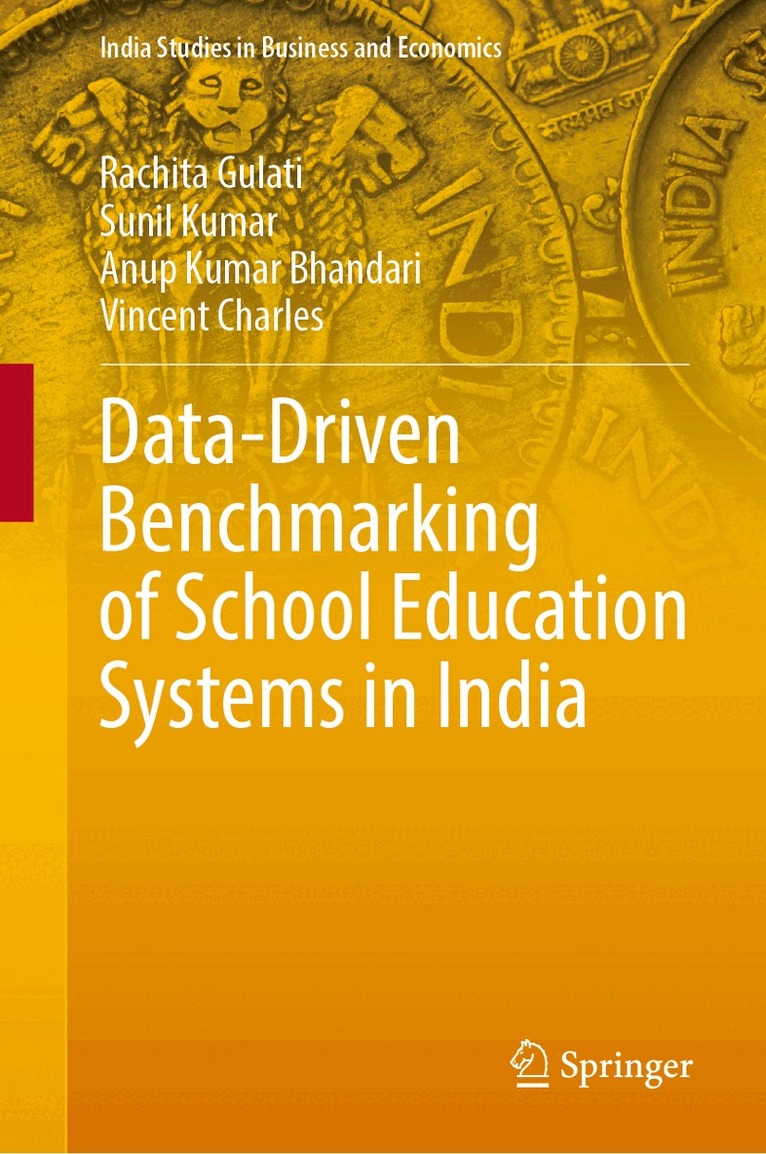
Inbunden, Engelska, 2027
Data-Driven Benchmarking of School Education Systems in India
Av Rachita Gulati, Sunil Kumar, Anup Kumar Bhandari, Vincent Charles
1687 kr
Kommande
Beskrivning
This book presents a comprehensive study that conducts a data-driven performance benchmarking exercise for regional school education systems in India, with a clear focus on highlighting disparities and challenges within these systems, as well as providing targeted policy recommendations for potential improvements. The book conducts an in-depth examination of the educational environment, current status, policies, and interventions across schools. It explores why, despite various national initiatives aimed at improving access to and quality of school education, significant gaps persist across Indian states, particularly in the two most populous states, Uttar Pradesh and Bihar, which face a range of economic challenges.The book evaluates rankings and efficiency variations in school education development and develops a novel nonparametric efficiency-effectiveness framework to analyze the performance of the school education system. In addition to employing a state-of-the-art meta-BoD-RDM framework for constructing a school education development index, the empirical analysis employs a two-stage network Data Envelopment Analysis (NDEA) model using survey-based data from schools in India to compute school-wise efficiency and effectiveness scores. These scores are then integrated with a machine learning-based Random Forest algorithm to identify the key factors behind the observed inter-school variations in school efficiency and school effectiveness. The book also discusses progress in school education development during the COVID-19 pandemic. It identifies several key areas that require policy intervention and urgent attention from educationists and governments. This data-enabled benchmarking and analytical study not only contributes to understanding the current landscape but also supports the formulation of future educational policies aimed at effectively addressing the evolving needs of the school education system in India.
Produktinformation
- Utgivningsdatum: 2027-02-24
- Mått: 155 x 235 x undefined mm
- Format: Inbunden
- Språk: Engelska
- Serie: India Studies in Business and Economics
- Antal sidor: 322
- Förlag: Springer Verlag, Singapore
- ISBN: 9789819599523
Utforska kategorier
Betyg & recensioner
0 recensioner
Inga recensioner tillgängliga.