• Fri frakt över 249 kr
  • •
  • Snabba leveranser
  • •
  • Billiga böcker
Kundservice

Du är på sajten för privatpersoner.

Företag, bibliotek eller offentlig verksamhet?

Du handlar på classic.bokus.com, där alla dina funktioner finns intakta.
Till classic.bokus.com
Bokus logotyp. Gå till startsidan.
  • Erbjudanden
  • Nyheter
  • Student
  • Topplistor
  • Barn & ungdom
  • Bokus Play
  • E-böcker
  • Pocketböcker
  • Spel & pussel

10% rabatt på allt med kod: NYSTART10 →

Sidfot

Mina sidor

    Hjälp

    • Kundservice
    • Vanliga frågor och svar
    • Frakt och leverans
    • Retur vid ångerrätt
    • Reklamera vara
    • Betalning
    • Köpvillkor
    • Allmänna villkor
    • Information om webbplatsens tillgänglighet

    Om Bokus

    • Om oss
    • Pressrum
    • För studenter
    • För företag
    • För bibliotek och offentlig verksamhet
    • För leverantörer
    • Hållbarhet

    Populärt

    • Aktuella erbjudanden
    • Presentkort
    • Studentlitteratur
    • Nya böcker
    • Topplistor
    • Signerade böcker
    • Engelska böcker

    Inspiration

    • Boktips
    • BookTok
    • Populära bokserier
    • Barnbokskaraktärer
    • Populära författare
    Logotyp för Bokus
    Följ oss på Facebook (extern länk)Följ oss på Instagram (extern länk)Följ oss på YouTube (extern länk)Följ oss på TikTok (extern länk)
    bokus @ CookiesAnpassa cookiesIntegritetspolicyKöpvillkor
    Till Citymail hemsida (extern länk)Till Budbee hemsida (extern länk)Till Postnord hemsida (extern länk)Till Schenker hemsida (extern länk)Till Early Bird hemsida (extern länk)Till Walleys hemsida (extern länk)
    1. Ekonomi och Ledarskap
    2. Nationalekonomi
    3. Mikroekonomi

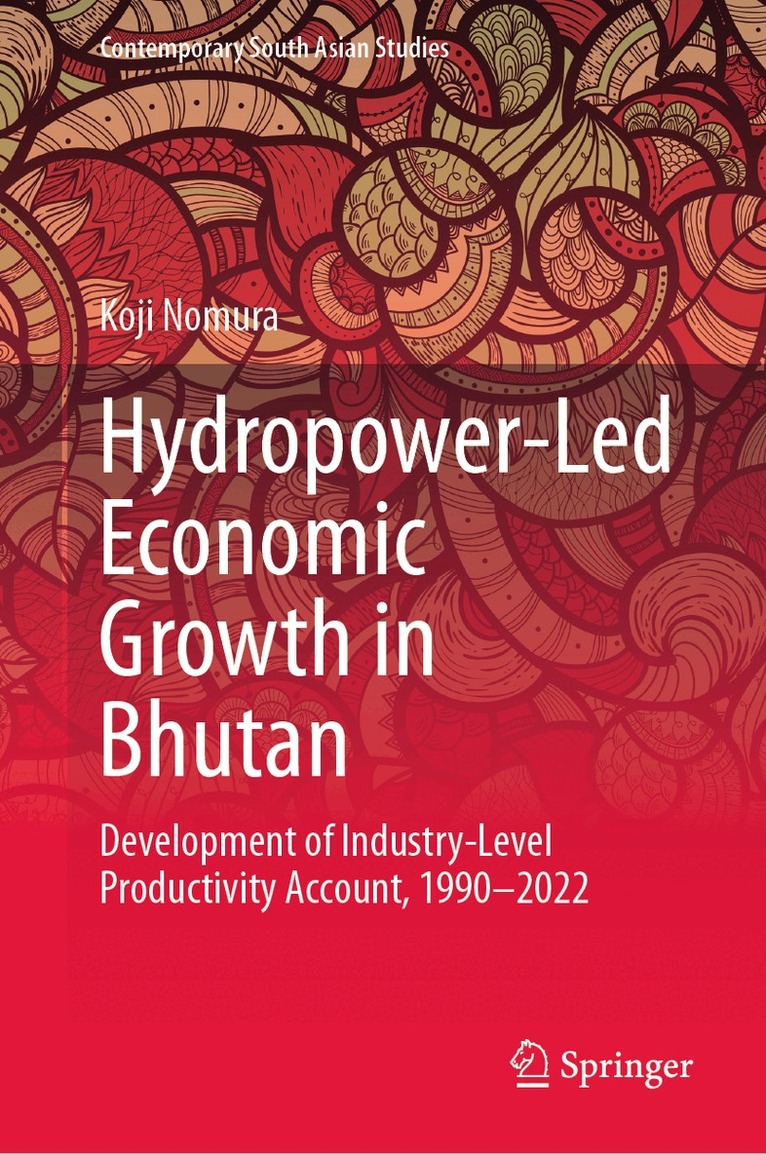
    Hydropower-Led Economic Growth in Bhutan

    Development of Industry-Level Productivity Account, 1990–2022

    AvKoji Nomura

    Inbunden, Engelska, 2025

    Del i serien Contemporary South Asian Studies

    1 452 kr

    Beställningsvara. Skickas inom 5-8 vardagar. Fri frakt över 249 kr.

    Fler format och utgåvor

    E-bok

    1 780 kr

    Häftad

    1 452 kr

    Beskrivning

    This book provides a comprehensive analysis of Bhutan’s economic growth and productivity dynamics from 1990 to 2022, with a special focus on hydropower development. Through the construction of detailed industry-level productivity accounts, the study addresses significant data gaps in Bhutan’s national accounts, measuring outputs and inputs across various sectors and developing quality-adjusted labor and capital input series. The analysis reveals the complexities of Bhutan’s hydropower-led growth strategy: while the sector has driven substantial economic growth, its contribution to overall productivity improvement has been limited. The electricity sector shows gains in labor productivity but declining capital productivity, resulting in stagnant Total Factor Productivity (TFP). The study also examines productivity trends in non-electricity sectors and addresses potential “Dutch disease” effects on manufacturing and agricultural competitiveness. International comparisons place Bhutan’s productivity performance in a regional context, revealing significant gaps in productivity performance, particularly when compared to India, Bhutan’s largest trading partner and a regional economic benchmark. This comparative analysis informs policy recommendations for achieving more balanced and sustainable economic growth. The findings are particularly relevant for Bhutan’s Thirteenth Five-Year Plan (2024–2029), which emphasizes productivity improvements across all economic sectors. The book serves as a valuable resource for policymakers, economists, and researchers interested in development economics, particularly those focused on the unique challenges faced by small, landlocked nations pursuing sustainable economic development.

    Produktinformation

    • Utgivningsdatum:2025-05-29
    • Mått:155 x 235 x 20 mm
    • Vikt:557 g
    • Format:Inbunden
    • Språk:Engelska
    • Serie:Contemporary South Asian Studies
    • Antal sidor:237
    • Förlag:Springer Nature Switzerland AG
    • ISBN:9789819651498

    Utforska kategorier

    • Mikroekonomi inom Ekonomi och Ledarskap
    • Ekonomisk historia inom Ekonomi och Ledarskap
    • Energiindustri inom Ekonomi och Ledarskap

    Mer om författaren

    Koji Nomura is a Professor and Director at the Keio Economic Observatory, Keio University, Tokyo. Nomura received a BA in 1993, an MA in 1995, and a Ph.D. in 2005 from Keio University. He has previously served as an assistant professor (1996–2003) and associate professor (2003–2017) at Keio University; a CBG fellow at the JFK School of Government, Harvard University (2003–2005); an economist at the OECD (2006–2007); a faculty fellow at the Research Institute of Economy, Trade, and Industry (2013–2019); a consultant for the United Nations Department of Economic and Social Affairs (2015–2016); and chief research officer at The 21st Century Public Policy Institute, Keidanren (2019–2020). He is currently a visiting fellow at the Economic Social Research Institute, Cabinet Office, Government of Japan (2005–2008 and 2012–present); a project manager for the APO Productivity Database at the Asian Productivity Organization (2007–present); a visiting senior fellow at the Research Institute of Capital Formation, Development Bank of Japan (2009–present); and a consultant for the United Nations Economic and Social Commission for Asia and the Pacific (2024–present).  His research focuses on economic measurement, productivity analysis, and energy economics. He is the author of Measurement of Capital and Productivity in Japan (in Japanese, Keio University Press, 2004), APO Productivity Databook (Asian Productivity Organization, annual publication from 2008 to 2024), Energy Productivity in Japan’s Economic Growth: Exploring Possibilities for Balancing Economy and Environment (in Japanese, Keio University Press, 2021), and Energy Productivity and Economic Growth: Experiences of the Japanese Industries, 1955–2019 (Springer, 2023).

    Innehållsförteckning

    • Bhutan’s Hydropower-Led Economic Growth.- Bhutan’s Aggregate Output: A Review.- Reevaluating Industry Origins of Bhutan’s Economic Growth.- Labor Input and Quality Evolution in Bhutan.- Measuring Capital Accumulation in Bhutan.- Bhutan’s Productivity Stagnation: Hydropower and Beyond.