• Fri frakt över 249 kr
  • •
  • Snabba leveranser
  • •
  • Billiga böcker
Kundservice

Du är på sajten för privatpersoner.

Företag, bibliotek eller offentlig verksamhet?

Du handlar på classic.bokus.com, där alla dina funktioner finns intakta.
Till classic.bokus.com
Bokus logotyp. Gå till startsidan.
  • Erbjudanden
  • Nyheter
  • Student
  • Topplistor
  • Barn & ungdom
  • Bokus Play
  • E-böcker
  • Pocketböcker
  • Spel & pussel

10% rabatt på allt med kod: NYSTART10 →

Sidfot

Mina sidor

    Hjälp

    • Kundservice
    • Vanliga frågor och svar
    • Frakt och leverans
    • Retur vid ångerrätt
    • Reklamera vara
    • Betalning
    • Köpvillkor
    • Allmänna villkor
    • Information om webbplatsens tillgänglighet

    Om Bokus

    • Om oss
    • Pressrum
    • För studenter
    • För företag
    • För bibliotek och offentlig verksamhet
    • För leverantörer
    • Hållbarhet

    Populärt

    • Aktuella erbjudanden
    • Presentkort
    • Studentlitteratur
    • Nya böcker
    • Topplistor
    • Signerade böcker
    • Engelska böcker

    Inspiration

    • Boktips
    • BookTok
    • Populära bokserier
    • Barnbokskaraktärer
    • Populära författare
    Logotyp för Bokus
    Följ oss på Facebook (extern länk)Följ oss på Instagram (extern länk)Följ oss på YouTube (extern länk)Följ oss på TikTok (extern länk)
    bokus @ CookiesAnpassa cookiesIntegritetspolicyKöpvillkor
    Till Citymail hemsida (extern länk)Till Budbee hemsida (extern länk)Till Postnord hemsida (extern länk)Till Schenker hemsida (extern länk)Till Early Bird hemsida (extern länk)Till Walleys hemsida (extern länk)
    1. Samhälle och politik
    2. Sociologi och antropologi
    3. Antropologi

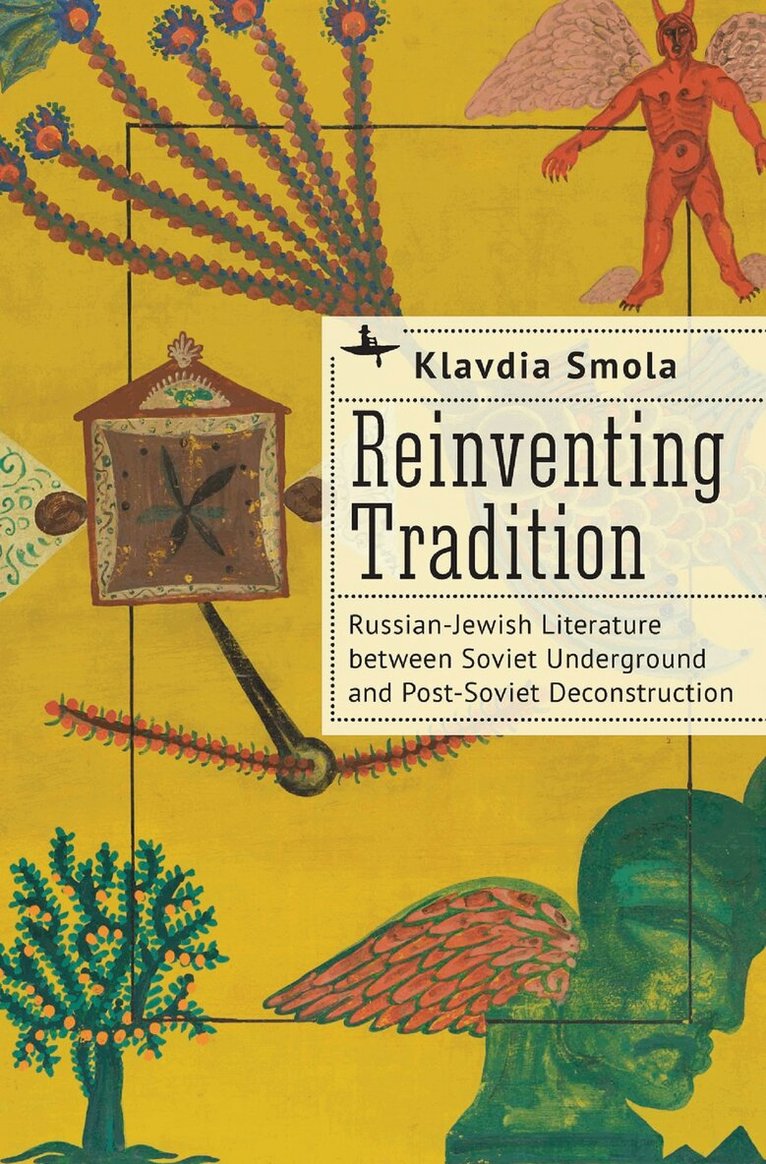
    Reinventing Tradition

    Russian-Jewish Literature between Soviet Underground and Post-Soviet Deconstruction

    AvKlavdia Smola

    Inbunden, Engelska, 2023

    Del i serien Jews of Russia & Eastern Europe and Their Legacy

    1 276 kr

    Skickas . Fri frakt över 249 kr.

    Fler format och utgåvor

    E-bok

    3 213 kr

    E-bok

    2 553 kr

    Beskrivning

    How was the Jewish tradition reinvented in Russian-Jewish literature after a long period of assimilation, the Holocaust, and decades of Communism? The process of reinventing the tradition began in the counter-culture of Jewish dissidents, in the midst of the late-Soviet underground of the 1960-1970s, and it continues to the present day. In this period, Jewish literature addresses the reader of the ‘post-human’ epoch, when the knowledge about traditional Jewry and Judaism is received not from the family members or the collective environment, but rather from books, paintings, museums and popular culture.Klavdia Smola explores how contemporary Russian-Jewish literature turns to the traditions of Jewish writing, from biblical Judaism to early-Soviet (anti-)Zionist novels, and how it ‘re-writes’ Haskalah satire, Hassidic Midrash or Yiddish travelogues.

    Produktinformation

    • Utgivningsdatum:2023-07-25
    • Mått:155 x 233 x 23 mm
    • Vikt:775 g
    • Format:Inbunden
    • Språk:Engelska
    • Serie:Jews of Russia & Eastern Europe and Their Legacy
    • Antal sidor:460
    • Förlag:Academic Studies Press
    • ISBN:9798887191904

    Utforska kategorier

    • Antropologi inom Samhälle och politik
    • Europas historia inom Historia och arkeologi
    • Mellanösterns historia inom Historia och arkeologi

    Mer om författaren

    Klavdia Smola is Professor and Chair of Slavic Literatures at the University of Dresden. She (co-)edited among others The Oxford Handbook of Soviet Underground Culture (2022); (Multi)national Faces of Socialist Realism: Beyond the Russian Literary Canon (special issue of Slavic Review, 2022), and Russia – Culture of (Non-)Conformity: From the Late Soviet Era to the Present (special issue of Russian Literature, 2018).

    Recensioner i media

    “Readers ... will find a clear and insightful survey of contemporary works in Russian on Jewish themes. Smola’s study is innovative in its focus on the Jewish revival in the late Soviet period and subsequent works written in Israel, Germany, France and the United States (as well as Russia) following mass migration.”— Ann Komaromi, The Slavonic and East European Review“[T]his book is analytically rich, thus opening a lot of doors for the enquiring reader…Klavdia Smola’s book represents an excellent resource for the academic library.”— Dr John Cook, Australian Slavonic and East European Studies “The reader, thanks to the author’s deep dive into the literary works she brings forward to make her case, will come away from this book with a recognition and appreciation of the work of a number of well-regarded (although not widely known) authors, whether resident in Russia, Israel, the US or elsewhere, concerned with Jewish identity as shaped and perceived through Soviet and Russian experience. … Reinventing Tradition is a distinguished contribution to the understanding of this revitalization and rediscovery, looking to make the search by Soviet and Russian Jewish authors more widely known and a source of insight and wisdom to be brought near.”— Mindy C. Reiser, AJL News & Reviews“It is well known that a driving force for the formation of underground cultures in former republics of the USSR was the national revival. In her excellent monograph, Klavdia Smola, a prominent scholar of the Soviet nonconformism, focuses on underground literature born by Jewish national revival—a decentralized process that engaged Jews from all republics and regions of the Soviet Union. She meticulously reconstructs a cultural dimension of the political movement for Jewish immigration from the USSR and through the analysis of Russophone Jewish underground literature, traces the development of its main myths and discourses, from their emergence in the 1960s prose of exodus to their ironic deconstructions in postmodernist writings of the 1980s-90s and essentialization in neo-Zionist narratives in the 2000s. This book will be invaluable not only for students of Jewish cultural history but also in courses on national revival in the late Soviet Union and on Russophone literature as a growing new field of studies. Klavdia Smola’s book is pioneering in all these directions.”— Mark Lipovetsky, Columbia University“Klavdia Smola’s superbly researched and deeply illuminating book is a must have for anyone interested in the pathways of Jewish creativity in Russian during the late Soviet and post-Soviet epochs. Especially noteworthy are Smola’s intricate readings of the little known writers who were part of the underground scene in the Soviet Union and later immigrated to Israel. With its breadth of the material covered and innovative theoretical approaches, Smola’s volume makes an invaluable contribution to the study of Russian Jewish literature and culture.”— Marat Grinberg, Professor of Russian and Humanities, Reed College, Author of The Soviet Jewish Bookshelf: Jewish Culture and Identity between the Lines“The course of Russian-Jewish literature never did run smooth: not when most Russian-speaking Jews were forced by the Tsars to live within the Pale of Settlement; not  under Lenin, Stalin, Khrushchev et al.; not after the collapse of the Soviet Empire—how much less so with the successive waves of mass Jewish emigration to Israel, Germany, and North America. Only an expert cartographer like Klavdia Smola, therefore, could see what no one else has seen: that it was through prose fiction and storytelling that three generations of Russian-Jewish writers have constructed their own ‘bridge of longing’ across the historical abyss. As this densely argued book demonstrates, the story doesn’t end with those who experienced corporate Jewish life first-hand. Rather, through all the tricks of the literary trade and by drawing creatively from a century of modern Yiddish writing, they succeeded in fashioning a complex new identity and a new Jewish mythology.”— David G. Roskies, Emeritus Professor of Yiddish Literature and Culture, the Jewish Theological Seminary

    Innehållsförteckning

    • Acknowledgments Introduction Tradition and Innovation in Judaism—Text and CommentarySemantics of the Posthuman Era: The (Re)Invention of Jewishness Semiotic Context Cultural-Historical Context Poetics of (Anti-)Imperial (Anti-)Assimilation Research Approaches Research Trends and Research Deficits State of the Art Perspective and Boundaries of the StudyAbove the Ground Refocusing Jewish StudiesLiterary History, Poetics, and Cultural StudiesText Selection: Time and Geography Russian Jewish Literature as a Bicultural Phenomenon Jewish Dissent of the Late Soviet Era: Underground, Exodus, Literature Soviet Jews: Collective Images and MythsJews as Translators: Literary MimicryPolitical Context and Literary Reflections of Jewish Counter-Culture: An Overview Emigration, Literary Institutions, and ReadersProse of Exodus “The Excitement of Memory”: Efrem Baukh’s Jacob’s LadderThe Martyrdom of Refusal: David Shrayer-Petrov’s Herbert and NelliMysticism of the Exodus: Eli Liuksemburg“The Third Temple” The Tenth HungerEducation of the New Jew: David Markish’s PreambleLate Soviet Exodus Novels: Poetics and MessageBipolar Models: The Zionist and the Socialist-Realist NovelAxes of Nonconformist Jewish Literature Iuz Aleshkovskii: “Carousel” Grigorii Vol′dman: Sheremetyevo Feliks Kandel′: The Gates of Our Exodus and Semen Lipkin: Pictures and VoicesIakov Tsigel′man: The Funeral of Moishe DorferIuliia Shmukler: “This Last Day”Negated Dichotomies: The Failed Utopia of Aliyah Efraim Sevela’s Zionist Counter-Narratives Iakov Tsigel′man’s Novel-Palimpsest Time and Space Structures in Nonconformist Jewish Literature Reinvention of Yiddish Storytelling Jewish Narrative and Semiotics of YiddishShlemiels and Rogues: Efraim Sevela’s The Legends of Invalidnaia Street An Old Jewess in a Monologue with the Reader: Filipp Isaak Berman’s “Sarra and the Little Rooster”Conclusion: Yiddish as a QuoteAftermath and Impact of Jewish Counter-Culture Neo-Zionist Essentialist Narratives Jewish Revival Russian Jewish Literature after Communism (Post)Memorial Literature: Palimpsests, Residuals, Reinvention (Post)Memorial Jewish WritingMemory as Obsession and Fragment: Izrail′ Metter’s “Family Tree” (Post)Memorial Topographies: Grigorii Kanovich’s “Dream about the Disappeared Jerusalem” Jewish Deconstruction of the Empire Archaic Language of the Dictatorship: Mikhail Iudson’s Dystopia The Ladder onto the Closet Postcolonial Mimic Man: Aleksandr Melikhov’s The Confession of a JewOleg Iur′ev’s Hybrid Poetics: Peninsula ZhidiatinIakov Tsigel′man’s Postmodern Midrash: Shebsl the MusicianConclusion Bibliography Literary WorksResearch Literature Index of Names