• Fri frakt över 249 kr
  • •
  • Snabba leveranser
  • •
  • Billiga böcker
Kundservice

Du är på sajten för privatpersoner.

Företag, bibliotek eller offentlig verksamhet?

Du handlar på classic.bokus.com, där alla dina funktioner finns intakta.
Till classic.bokus.com
Bokus logotyp. Gå till startsidan.
  • Erbjudanden
  • Nyheter
  • Student
  • Topplistor
  • Barn & ungdom
  • Bokus Play
  • E-böcker
  • Pocketböcker
  • Spel & pussel

Må bättre, för mindre! Upp till 50% rabatt på hälsoböcker

Sidfot

Mina sidor

    Hjälp

    • Kundservice
    • Vanliga frågor och svar
    • Frakt och leverans
    • Retur vid ångerrätt
    • Reklamera vara
    • Betalning
    • Köpvillkor
    • Allmänna villkor
    • Information om webbplatsens tillgänglighet

    Om Bokus

    • Om oss
    • Pressrum
    • För studenter
    • För företag
    • För bibliotek och offentlig verksamhet
    • För leverantörer
    • Hållbarhet

    Populärt

    • Aktuella erbjudanden
    • Presentkort
    • Studentlitteratur
    • Nya böcker
    • Topplistor
    • Signerade böcker
    • Engelska böcker

    Inspiration

    • Boktips
    • BookTok
    • Populära bokserier
    • Barnbokskaraktärer
    • Populära författare
    Logotyp för Bokus
    Följ oss på Facebook (extern länk)Följ oss på Instagram (extern länk)Följ oss på YouTube (extern länk)Följ oss på TikTok (extern länk)
    bokus @ CookiesAnpassa cookiesIntegritetspolicyKöpvillkor
    Till Citymail hemsida (extern länk)Till Budbee hemsida (extern länk)Till Postnord hemsida (extern länk)Till Schenker hemsida (extern länk)Till Early Bird hemsida (extern länk)Till Walleys hemsida (extern länk)
    1. Historia och arkeologi
    2. Arkeologi
    3. Arkeologiska perioder och områden

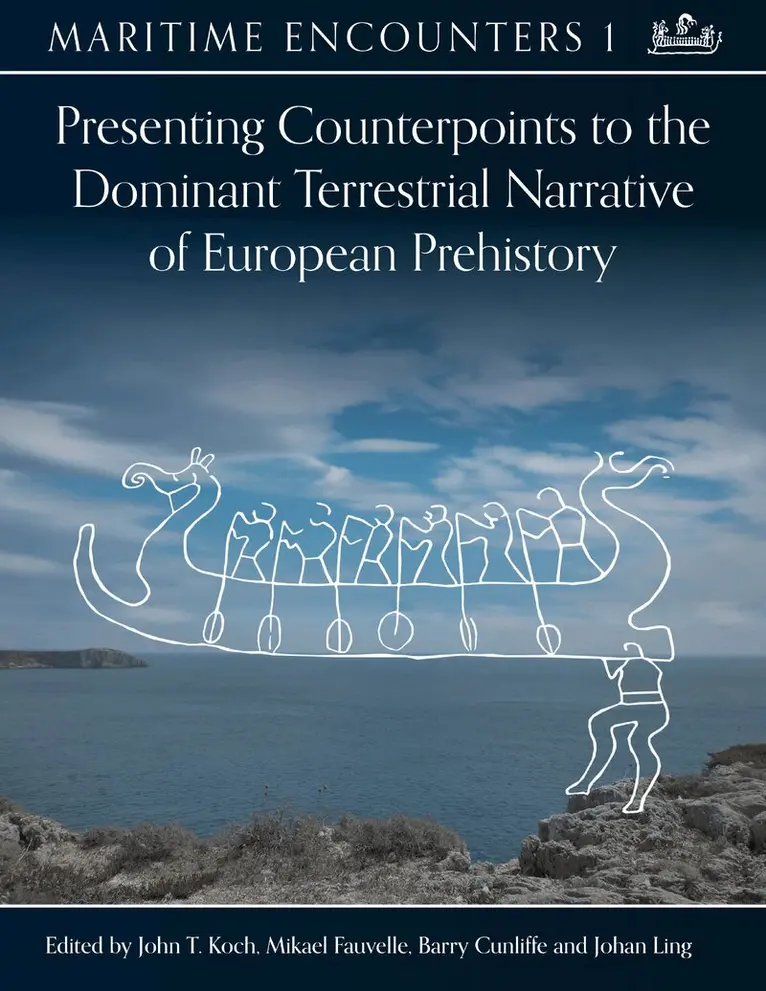
    Presenting Counterpoints to the Dominant Terrestrial Narrative of European Prehistory

    AvJohn T. Koch,Mikael Fauvelle

    Inbunden, Engelska, 2025

    767 kr

    Skickas . Fri frakt över 249 kr.

    Beskrivning

    This book is the first in the multi-author series Maritime Encounters, outputs of the major six-year (2022–2028) international research initiative, funded by Sweden’s central bank. Our programme is based on a maritime perspective, a counterpoint to prevailing land-based vantages on Europe’s prehistory. In the Maritime Encounters project a highly international cross-disciplinary team has embarked on a diverse range of research goals to provide a more detailed and nuanced story of how prehistoric societies realised major and minor sea crossings, organised long-distance exchange, and adapted to ways of life by the sea in prehistory.Recent advances with ancient DNA have brought migration back into archaeological explanation, but little attention has been paid to maritime aspects of these movements or the maritime legacies inherited from indigenous cultures. The formation of the populations, cultures, and languages of Europe are now seen largely as consequences of three great prehistoric migrations: hunter-gatherers repopulating the post-glacial landscape, followed by farmers spreading from Anatolia, and then Indo-European-speaking pastoralists from the steppe.There is a significant gap in this current model that we sense most acutely in Scandinavia and the British Isles. Unanswered questions include: How these groups reached the islands and peninsulas of Atlantic Europe? What types of boats were used? How many people and animals could they carry? To what extent did indigenous coastal peoples contribute traditions and knowledge of boats, boat building, seaways, navigation, and subsistence in coastal environments? How was the long-distance trade in metals organised during the European Bronze Age? And what was the impact of this seacrossing network on the cultures, languages, and populations of the producers and consumers of bronze?

    Produktinformation

    • Utgivningsdatum:2025-03-15
    • Mått:216 x 280 x 21 mm
    • Vikt:1 118 g
    • Format:Inbunden
    • Språk:Engelska
    • Antal sidor:240
    • Förlag:Casemate Publishers
    • ISBN:9798888571842

    Utforska kategorier

    • Arkeologiska perioder och områden inom Historia och arkeologi
    • Sjöfartshistoria inom Historia och arkeologi
    • Språkvetenskap och lingvistik inom Språk och ordböcker

    Mer om författaren

    John T. Koch is Research Professor at the University of Wales Centre for Advanced Welsh and Celtic Studies in Aberystwyth. A historical linguist specialising in early Celtic languages with a unique multidisciplinary profile, Koch’s research includes Indo-European origins of Celtic names, words, and grammar. Mikael Fauvelle is a researcher in the department of archaeology and ancient history at Lund University. He is an anthropological archaeologist specialising in early complex economic systems and the emergence of maritime trade networks. His research has focused on topics including the origins of money, the innovation of ancient watercraft, and the formation of early chiefdoms. He has directed archaeological field projects in North America, Central America, and Scandinavia. Sir Barry Cunliffe is Professor Emeritus of European Prehistory in the University of Oxford. A phenomenally prolific author and excavator, his publications include highly readable synthetic overviews that encompass long chronological sweeps of the archaeology of Britain, Eurasia, the Celtic world, and the Atlantic façade. Johan Ling is Professor of Archaeology at the Department of Historical Studies, Gothenburg University and is Director of the Rock Art research Archives (SHFA). He is a specialist in Bronze Age archaeology with a focus on Scandinavian rock art and maritime trade.

    Innehållsförteckning

    • List of illustrationsList of tablesContributorsIntroductionJohn T. Koch, Mikael Fauvelle, Barry Cunliffe & Johan Ling1. A millennium of war – violent encounters during the 4th and 3rd millennia BC in the western Baltic SeaChristian Horn & Sebastian Schultrich2. Chalcolithic and Bronze Age Atlantic connections c. 2500–800 BCAurélien Burlot3. Using direct and indirect evidence of boats and boatbuilding for understanding the nature of seafaring in Atlantic Europe c. 5000–500 BCBoel Bengtsson4. Larger boats, longer voyages, and powerful leaders: comparing Maritime Modes of Production in Scandinavia and CaliforniaMikael Fauvelle & Johan Ling5. The Maritime Mode of Production in relation to self-sufficiency, reciprocity, and comparative advantagesJohan Ling6. The origins of secret societies and their contribution to the rise of social complexityRichard Chacon, David Dye, Brian Hayden, Johan Ling, & Yamilette Chacon7. Maritime memoria: navigating Bronze Age rock artCecilia Lindhé8. Archaeology and science: impact of lead isotope analyses on the archaeological discourse of metal trade for the Scandinavian and British communities in the 3rd–1st millennia BCZofia Anna Stos-Gale & Johan Ling9. Late Bronze Age copper mining in southern Iberia: preliminary results of fieldwork at Las Minillas (Granja de Torrehermosa, Badajoz, Spain)Mark A. Hunt-Ortiz, Juan Latorre-Ruiz, Miguel Ángel de Dios-Pérez, Jacobo Vázquez-Paz, Magnus Artursson, Manuel Grueso-Montero, Marta Díaz-Guardamino, Zofia Stos-Gale, & Johan Ling10. What genetics can say about Iron Age and Bronze Age BritainNick Patterson11. Cross-disciplinary considerations: ‘hedge’, ‘hull’, ‘fool’, and the triumph of linguistic palaeontologyJohn T. Koch12. Convergence in situ: the formation of the Indo-European branches and the Bronze–Iron transitionJohn T. KochIndex