Alison Fox – författare
296 kr
Skickas inom 3-6 vardagar
297 kr
Läs direkt efter köp
2 133 kr
Skickas inom 10-15 vardagar
542 kr
Skickas inom 10-15 vardagar
528 kr
Skickas inom 10-15 vardagar
2 200 kr
Skickas inom 10-15 vardagar
665 kr
Skickas inom 10-15 vardagar
2 200 kr
Skickas inom 10-15 vardagar
720 kr
Skickas inom 10-15 vardagar
458 kr
Läs direkt efter köp
Providing theoretical grounding, case studies and practical solutions, Implementing Ethics in Educational Ethnography examines how researchers can overcome ethical dilemmas associated with and encountered during ethnographic research. From the initial stages of research design such as consideration from regulatory bodies, through research occurring in the field to project completion and reporting, it explores many of the factors associated with ensuring culturally sensitive and ethical studies.
The book covers key questions including:
What can researchers expect of ethical review boards? Where and with whom should dialogue take place about ethicality within research? What effect does a research focus have on regulation and research practice? What is the effect of context on ethical practices? Does the positionality of a researcher have an effect on ethical practices? How do we ensure that ethicality supports the trustworthiness of research projects?Using a range of international case studies, Implementing Ethics in Educational Ethnography provides researchers and students with invaluable details about how to navigate the field, ensuring that they can sustain good ethical practice throughout the life of a research project.
Chapters 4 and 6 of this book are freely available as downloadable Open Access PDFs at http://www.taylorfrancis.com under a Creative Commons Attribution-Non Commercial-No Derivatives (CC-BY-NC-ND) 4.0 license.
458 kr
Läs direkt efter köp
Providing theoretical grounding, case studies and practical solutions, Implementing Ethics in Educational Ethnography examines how researchers can overcome ethical dilemmas associated with and encountered during ethnographic research. From the initial stages of research design such as consideration from regulatory bodies, through research occurring in the field to project completion and reporting, it explores many of the factors associated with ensuring culturally sensitive and ethical studies.
The book covers key questions including:
What can researchers expect of ethical review boards? Where and with whom should dialogue take place about ethicality within research? What effect does a research focus have on regulation and research practice? What is the effect of context on ethical practices? Does the positionality of a researcher have an effect on ethical practices? How do we ensure that ethicality supports the trustworthiness of research projects?Using a range of international case studies, Implementing Ethics in Educational Ethnography provides researchers and students with invaluable details about how to navigate the field, ensuring that they can sustain good ethical practice throughout the life of a research project.
Chapters 4 and 6 of this book are freely available as downloadable Open Access PDFs at http://www.taylorfrancis.com under a Creative Commons Attribution-Non Commercial-No Derivatives (CC-BY-NC-ND) 4.0 license.
637 kr
Läs direkt efter köp
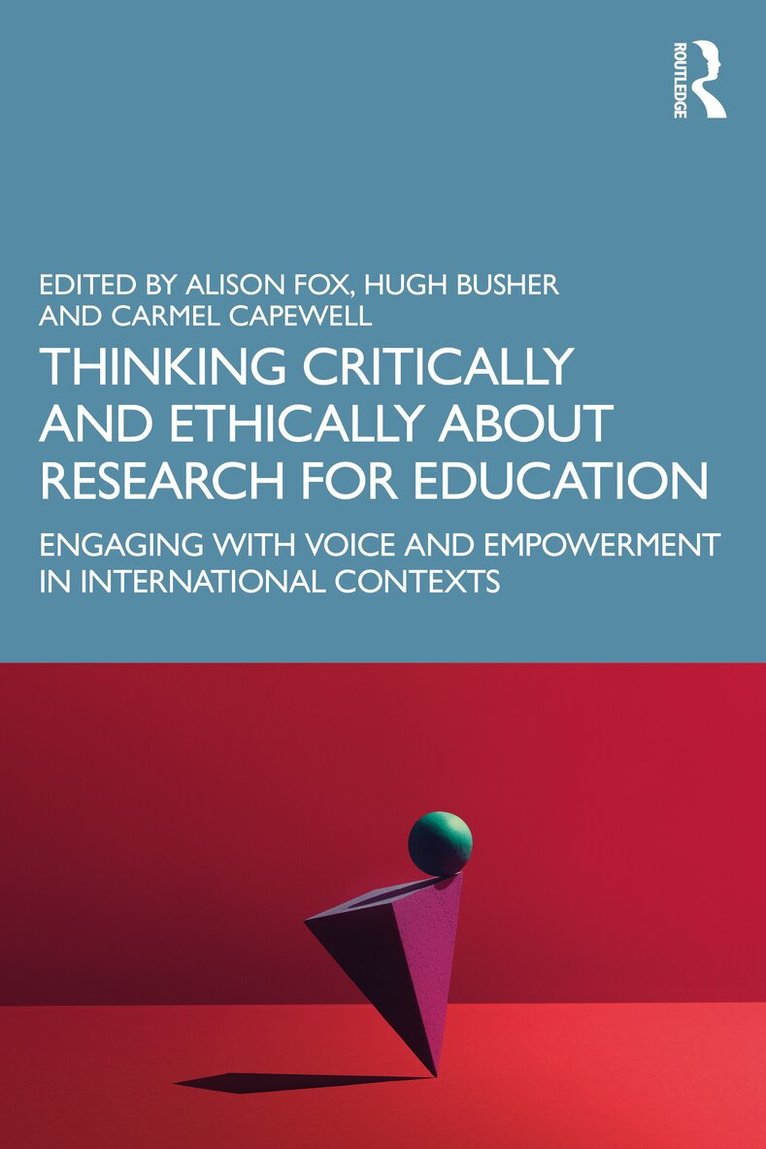
Thinking Critically and Ethically about Research for Education draws on the experiences of a range of researchers in the discipline to explore the lived realities, including ethical and methodological complexities, involved in undertaking educational research.
Using global case studies, this book examines the meaning of ethical research practice and raises questions about representation, power and empowerment in the field. It provides critical reflections from researchers, reviewing the methodologies they used in their studies and the ethical implications of these in theory and practice. The book highlights the various difficulties and realities present in education research and provides researchers with the tools necessary for refining their skills and understanding ethical research methodologies.
The chapters reflect authors’ responses to the following questions:
What values prompted you to do this work and how did you share these with participants?
What were the ethical considerations raised beforehand and how were these tackled in terms of meeting obligations (including to ERBs), maximising benefits and dealing with issues arising during the study and through to publication?
What does ‘empowerment’ and/or ‘voice’ mean to you as a researcher and how did you express this to your participants?
In what ways were the participants given opportunities to be empowered in or through your study?
With critical discussions on ethics and research practices in education research, this book is ideal for student, novice and experienced researchers looking to undertake ethical education research.
637 kr
Läs direkt efter köp
Thinking Critically and Ethically about Research for Education draws on the experiences of a range of researchers in the discipline to explore the lived realities, including ethical and methodological complexities, involved in undertaking educational research.
Using global case studies, this book examines the meaning of ethical research practice and raises questions about representation, power and empowerment in the field. It provides critical reflections from researchers, reviewing the methodologies they used in their studies and the ethical implications of these in theory and practice. The book highlights the various difficulties and realities present in education research and provides researchers with the tools necessary for refining their skills and understanding ethical research methodologies.
The chapters reflect authors’ responses to the following questions:
What values prompted you to do this work and how did you share these with participants?
What were the ethical considerations raised beforehand and how were these tackled in terms of meeting obligations (including to ERBs), maximising benefits and dealing with issues arising during the study and through to publication?
What does ‘empowerment’ and/or ‘voice’ mean to you as a researcher and how did you express this to your participants?
In what ways were the participants given opportunities to be empowered in or through your study?
With critical discussions on ethics and research practices in education research, this book is ideal for student, novice and experienced researchers looking to undertake ethical education research.
343 kr
Läs direkt efter köp
343 kr
Läs direkt efter köp
784 kr
Läs direkt efter köp
Learning how to learn is an essential preparation for lifelong learning. Whilst this is widely acknowledged by teachers, they have lacked a rich professional knowledge base from which they can teach their pupils how to learn.
This book makes a major contribution to the creation of such a professional knowledge base for teachers by building on previous work associated with ‘formative assessment’ or ‘assessment for learning’ which has a strong evidence base, and is now being promoted nationally and internationally. However, it adds an important new dimension by reporting the conditions within schools, and across networks of schools, that are conducive to the promotion, in classrooms, of learning how to learn as an extension of assessment for learning.
There is a companion book, Learning How to Learn in Classrooms: Tools for schools (also available from Routledge), which provides practical resources for those teachers looking to put into practice the principles covered in this book.
784 kr
Läs direkt efter köp
Learning how to learn is an essential preparation for lifelong learning. Whilst this is widely acknowledged by teachers, they have lacked a rich professional knowledge base from which they can teach their pupils how to learn.
This book makes a major contribution to the creation of such a professional knowledge base for teachers by building on previous work associated with ‘formative assessment’ or ‘assessment for learning’ which has a strong evidence base, and is now being promoted nationally and internationally. However, it adds an important new dimension by reporting the conditions within schools, and across networks of schools, that are conducive to the promotion, in classrooms, of learning how to learn as an extension of assessment for learning.
There is a companion book, Learning How to Learn in Classrooms: Tools for schools (also available from Routledge), which provides practical resources for those teachers looking to put into practice the principles covered in this book.
507 kr
Läs direkt efter köp
Learning how to learn is an essential preparation for lifelong learning. This book offers a set of in-service resources to help teachers develop new classroom practices informed by sound research. It builds on previous work associated with ‘formative assessment’ or ‘assessment for learning’. However, it adds an important new dimension by taking account of the conditions within schools that are conducive to the promotion, in classrooms, of learning how to learn as an extension of assessment for learning. Among the materials included you will find:
an introductory in-service session self-evaluation questionnaires an action planning activity workshops tools for school development a network mapping activity guidance about different ways of using the resources teachers descriptions of ways they have used of adapted them references to further information and advice.In addition, there is a support website and examples of how individual schools have used or adapted these materials to maximize their benefits.
507 kr
Läs direkt efter köp
Learning how to learn is an essential preparation for lifelong learning. This book offers a set of in-service resources to help teachers develop new classroom practices informed by sound research. It builds on previous work associated with ‘formative assessment’ or ‘assessment for learning’. However, it adds an important new dimension by taking account of the conditions within schools that are conducive to the promotion, in classrooms, of learning how to learn as an extension of assessment for learning. Among the materials included you will find:
an introductory in-service session self-evaluation questionnaires an action planning activity workshops tools for school development a network mapping activity guidance about different ways of using the resources teachers descriptions of ways they have used of adapted them references to further information and advice.In addition, there is a support website and examples of how individual schools have used or adapted these materials to maximize their benefits.
850 kr
Läs direkt efter köp
In the twenty-first century, what could be more important than networks? Such is the power of their influence and attendant technologies that it is unsurprising that our thinking about networks is permeated with images and metaphors from electronic networks. This orientation may equally influence thinking about education, whether that is of students or teachers.
Researching and Understanding Educational Networks extends the discussion of educational networks in a unique and novel way by relating it to teacher learning. Following an investigation of teacher and school networks in the UK, the authors found that theoretical perspectives taken from existing work on such networks were not adequate to provide an understanding of their potential, nor to provide the basis for researching them in ways that reflected the variety of teacher experience.
This book presents analyses of the problems with existing theories of teacher learning, which for example draw on ideas of ''communities of practice'', and explores what network theories can be brought to the problem of how teachers and schools create and share new knowledge about practice. Innovative networking theories discussed include:
social network analysis social capital theories actor-network theory investigations of electronic networks including computer-meditated conferencing how people learn at events such as conferences.Researching and Understanding Educational Networks explores a new application of networks theories derived from quite different fields of work, and extends it both by being concerned about networks beyond organisations and specifically about educational networks. Their application to educational networks, and to teacher learning in particular, is a unique contribution of the book. This enables it to be of interest to both researchers and those studying for higher degrees, including students who are professionals working in schools.
850 kr
Läs direkt efter köp
In the twenty-first century, what could be more important than networks? Such is the power of their influence and attendant technologies that it is unsurprising that our thinking about networks is permeated with images and metaphors from electronic networks. This orientation may equally influence thinking about education, whether that is of students or teachers.
Researching and Understanding Educational Networks extends the discussion of educational networks in a unique and novel way by relating it to teacher learning. Following an investigation of teacher and school networks in the UK, the authors found that theoretical perspectives taken from existing work on such networks were not adequate to provide an understanding of their potential, nor to provide the basis for researching them in ways that reflected the variety of teacher experience.
This book presents analyses of the problems with existing theories of teacher learning, which for example draw on ideas of ''communities of practice'', and explores what network theories can be brought to the problem of how teachers and schools create and share new knowledge about practice. Innovative networking theories discussed include:
social network analysis social capital theories actor-network theory investigations of electronic networks including computer-meditated conferencing how people learn at events such as conferences.Researching and Understanding Educational Networks explores a new application of networks theories derived from quite different fields of work, and extends it both by being concerned about networks beyond organisations and specifically about educational networks. Their application to educational networks, and to teacher learning in particular, is a unique contribution of the book. This enables it to be of interest to both researchers and those studying for higher degrees, including students who are professionals working in schools.
1 927 kr
Skickas inom 10-15 vardagar
1 983 kr
Skickas inom 10-15 vardagar
430 kr
Skickas inom 10-15 vardagar
1 289 kr
Skickas inom 10-15 vardagar
406 kr
Skickas inom 5-8 vardagar
426 kr
Läs direkt efter köp
441 kr
Läs direkt efter köp
295 kr
Skickas inom 10-15 vardagar