Amy Kind – författare
285 kr
Skickas inom 10-15 vardagar
1 193 kr
Läs direkt efter köp
2 143 kr
Skickas inom 5-8 vardagar
1 718 kr
Läs direkt efter köp
1 780 kr
Läs direkt efter köp
1 296 kr
Skickas inom 5-8 vardagar
526 kr
Skickas inom 10-15 vardagar
2 183 kr
Skickas inom 10-15 vardagar
554 kr
Skickas inom 10-15 vardagar
4 078 kr
Skickas inom 10-15 vardagar
622 kr
Läs direkt efter köp
While the philosophical study of mind has always required philosophers to attend to the scientific developments of their day, from the twentieth century onwards it has been especially influenced and informed by psychology, neuroscience, and computer science.
Philosophy of Mind in the Twentieth and Twenty-First Centuries provides an outstanding survey of the most prominent themes in twentieth-century and contemporary philosophy of mind. It also looks to the future, offering cautious predictions about developments in the field in the years to come.
Following an introduction by Amy Kind, twelve specially commissioned chapters by an international team of contributors discuss key topics, thinkers, and debates, including:
the phenomenological tradition, the mind–body problem, theories of consciousness, theories of perception, theories of personal identity, mental causation, intentionality, Wittgenstein and his legacy, cognitive science, and future directions for philosophy of mind.
Essential reading for students and researchers in philosophy of mind and philosophy of psychology, Philosophy of Mind in the Twentieth and Twenty-First Centuries is also a valuable resource for those in related disciplines such as psychology and cognitive science.
622 kr
Läs direkt efter köp
While the philosophical study of mind has always required philosophers to attend to the scientific developments of their day, from the twentieth century onwards it has been especially influenced and informed by psychology, neuroscience, and computer science.
Philosophy of Mind in the Twentieth and Twenty-First Centuries provides an outstanding survey of the most prominent themes in twentieth-century and contemporary philosophy of mind. It also looks to the future, offering cautious predictions about developments in the field in the years to come.
Following an introduction by Amy Kind, twelve specially commissioned chapters by an international team of contributors discuss key topics, thinkers, and debates, including:
the phenomenological tradition, the mind–body problem, theories of consciousness, theories of perception, theories of personal identity, mental causation, intentionality, Wittgenstein and his legacy, cognitive science, and future directions for philosophy of mind.
Essential reading for students and researchers in philosophy of mind and philosophy of psychology, Philosophy of Mind in the Twentieth and Twenty-First Centuries is also a valuable resource for those in related disciplines such as psychology and cognitive science.
671 kr
Skickas inom 5-8 vardagar
259 kr
Skickas inom 5-8 vardagar
673 kr
Läs direkt efter köp
This book explores a topic that has recently become the subject of increased philosophical interest: how can imagination be put to epistemic use? Though imagination has long been invoked in contexts of modal knowledge, in recent years philosophers have begun to explore its capacity to play an epistemic role in a variety of other contexts as well.
In this collection, the contributors address an assortment of issues relating to epistemic uses of imagination, and in particular, they take up the ways in which our imaginings must be constrained so as to justify beliefs and give rise to knowledge. These constraints are explored across several different contexts in which imagination is appealed to for justification, namely reasoning, modality and modal knowledge, thought experiments, and knowledge of self and others. Taken as a whole, the contributions in this volume break new ground in explicating when and how imagination can be epistemically useful.
Epistemic Uses of Imagination will be of interest to scholars and advanced students who are working on imagination, as well as those working more broadly in epistemology, aesthetics, and philosophy of mind.
Chapters 6 and 12 of this book are freely available as downloadable Open Access PDFs at http://www.taylorfrancis.com under a Creative Commons Attribution-Non Commercial-No Derivatives (CC-BY-NC-ND) 4.0 license.
649 kr
Läs direkt efter köp
This book explores a topic that has recently become the subject of increased philosophical interest: how can imagination be put to epistemic use? Though imagination has long been invoked in contexts of modal knowledge, in recent years philosophers have begun to explore its capacity to play an epistemic role in a variety of other contexts as well.
In this collection, the contributors address an assortment of issues relating to epistemic uses of imagination, and in particular, they take up the ways in which our imaginings must be constrained so as to justify beliefs and give rise to knowledge. These constraints are explored across several different contexts in which imagination is appealed to for justification, namely reasoning, modality and modal knowledge, thought experiments, and knowledge of self and others. Taken as a whole, the contributions in this volume break new ground in explicating when and how imagination can be epistemically useful.
Epistemic Uses of Imagination will be of interest to scholars and advanced students who are working on imagination, as well as those working more broadly in epistemology, aesthetics, and philosophy of mind.
Chapters 6 and 12 of this book are freely available as downloadable Open Access PDFs at http://www.taylorfrancis.com under a Creative Commons Attribution-Non Commercial-No Derivatives (CC-BY-NC-ND) 4.0 license.
589 kr
Läs direkt efter köp
What is consciousness and why is it so philosophically and scientifically puzzling? For many years philosophers approached this question assuming a standard physicalist framework on which consciousness can be explained by contemporary physics, biology, neuroscience, and cognitive science. This book is a debate between two philosophers who are united in their rejection of this kind of "standard" physicalism - but who differ sharply in what lesson to draw from this. Amy Kind defends dualism 2.0, a thoroughly modern version of dualism (the theory that there are two fundamentally different kinds of things in the world: those that are physical and those that are mental) decoupled from any religious or non-scientific connotations. Daniel Stoljar defends non-standard physicalism, a kind of physicalism different from both the standard version and dualism 2.0. The book presents a cutting-edge assessment of the philosophy of consciousness and provides a glimpse at what the future study of this area might bring.
Key Features
Outlines the different things people mean by "consciousness" and provides an account of what consciousness is Reviews the key arguments for thinking that consciousness is incompatible with physicalism Explores and provides a defense of contrasting responses to those arguments, with a special focus on responses that reject the standard physicalist framework Provides an account of the basic aims of the science of consciousness Written in a lively and accessibly style Includes a comprehensive glossary589 kr
Läs direkt efter köp
What is consciousness and why is it so philosophically and scientifically puzzling? For many years philosophers approached this question assuming a standard physicalist framework on which consciousness can be explained by contemporary physics, biology, neuroscience, and cognitive science. This book is a debate between two philosophers who are united in their rejection of this kind of "standard" physicalism - but who differ sharply in what lesson to draw from this. Amy Kind defends dualism 2.0, a thoroughly modern version of dualism (the theory that there are two fundamentally different kinds of things in the world: those that are physical and those that are mental) decoupled from any religious or non-scientific connotations. Daniel Stoljar defends non-standard physicalism, a kind of physicalism different from both the standard version and dualism 2.0. The book presents a cutting-edge assessment of the philosophy of consciousness and provides a glimpse at what the future study of this area might bring.
Key Features
Outlines the different things people mean by "consciousness" and provides an account of what consciousness is Reviews the key arguments for thinking that consciousness is incompatible with physicalism Explores and provides a defense of contrasting responses to those arguments, with a special focus on responses that reject the standard physicalist framework Provides an account of the basic aims of the science of consciousness Written in a lively and accessibly style Includes a comprehensive glossary521 kr
Läs direkt efter köp
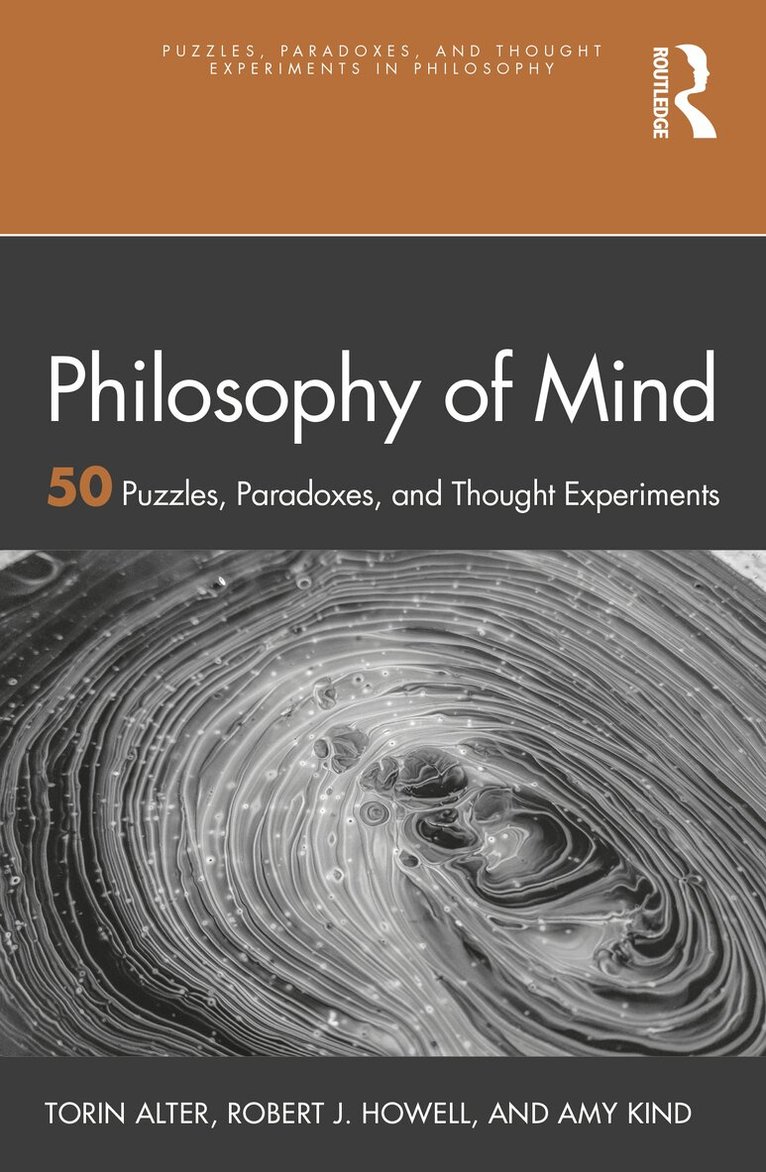
Imaginative cases, or what might be called puzzles and other thought experiments, play a central role in philosophy of mind. The real world also furnishes philosophers with an ample supply of such puzzles.
This volume collects 50 of the most important historical and contemporary cases in philosophy of mind and describes their significance. The authors divide them into five sections: consciousness and dualism; physicalist theories and the metaphysics of mind; content, intentionality, and representation; perception, imagination, and attention; and persons, personal identity, and the self. Each chapter provides background, describes a central case or cases, discusses the relevant literature, and suggests further readings. Philosophy of Mind: 50 Puzzles, Paradoxes, and Thought Experiments promises to be a useful teaching tool as well as a handy resource for anyone interested in the area.
Key Features:
Offers stand-alone chapters, each presented in an identical format: Background The Case Discussion Recommended Reading Each chapter is self-contained, allowing students to quickly understand an issue and giving instructors flexibility in assigning readings to match the themes of the course. Additional pedagogical features include a general volume introduction as well as smaller introductions to each of the five sections and a glossary at the end of the book.521 kr
Läs direkt efter köp
Imaginative cases, or what might be called puzzles and other thought experiments, play a central role in philosophy of mind. The real world also furnishes philosophers with an ample supply of such puzzles.
This volume collects 50 of the most important historical and contemporary cases in philosophy of mind and describes their significance. The authors divide them into five sections: consciousness and dualism; physicalist theories and the metaphysics of mind; content, intentionality, and representation; perception, imagination, and attention; and persons, personal identity, and the self. Each chapter provides background, describes a central case or cases, discusses the relevant literature, and suggests further readings. Philosophy of Mind: 50 Puzzles, Paradoxes, and Thought Experiments promises to be a useful teaching tool as well as a handy resource for anyone interested in the area.
Key Features:
Offers stand-alone chapters, each presented in an identical format: Background The Case Discussion Recommended Reading Each chapter is self-contained, allowing students to quickly understand an issue and giving instructors flexibility in assigning readings to match the themes of the course. Additional pedagogical features include a general volume introduction as well as smaller introductions to each of the five sections and a glossary at the end of the book.444 kr
Skickas inom 10-15 vardagar
2 193 kr
Skickas inom 10-15 vardagar
599 kr
Skickas inom 10-15 vardagar
2 056 kr
Skickas inom 10-15 vardagar
285 kr
Läs direkt efter köp
275 kr
Läs direkt efter köp
239 kr
Skickas inom 7-10 vardagar
2 421 kr
Skickas inom 10-15 vardagar
779 kr
Skickas inom 10-15 vardagar
1 481 kr
Skickas inom 10-15 vardagar