and Public Policy Committee on Science, Engineering, Medicine – författare
714 kr
Läs direkt efter köp
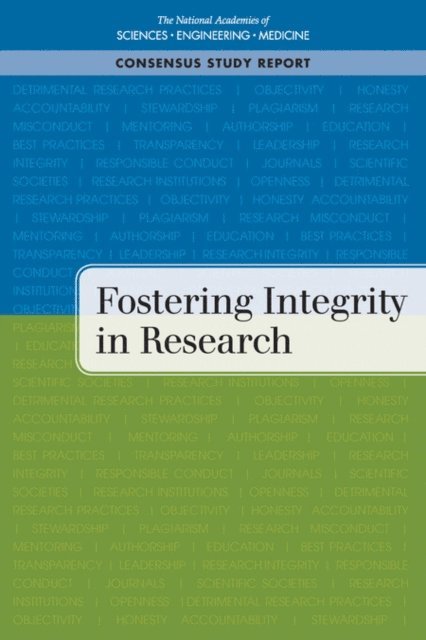
The integrity of knowledge that emerges from research is based on individual and collective adherence to core values of objectivity, honesty, openness, fairness, accountability, and stewardship. Integrity in science means that the organizations in which research is conducted encourage those involved to exemplify these values in every step of the research process. Understanding the dynamics that support – or distort – practices that uphold the integrity of research by all participants ensures that the research enterprise advances knowledge.
The 1992 report Responsible Science: Ensuring the Integrity of the Research Process evaluated issues related to scientific responsibility and the conduct of research. It provided a valuable service in describing and analyzing a very complicated set of issues, and has served as a crucial basis for thinking about research integrity for more than two decades. However, as experience has accumulated with various forms of research misconduct, detrimental research practices, and other forms of misconduct, as subsequent empirical research has revealed more about the nature of scientific misconduct, and because technological and social changes have altered the environment in which science is conducted, it is clear that the framework established more than two decades ago needs to be updated.
Responsible Science served as a valuable benchmark to set the context for this most recent analysis and to help guide the committee''s thought process. Fostering Integrity in Research identifies best practices in research and recommends practical options for discouraging and addressing research misconduct and detrimental research practices.
292 kr
Läs direkt efter köp
The agencies within the U.S. Intelligence Community (IC) depend on advanced technology to achieve their goals. While AI, cloud computing, advanced sensors, and big data analytics will fundamentally change both the global threat landscape and IC tradecraft, advances from biology, chemistry, materials, quantum science, network science, social/behavioral/economic sciences, and other fields also have that potential. Maintaining awareness of advances in science and technology is more essential than ever, to avoid surprise, to inflict surprise on adversaries, and to leverage those advances for the benefit of the nation and the IC. This report explores ways in which the IC might leverage the future research and development ecosystem.
341 kr
Läs direkt efter köp
U.S. leadership in technology innovation is central to our nation''s interests, including its security, economic prosperity, and quality of life. Our nation has created a science and technology ecosystem that fosters innovation, risk taking, and the discovery of new ideas that lead to new technologies through robust collaborations across and within academia, industry, and government, and our research and development enterprise has attracted the best and brightest scientists, engineers, and entrepreneurs from around the world. The quality and openness of our research enterprise have been the basis of our global leadership in technological innovation, which has brought enormous advantages to our national interests.
In today''s rapidly changing landscapes of technology and competition, however, the assumption that the United States will continue to hold a dominant competitive position by depending primarily on its historical approach of identifying specific and narrow technology areas requiring controls or restrictions is not valid. Further challenging that approach is the proliferation of highly integrated and globally shared platforms that power and enable most modern technology applications.
To review the protection of technologies that have strategic importance for national security in an era of openness and competition, Protecting U.S. Technological Advantage considers policies and practices related to the production and commercialization of research in domains critical to national security. This report makes recommendations for changes to technology protection policies and practices that reflect the current realities of how technologies are developed and incorporated into new products and processes.
477 kr
Tillfälligt slut
573 kr
Tillfälligt slut
202 kr
Tillfälligt slut
225 kr
Tillfälligt slut
225 kr
Tillfälligt slut