Anna Collar – författare
Visar alla böcker från författaren Anna Collar. Handla med fri frakt och snabb leverans.
15 produkter
15 produkter
Inbunden, Engelska, 2016
1 844 kr
Skickas inom 5-8 vardagar
One of the most exciting recent developments in archaeology and history has been the adoption of new perspectives which see human societies in the past-as in the present-as made up of networks of interlinked individuals. This view of people as always connected through physical and conceptual networks along which resources, information, and disease flow, requires archaeologists and historians to use new methods to understand how these networks form, function, and change over time. The Connected Past provides a constructive methodological and theoretical critique of the growth in research applying network perspectives in archaeology and history, and considers the unique challenges presented by datasets in these disciplines, including the fragmentary and material nature of such data and the functioning and change of social processes over long timespans. An international and multidisciplinary range of scholars debate both the rationale and practicalities of applying network methodologies, addressing the merits and drawbacks of specific techniques of analysis for a range of datasets and research questions, and demonstrating their approaches with concrete case studies and detailed illustrations. As well as revealing the valuable contributions archaeologists and historians can make to network science, the volume represents a crucial step towards the development of best practice in the field, especially in exploring the interactions between social and material elements of networks, and long-term network evolution.
Häftad, Engelska, 2024
605 kr
Skickas inom 10-15 vardagar
Networks and the Spread of Ideas in the Past: Strong Ties, Innovation and Knowledge Exchange gathers contributions from an international group of scholars to reconsider the role that strong social ties play in the transmission of new ideas, and their crucial place in network analyses of the past.Drawing on case studies that range from the early Iron Age Mediterranean to medieval Britain, the contributing authors showcase the importance of looking at strong social ties in the transmission of complex information, which requires relationships structured through mutual trust, memory, and reciprocity. They highlight the importance of sanctuaries in the process of information transmission, the power of narrative in creating a sense of community even across geographical space, and the control of social systems in order to facilitate or stifle new information transfer.Networks and the Spread of Ideas in the Past demonstrates the value of searching the past for powerful social connections, offers us the chance to tell more human stories through our analyses, and represents an essential new addition to the study and use of networks in archaeology and history. The book will be useful to academics and students working in the Digital Humanities, History, and Archaeology.
Inbunden, Engelska, 2013
1 277 kr
Skickas inom 7-10 vardagar
The first three centuries AD saw the spread of new religious ideas through the Roman Empire, crossing a vast and diverse geographical, social and cultural space. In this innovative study, Anna Collar explores both how this happened and why. Drawing on research in the sociology and anthropology of religion, physics and computer science, Collar explores the relationship between social networks and religious transmission to explore why some religious movements succeed, while others, seemingly equally successful at a certain time, ultimately fail. Using extensive epigraphic data, Collar provides new interpretations of the diffusion of ideas across the social networks of the Jewish Diaspora and the cults of Jupiter Dolichenus and Theos Hypsistos, and in turn offers important reappraisals of the spread of religious innovations in the Roman Empire. This study will be a valuable resource for students and scholars of ancient history, archaeology, ancient religion and network theory.
Häftad, Engelska, 2017
604 kr
Skickas inom 7-10 vardagar
The first three centuries AD saw the spread of new religious ideas through the Roman Empire, crossing a vast and diverse geographical, social and cultural space. In this innovative study, Anna Collar explores both how this happened and why. Drawing on research in the sociology and anthropology of religion, physics and computer science, Collar explores the relationship between social networks and religious transmission to explore why some religious movements succeed, while others, seemingly equally successful at a certain time, ultimately fail. Using extensive epigraphic data, Collar provides new interpretations of the diffusion of ideas across the social networks of the Jewish Diaspora and the cults of Jupiter Dolichenus and Theos Hypsistos, and in turn offers important reappraisals of the spread of religious innovations in the Roman Empire. This study will be a valuable resource for students and scholars of ancient history, archaeology, ancient religion and network theory.
Inbunden, Engelska, 2022
2 212 kr
Skickas inom 10-15 vardagar
Networks and the Spread of Ideas in the Past: Strong Ties, Innovation and Knowledge Exchange gathers contributions from an international group of scholars to reconsider the role that strong social ties play in the transmission of new ideas, and their crucial place in network analyses of the past.Drawing on case studies that range from the early Iron Age Mediterranean to medieval Britain, the contributing authors showcase the importance of looking at strong social ties in the transmission of complex information, which requires relationships structured through mutual trust, memory, and reciprocity. They highlight the importance of sanctuaries in the process of information transmission, the power of narrative in creating a sense of community even across geographical space, and the control of social systems in order to facilitate or stifle new information transfer.Networks and the Spread of Ideas in the Past demonstrates the value of searching the past for powerful social connections, offers us the chance to tell more human stories through our analyses, and represents an essential new addition to the study and use of networks in archaeology and history. The book will be useful to academics and students working in the Digital Humanities, History, and Archaeology.
Inbunden, Engelska, 2022
1 345 kr
Skickas inom 10-15 vardagar
Presenting a new perspective on human–animal relations in the ancient Near East, this volume considers how we should understand equids (horses, donkeys, onagers and various hybrids) as animals that are social actors. Recht brings together a wealth of new data, including Bronze Age Near Eastern material culture from a range of archaeological contexts with equid remains as well as iconography and texts. She looks in particular at finds of equids themselves from burials, sacred space and settlements alongside associated artefacts such as chariots and harnesses.This is the first time the agency of animals is recognized. The study is essential reading for prehistorians, archaeologists and those studying early animal domestication, showcasing how humans encounter and interact with other animals, and how those animals in turn interact with humans. Recht outlines the broader implications for human involvement with their environment, both today and in the past, and points to further study in a number of focused appendices.
Inbunden, Engelska, 2023
1 274 kr
Skickas inom 10-15 vardagar
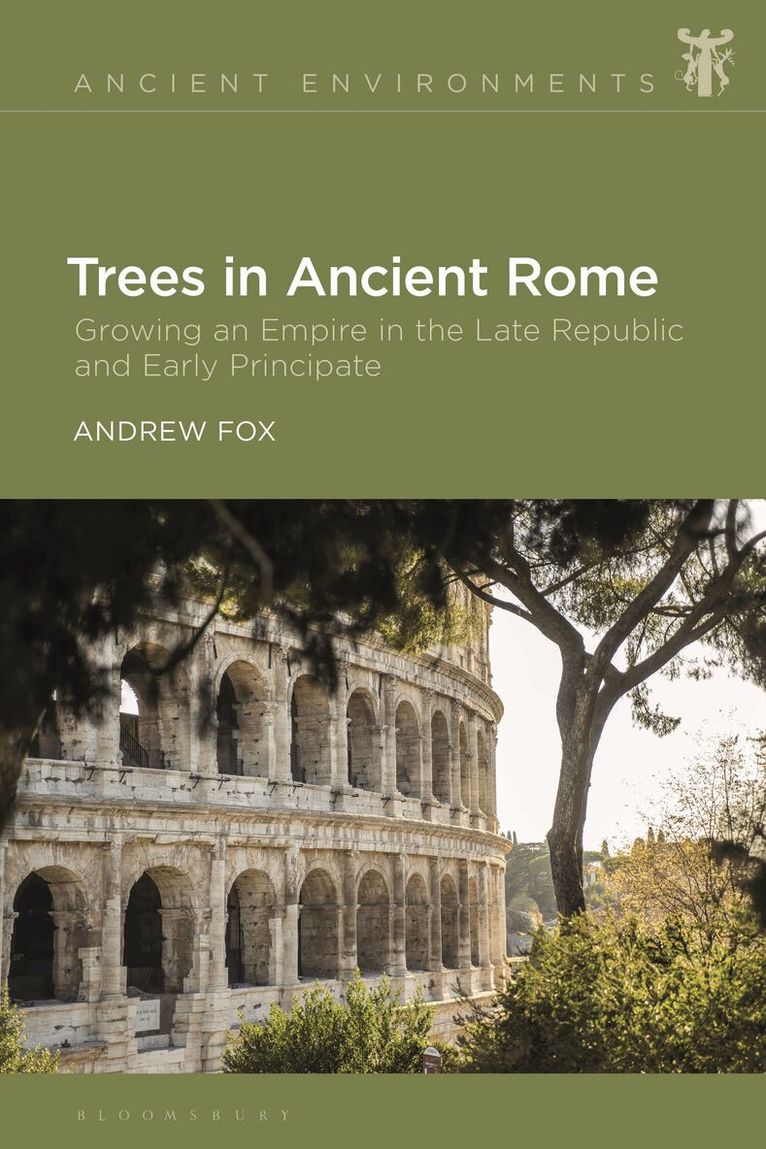
Focusing on the transitional period of the late Republic to the early Principate, Trees in Ancient Rome offers a sustained examination of the deployment of trees in the ancient city, exploring not only the practicalities of their cultivation, but also their symbolic value. The Ruminal fig tree sheltered the she-wolf as she nursed Romulus and Remus and year’s later Rome was founded between two groves. As the city grew, neighbourhoods bore the names of groves and hills were known by the trees which grew atop them. From the 1st century BCE, triumphs included trees among their spoils and Rome’s green cityscape grew, as did the challenges of finding room for trees within the congested city.This volume begins with an examination of the role of trees as repositories of human memory, lasting for several generations. It goes on to untangle the import of trees, and their role in the triumphal procession, before closing with a discussion of how trees could be grown in Rome’s urban spaces. Drawing on a combination of literary, visual and archaeological sources, it reveals the rich variety of trees in evidence, and explores how they impacted, and were used to impact, life in the ancient city.
Häftad, Engelska, 2025
415 kr
Skickas inom 10-15 vardagar
Focusing on the transitional period of the late Republic to the early Principate, Trees in Ancient Rome offers a sustained examination of the deployment of trees in the ancient city, exploring not only the practicalities of their cultivation, but also their symbolic value. The Ruminal fig tree sheltered the she-wolf as she nursed Romulus and Remus and year’s later Rome was founded between two groves. As the city grew, neighbourhoods bore the names of groves and hills were known by the trees which grew atop them. From the 1st century BCE, triumphs included trees among their spoils and Rome’s green cityscape grew, as did the challenges of finding room for trees within the congested city.This volume begins with an examination of the role of trees as repositories of human memory, lasting for several generations. It goes on to untangle the import of trees, and their role in the triumphal procession, before closing with a discussion of how trees could be grown in Rome’s urban spaces. Drawing on a combination of literary, visual and archaeological sources, it reveals the rich variety of trees in evidence, and explores how they impacted, and were used to impact, life in the ancient city.
Inbunden, Engelska, 2023
1 274 kr
Skickas inom 10-15 vardagar
This book demonstrates how the Romans constructed garden boundaries specifically in order to open up or undermine the division between a number of oppositions, such as inside/outside, sacred/profane, art/nature, and real/imagined. Using case studies from across literature and material and visual culture, Victoria Austen explores the perception of individual garden sites in response to their limits, and showcases how the Romans delighted in playing with concepts of boundedness and separation. Transculturally, the garden is understood as a marked-off and cultivated space. Distinct from their surroundings, gardens are material and symbolic spaces that constitute both universal and culturally specific ways of accommodating the natural world and expressing human attitudes and values. Although we define these spaces explicitly through the notions of separation and division, in many cases we are unable to make sense of the most basic distinction between ‘garden’ and ‘not-garden’. In response to this ambiguity, Austen interrogates the notion of the ‘boundary’ as an essential characteristic of the Roman garden.
Häftad, Engelska, 2024
429 kr
Skickas inom 10-15 vardagar
This book demonstrates how the Romans constructed garden boundaries specifically in order to open up or undermine the division between a number of oppositions, such as inside/outside, sacred/profane, art/nature, and real/imagined. Using case studies from across literature and material and visual culture, Victoria Austen explores the perception of individual garden sites in response to their limits, and showcases how the Romans delighted in playing with concepts of boundedness and separation. Transculturally, the garden is understood as a marked-off and cultivated space. Distinct from their surroundings, gardens are material and symbolic spaces that constitute both universal and culturally specific ways of accommodating the natural world and expressing human attitudes and values. Although we define these spaces explicitly through the notions of separation and division, in many cases we are unable to make sense of the most basic distinction between ‘garden’ and ‘not-garden’. In response to this ambiguity, Austen interrogates the notion of the ‘boundary’ as an essential characteristic of the Roman garden.
Häftad, Engelska, 2023
429 kr
Skickas inom 10-15 vardagar
Presenting a new perspective on human–animal relations in the ancient Near East, this volume considers how we should understand equids (horses, donkeys, onagers and various hybrids) as animals that are social actors. Recht brings together a wealth of new data, including Bronze Age Near Eastern material culture from a range of archaeological contexts with equid remains as well as iconography and texts. She looks in particular at finds of equids themselves from burials, sacred space and settlements alongside associated artefacts such as chariots and harnesses.This is the first time the agency of animals is recognized. The study is essential reading for prehistorians, archaeologists and those studying early animal domestication, showcasing how humans encounter and interact with other animals, and how those animals in turn interact with humans. Recht outlines the broader implications for human involvement with their environment, both today and in the past, and points to further study in a number of focused appendices.
Inbunden, Engelska, 2026
1 594 kr
Kommande
Examining a vast corpus of literary references and artistic representations, this volume offers the first comprehensive study of the ketos - the sea monster imagined by the ancient Greeks and Romans.The chapters examine the three central traditions of thought that existed about this imaginary animal in Graeco-Roman culture. The first tradition concerns the ketos as a divinely associated monster: a force aligned with marine gods (chiefly Poseidon) and one which was fought by Heracles and Perseus. The second tradition features the ketos in more naturalised contexts, as depicted among ancient geographers and historians, as a type of monster roaming the distant waters of the Atlantic and Indian Oceans. The third tradition concerns the fusion of the ketos with Leviathan and the other Old Testament sea monsters in the minds of early Christians. Accordingly, this classical sea monster became the image of the creature that swallowed Jonah, and, alternatively, a monster associated with the Devil and cosmological evil.While other monsters of Graeco-Roman mythology, such as the Minotaur and Medusa, are household names in modern popular culture, the ketos has effectively been lost in the modern imagination. Yet it was no small part of the Graeco-Roman imagination. This sea monster formed a key aspect as to how the sea-adjacent societies of ancient Greece and Rome perceived ancient marine environments. It was this fantastic sea beast that so haunted ancient mariners, and in turn, which contributed to ancient perceptions of the marine world as a profoundly alien and hostile environment.
Inbunden, Engelska, 2026
818 kr
Kommande
Professor Simon Keay had a long and industrious career in Roman Archaeology. Following completion of a PhD at UCL specialising in Roman amphorae, his career included fieldwork at major archaeological sites in Spain and Italy culminating in the Portuslimen project, bringing together colleagues from across the Mediterranean to study the ports and trade networks of the Roman Empire. His research meant close involvement with the British School at Rome, as well as the Catalan Institute of Classical Archaeology and colleagues at the site of Italica, Andalusia among many others. Simon’s contribution to the discipline of Roman Archaeology was immense, and his energy and mentorship influenced scholars from many different backgrounds.This volume brings together papers authored by those who knew Simon and who were supported and enabled by his passion for archaeology, from amphora studies to research on Roman urbanism and landscapes. Each section deals with a particular area of Simon’s interests; Mediterranean ports and river systems, trade and connectivity, and landscapes and urbanism. The contributions include reminiscences of Simon and his work, together with the results of his different projects, and research that has stemmed from his scholarship. Here, these paper underscore the diversity and vibrancy of contemporary research in the areas that interested Simon, reflecting the contribution he made and the legacy of his work.
Inbunden, Engelska, 2024
405 kr
Skickas
Pilgrims in Place, Pilgrims in Motion: Sacred Travel in the Ancient Mediterranean brings together exciting interdisciplinary scholarship on the connected poles of pilgrimage: the sanctuaries being visited, and the journeys to get there. Contributions investigate different concepts of place, community, social tensions and expectations of pilgrim behaviour; long-term meanings of place as embodied in memory and topography; mobility, migration and place-making; connectivity and its relationship to pilgrimage. Individual chapters discuss shrines, sanctuaries and sacred places as well as journeys and mobility across Greek, Roman and late antique contexts, framed as part of a key debate within the study of pilgrimage, the central tension between place and motion.
Del 192 - Religions in the Graeco-Roman World
Pilgrimage and Economy in the Ancient Mediterranean
Inbunden, Engelska, 2020
2 787 kr
Skickas inom 5-8 vardagar
In Pilgrimage and Economy in the Ancient Mediterranean, Anna Collar and Troels Myrup Kristensen bring together diverse scholarship to explore the socioeconomic dynamics of ancient Mediterranean pilgrimage from archaic Greece to Late Antiquity, the Greek mainland to Egypt and the Near East. This broad chronological and geographical canvas demonstrates how our modern concepts of religion and economy were entangled in the ancient world. By taking material culture as a starting point, the volume examines the ways that landscapes, architecture, and objects shaped the pilgrim’s experiences, and the manifold ways in which economy, belief and ritual behaviour intertwined, specifically through the processes and practices that were part of ancient Mediterranean pilgrimage over the course of more than 1,500 years.