Carlos de la Torre - Böcker
Visar alla böcker från författaren Carlos de la Torre. Handla med fri frakt och snabb leverans.
14 produkter
14 produkter
2 103 kr
Skickas inom 10-15 vardagar
This ground-breaking textbook describes and explains the global manifestations of populism. It reviews controversies about its relationships with democracy in the distinct and interrelated histories of the Americas, Asia, and Europe. The volume surveys the similarities and differences between populism, nationalism, fascism, and populist uses of religion and the media.Global Populisms invites students and the general public to move beyond simplistic conceptualizations of populism as an external virus and as an irrational threat to democracy, or, alternatively, as the path to return power to the people. The book differentiates populists’ correct critiques to inequalities, the loss of national sovereignty, and unresponsive politicians from its solutions. In the name of giving power to the people, populists in power from Hugo Chávez to Donald Trump, Narendra Modi, and Viktor Orbán entered in war with the media, made rivals into existential enemies, and attempted to concentrate power in the hands of the president.Written in a clear and accessible style, this interdisciplinary volume will appeal to undergraduate students as well as to non-academic audiences with an interest in political science, sociology, history, and communication studies.
548 kr
Skickas inom 10-15 vardagar
This ground-breaking textbook describes and explains the global manifestations of populism. It reviews controversies about its relationships with democracy in the distinct and interrelated histories of the Americas, Asia, and Europe. The volume surveys the similarities and differences between populism, nationalism, fascism, and populist uses of religion and the media.Global Populisms invites students and the general public to move beyond simplistic conceptualizations of populism as an external virus and as an irrational threat to democracy, or, alternatively, as the path to return power to the people. The book differentiates populists’ correct critiques to inequalities, the loss of national sovereignty, and unresponsive politicians from its solutions. In the name of giving power to the people, populists in power from Hugo Chávez to Donald Trump, Narendra Modi, and Viktor Orbán entered in war with the media, made rivals into existential enemies, and attempted to concentrate power in the hands of the president.Written in a clear and accessible style, this interdisciplinary volume will appeal to undergraduate students as well as to non-academic audiences with an interest in political science, sociology, history, and communication studies.
724 kr
Skickas inom 10-15 vardagar
This volume illustrates the diversity of populism globally. When seeking power, populists politicize issues, and point to problems that need to be addressed such as inequalities, the loss of national sovereignty to globalization, or the rule of unresponsive political elites. Yet their solutions tend to be problematic, simplistic, and in most instances, instead of leading to better forms of democracy, their outcomes are authoritarian. Populists use a playbook of concentrating power in the hands of the president, using the legal system instrumentally to punish critics, and attacking the media and civil society. Despite promising to empower the people, populists lead to processes of democratic erosion and even transform malfunctioning democracies into hybrid regimes.The Routledge Handbook of Global Populism provides instructors, students, and researchers with a thorough and systematic overview of the history and development of populism and analyzes the main debates. It is divided into sections on the theories of populism, on political and social theory and populism, on how populists politicize inequalities and differences, on the media and populism, on its ambiguous relationships with democratization and authoritarianism, and on the distinct regional manifestations of populism. Leading international academics from history, political science, media studies, and sociology map innovative ideas and areas of theoretical and empirical research to understand the phenomenon of global populism.
3 320 kr
Skickas inom 10-15 vardagar
This volume illustrates the diversity of populism globally. When seeking power, populists politicize issues, and point to problems that need to be addressed such as inequalities, the loss of national sovereignty to globalization, or the rule of unresponsive political elites. Yet their solutions tend to be problematic, simplistic, and in most instances, instead of leading to better forms of democracy, their outcomes are authoritarian. Populists use a playbook of concentrating power in the hands of the president, using the legal system instrumentally to punish critics, and attacking the media and civil society. Despite promising to empower the people, populists lead to processes of democratic erosion and even transform malfunctioning democracies into hybrid regimes.The Routledge Handbook of Global Populism provides instructors, students, and researchers with a thorough and systematic overview of the history and development of populism and analyzes the main debates. It is divided into sections on the theories of populism, on political and social theory and populism, on how populists politicize inequalities and differences, on the media and populism, on its ambiguous relationships with democratization and authoritarianism, and on the distinct regional manifestations of populism. Leading international academics from history, political science, media studies, and sociology map innovative ideas and areas of theoretical and empirical research to understand the phenomenon of global populism.
775 kr
Skickas inom 3-6 vardagar
From the protesters in Cairo's Tahrir Square to the Tea Party in the United States to the campaign to elect indigenous leader Evo Morales in Bolivia, modern populist movements command international attention and compel political and social change. When citizens demand "power to the people," they evoke corrupt politicians, imperialists, or oligarchies that have appropriated power from its legitimate owners. These stereotypical narratives belie the vague and often contradictory definitions of the concept of "the people" and the many motives of those who use populism as a political tool.In The Promise and Perils of Populism, Carlos de la Torre assembles a group of international scholars to explore the ambiguous meanings and profound implications of grassroots movements across the globe. These trenchant essays explore how fragile political institutions allow populists to achieve power, while strong institutions confine them to the margins of political systems. Their comparative case studies illuminate how Latin American, African, and Thai populists have sought to empower marginalized groups of people, while similar groups in Australia, Europe, and the United States often exclude people whom they consider to possess different cultural values. While analyzing insurrections in Latin America, advocacy groups in the United States, Europe, and Australia, and populist parties in Asia and Africa, the contributors also pose questions and agendas for further research.This volume on contemporary populism from a comparative perspective could not be more timely, and scholars from a variety of disciplines will find it an invaluable contribution to the literature.
567 kr
Skickas inom 3-6 vardagar
From the protesters in Cairo's Tahrir Square to the Tea Party in the United States to the campaign to elect indigenous leader Evo Morales in Bolivia, modern populist movements command international attention and compel political and social change. When citizens demand "power to the people," they evoke corrupt politicians, imperialists, or oligarchies that have appropriated power from its legitimate owners. These stereotypical narratives belie the vague and often contradictory definitions of the concept of "the people" and the many motives of those who use populism as a political tool.In The Promise and Perils of Populism, Carlos de la Torre assembles a group of international scholars to explore the ambiguous meanings and profound implications of grassroots movements across the globe. These trenchant essays explore how fragile political institutions allow populists to achieve power, while strong institutions confine them to the margins of political systems. Their comparative case studies illuminate how Latin American, African, and Thai populists have sought to empower marginalized groups of people, while similar groups in Australia, Europe, and the United States often exclude people whom they consider to possess different cultural values. While analyzing insurrections in Latin America, advocacy groups in the United States, Europe, and Australia, and populist parties in Asia and Africa, the contributors also pose questions and agendas for further research.This volume on contemporary populism from a comparative perspective could not be more timely, and scholars from a variety of disciplines will find it an invaluable contribution to the literature.
332 kr
Skickas inom 7-10 vardagar
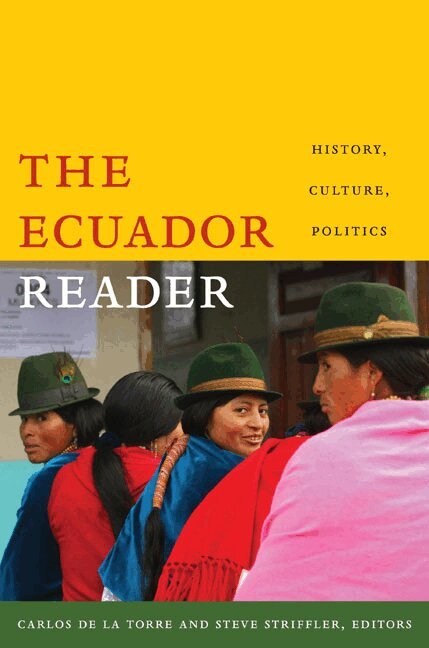
Encompassing Amazonian rainforests, Andean peaks, coastal lowlands, and the GalÁpagos Islands, Ecuador’s geography is notably diverse. So too are its history, culture, and politics, all of which are examined from many perspectives in The Ecuador Reader. Spanning the years before the arrival of the Spanish in the early 1500s to the present, this rich anthology addresses colonialism, independence, the nation’s integration into the world economy, and its tumultuous twentieth century. Interspersed among forty-eight written selections are more than three dozen images.The voices and creations of Ecuadorian politicians, writers, artists, scholars, activists, and journalists fill the Reader, from JosÉ MarÍa Velasco Ibarra, the nation’s ultimate populist and five-time president, to Pancho Jaime, a political satirist; from Julio Jaramillo, a popular twentieth-century singer, to anonymous indigenous women artists who produced ceramics in the 1500s; and from the poems of Afro-Ecuadorians, to the fiction of the vanguardist Pablo Palacio, to a recipe for traditional QuiteÑo-style shrimp. The Reader includes an interview with Nina Pacari, the first indigenous woman elected to Ecuador’s national assembly, and a reflection on how to balance tourism with the protection of the GalÁpagos Islands’ magnificent ecosystem. Complementing selections by Ecuadorians, many never published in English, are samples of some of the best writing on Ecuador by outsiders, including an account of how an indigenous group with non-Inca origins came to see themselves as definitively Incan, an exploration of the fascination with the Andes from the 1700s to the present, chronicles of the less-than-exemplary behavior of U.S. corporations in Ecuador, an examination of Ecuadorians’ overseas migration, and a look at the controversy surrounding the selection of the first black Miss Ecuador.
346 kr
Skickas inom 7-10 vardagar
Is Latin America experiencing a resurgence of leftwing governments, or are we seeing a rebirth of national-radical populism? Are the governments of Hugo Chávez, Evo Morales, and Rafael Correa becoming institutionalized as these leaders claim novel models of participatory and direct democracy? Or are they reenacting older traditions that have favored plebiscitary acclamation and clientelist distribution of resources to loyal followers? Are we seeing authentic forms of expression of the popular will by leaders who have empowered those previously disenfranchised? Or are these governments as charismatic, authoritarian, and messianic as their populist predecessors?This new and expanded edition of Populist Seduction in Latin America explores the ambiguous relationships between democracy and populism and brings de la Torre's earlier work up to date, comparing classical nationalist, populist regimes of the 1940s, such as those of Juan Perón and José María Velasco Ibarra, with their contemporary neoliberal and radical successors. De la Torre explores their similarities and differences, focusing on their discourses and uses of political symbols and myths.
241 kr
Skickas inom 7-10 vardagar
The elections of Donald Trump and Jair Bolsonaro, as well as the strengthening of the radical right globally, brought back debates of the similarities and differences between populism and fascism. This volume argues that fascism and populism are similar in so far that they constructed the people as one; understood leadership as embodiment; and performed politics of the extraordinary. They are different because there is a consensus that fascism occurred at a particular historical moment, and what came after was postfascism. There is not such an agreement to restrict populism to a historical moment. These isms also differ in the use of violence to deal with enemies, and on how they constructed their legitimacy using elections or abolishing democracy. Whereas fascism destroyed democracy and replaced elections with plebiscitary acclamation, populists promise to give power back to the people. Yet when in power the logic of populism leads to democratic erosion.
775 kr
Skickas inom 7-10 vardagar
The elections of Donald Trump and Jair Bolsonaro, as well as the strengthening of the radical right globally, brought back debates of the similarities and differences between populism and fascism. This volume argues that fascism and populism are similar in so far that they constructed the people as one; understood leadership as embodiment; and performed politics of the extraordinary. They are different because there is a consensus that fascism occurred at a particular historical moment, and what came after was postfascism. There is not such an agreement to restrict populism to a historical moment. These isms also differ in the use of violence to deal with enemies, and on how they constructed their legitimacy using elections or abolishing democracy. Whereas fascism destroyed democracy and replaced elections with plebiscitary acclamation, populists promise to give power back to the people. Yet when in power the logic of populism leads to democratic erosion.
2 088 kr
Skickas inom 10-15 vardagar
Still the Age of Populism? investigates current conceptions of populism and its relevance across the globe. Using contextualized case studies, cross-national comparisons, and theoretical interventions, this volume addresses key conceptual debates in comparative politics and political sociology.This essential volume brings together scholars from different traditions in political sociology, political science and cultural studies, and comparativists and area experts working on Latin America, Western and Eastern Europe, and the US. Chapters in the book employ innovative theoretical approaches to study aspects of populism in global comparative perspective whilst regional case studies, including Brazil, Venezuela, Germany, and the US, are utilised to explore populism in geographically specific contexts. In doing so, the volume addresses the key issues for those seeking to understand contemporary populism. What are the advantages and limits of the category of populism to understand contemporary debates on democratization and processes of democratic erosion? Under what structural, institutional, and cultural conditions does populism emerge? Is populism the nemesis of democracy, its shadow, or a path to move beyond “liberal democracy” towards “real democracy”? What lessons does the history of past populist moment hold for our understanding of contemporary populist governance? Under what conditions have populists in office led to political polarization and democratic erosion? What comes after populism, and how do societies deal with its legacies?Still the Age of Populism? will be of interest to a broad audience of students and scholars of political sociology and comparative politics.
549 kr
Skickas inom 10-15 vardagar
Still the Age of Populism? investigates current conceptions of populism and its relevance across the globe. Using contextualized case studies, cross-national comparisons, and theoretical interventions, this volume addresses key conceptual debates in comparative politics and political sociology.This essential volume brings together scholars from different traditions in political sociology, political science and cultural studies, and comparativists and area experts working on Latin America, Western and Eastern Europe, and the US. Chapters in the book employ innovative theoretical approaches to study aspects of populism in global comparative perspective whilst regional case studies, including Brazil, Venezuela, Germany, and the US, are utilised to explore populism in geographically specific contexts. In doing so, the volume addresses the key issues for those seeking to understand contemporary populism. What are the advantages and limits of the category of populism to understand contemporary debates on democratization and processes of democratic erosion? Under what structural, institutional, and cultural conditions does populism emerge? Is populism the nemesis of democracy, its shadow, or a path to move beyond “liberal democracy” towards “real democracy”? What lessons does the history of past populist moment hold for our understanding of contemporary populist governance? Under what conditions have populists in office led to political polarization and democratic erosion? What comes after populism, and how do societies deal with its legacies?Still the Age of Populism? will be of interest to a broad audience of students and scholars of political sociology and comparative politics.
410 kr
Skickas inom 5-8 vardagar
Venezuela's Hugo Chavez, Bolivia's Evo Morales, and Ecuador's Rafael Correa have brought the subject of Latin American populism once again to the fore of scholarly and policy debate in the region. "Latin American Populism in the Twenty-first Century" explains the emergence of today's radical populism and places it in historical context, identifying continuities as well as differences from both the classical populism of the 1930s and 1940s and the neo-populism of the 1990s. Leading Latin American, U.S., and European authors explore the institutional and socioeconomic contexts that give rise to populism and show how disputes over its meaning are closely intertwined with debates over the meaning of democracy. By analyzing the discourse and policies of populist leaders and reviewing their impact in particular countries, these contributors provide a deeper understanding of populism's democratizing promise as well as the authoritarian tendencies that threaten the foundation of liberal democracy.
156 kr
Skickas inom 5-8 vardagar