Committee on Human Factors – författare
656 kr
Skickas inom 3-6 vardagar
477 kr
Skickas
738 kr
Läs direkt efter köp
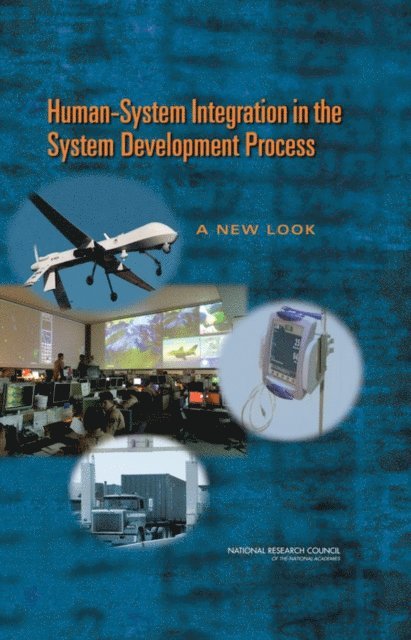
To prevent both the individually annoying and nationally significant consequences, human capabilities and needs must be considered early and throughout system design and development. One challenge for such consideration has been providing the background and data needed for the seamless integration of humans into the design process from various perspectives: human factors engineering, manpower, personnel, training, safety and health, and, in the military, habitability and survivability. This collection of development activities has come to be called human-system integration (HSI). Human-System Integration in the System Development Process reviews in detail more than 20 categories of HSI methods to provide invaluable guidance and information for system designers and developers.
1 055 kr
Läs direkt efter köp
To prevent both the individually annoying and nationally significant consequences, human capabilities and needs must be considered early and throughout system design and development. One challenge for such consideration has been providing the background and data needed for the seamless integration of humans into the design process from various perspectives: human factors engineering, manpower, personnel, training, safety and health, and, in the military, habitability and survivability. This collection of development activities has come to be called human-system integration (HSI). Human-System Integration in the System Development Process reviews in detail more than 20 categories of HSI methods to provide invaluable guidance and information for system designers and developers.
617 kr
Läs direkt efter köp
In May 1998 the National Institutes of Health asked the National Academy of Sciences/National Research Council to assemble a group of experts to examine the scientific literature relevant to work-related musculoskeletal disorders of the lower back, neck, and upper extremities. A steering committee was convened to design a workshop, to identify leading researchers on the topic to participate, and to prepare a report based on the workshop discussions and their own expertise. In addition, the steering committee was asked to address, to the extent possible, a set of seven questions posed by Congressman Robert Livingston on the topic of work-related musculoskeletal disorders. The steering committee includes experts in orthopedic surgery, occupational medicine, epidemiology, ergonomics, human factors, statistics, and risk analysis.
This document is based on the evidence presented and discussed at the two-day Workshop on Work-Related Musculoskeletal Injuries: Examining the Research Base, which was held on August 21 and 22, 1998, and on follow-up deliberations of the steering committee, reflecting its own expertise.
769 kr
Läs direkt efter köp
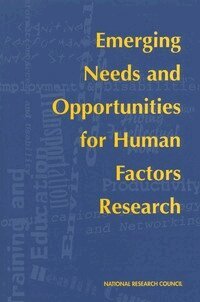
This book identifies areas that represent new needs and opportunities for human factors research in the coming decades. It is forward-looking, problem oriented, and selectively focused on national or global problems, including productivity in organizations, education and training, employment and disabilities, health care, and environmental change; technology issues, including communications technology and telenetworking, information access and usability, emerging technologies, automation, and flexible manufacturing, and advanced transportation systems; and human performance, including cognitive performance under stress and aiding intellectual work.
390 kr
Läs direkt efter köp
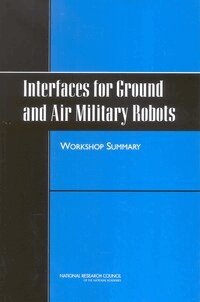
In the early years of robotics and automated vehicles, the fight was against nature and not against a manifestly intelligent opponent. In military environments, however, where prediction and anticipation are complicated by the existence of an intelligent adversary, it is essential to retain human operators in the control loop. Future combat systems will require operators to control and monitor aerial and ground robotic systems and to act as part of larger teams coordinating diverse robotic systems over multiple echelons. The National Research Council organized a workshop to identify the most important human-related research and design issues from both the engineering and human factors perspectives, and develop a list of fruitful research directions. Interfaces for Ground and Air Military Robots summarizes the presentations and discussions from this workshop.
674 kr
Läs direkt efter köp
543 kr
Läs direkt efter köp
This book identifies areas that represent new needs and opportunities for human factors research in the coming decades. It is forward-looking, problem oriented, and selectively focused on national or global problems, including productivity in organizations, education and training, employment and disabilities, health care, and environmental change; technology issues, including communications technology and telenetworking, information access and usability, emerging technologies, automation, and flexible manufacturing, and advanced transportation systems; and human performance, including cognitive performance under stress and aiding intellectual work.
268 kr
Läs direkt efter köp
In the early years of robotics and automated vehicles, the fight was against nature and not against a manifestly intelligent opponent. In military environments, however, where prediction and anticipation are complicated by the existence of an intelligent adversary, it is essential to retain human operators in the control loop. Future combat systems will require operators to control and monitor aerial and ground robotic systems and to act as part of larger teams coordinating diverse robotic systems over multiple echelons. The National Research Council organized a workshop to identify the most important human-related research and design issues from both the engineering and human factors perspectives, and develop a list of fruitful research directions. Interfaces for Ground and Air Military Robots summarizes the presentations and discussions from this workshop.
452 kr
Läs direkt efter köp
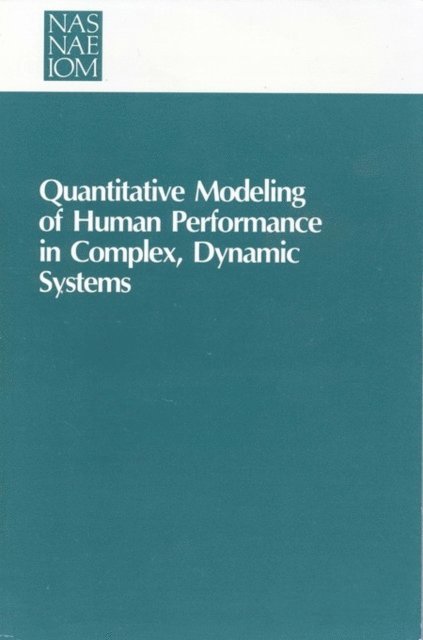
This book describes and evaluates existing models of human performance and their use in the design and evaluation of new human-technology systems. Its primary focus is on the modeling of system operators who perform supervisory and manual control tasks. After an introduction on human performance modeling, the book describes information processing, control theory, task network, and knowledge-based models.
It explains models of human performance in aircraft operations, nuclear power plant control, maintenance, and the supervisory control of process control systems, such as oil refineries. The book concludes with a discussion of model parameterization and validation and recommends a number of lines of research needed to strengthen model development and application.
390 kr
Läs direkt efter köp
187 kr
Läs direkt efter köp
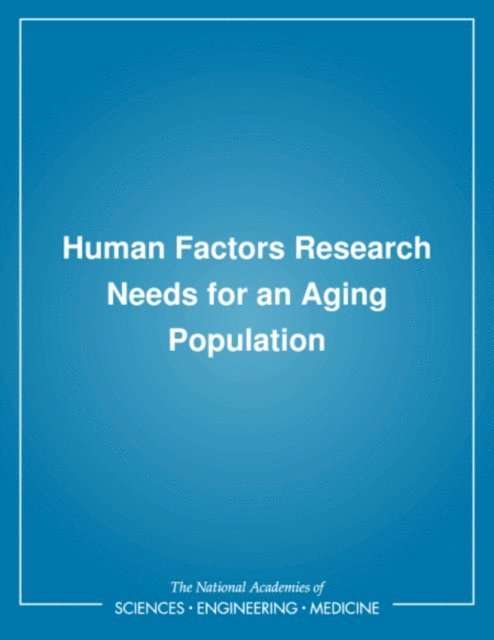
This book describes the demographic, sociological, and ecological background of the aging society, identifies human factors problems associated with aging, summarizes currently relevant information, and recommends directions for research. It suggests a program of research and technology development for the purpose of ameliorating the effects of functional changes that accompany the aging process and provides a basis for additional research and application of human factors engineering data to the design of environments in which aging people must function.
187 kr
Läs direkt efter köp
Decision making in today''s organizations is often distributed widely and usually supported by such technologies as satellite communications, electronic messaging, teleconferencing, and shared data bases. Distributed Decision Making outlines the process and problems involved in dispersed decision making, draws on current academic and case history information, and highlights the need for better theories, improved research methods and more interdisciplinary studies on the individual and organizational issues associated with distributed decision making. An appendix provides additional background reading on this socially and economically important problem area.
390 kr
Läs direkt efter köp
601 kr
Läs direkt efter köp
438 kr
Läs direkt efter köp
In May 1998 the National Institutes of Health asked the National Academy of Sciences/National Research Council to assemble a group of experts to examine the scientific literature relevant to work-related musculoskeletal disorders of the lower back, neck, and upper extremities. A steering committee was convened to design a workshop, to identify leading researchers on the topic to participate, and to prepare a report based on the workshop discussions and their own expertise. In addition, the steering committee was asked to address, to the extent possible, a set of seven questions posed by Congressman Robert Livingston on the topic of work-related musculoskeletal disorders. The steering committee includes experts in orthopedic surgery, occupational medicine, epidemiology, ergonomics, human factors, statistics, and risk analysis.
This document is based on the evidence presented and discussed at the two-day Workshop on Work-Related Musculoskeletal Injuries: Examining the Research Base, which was held on August 21 and 22, 1998, and on follow-up deliberations of the steering committee, reflecting its own expertise.
1 702 kr
Tillfälligt slut
1 656 kr
Tillfälligt slut
1 370 kr
Tillfälligt slut
1 328 kr
Tillfälligt slut
479 kr
Tillfälligt slut
1 752 kr
Tillfälligt slut
1 717 kr
Tillfälligt slut
2 400 kr
Tillfälligt slut
1 752 kr
Tillfälligt slut
1 747 kr
Tillfälligt slut
854 kr
Tillfälligt slut
923 kr
Tillfälligt slut