Diane Hildebrandt – författare
1 791 kr
Skickas inom 5-8 vardagar
2 030 kr
Läs direkt efter köp
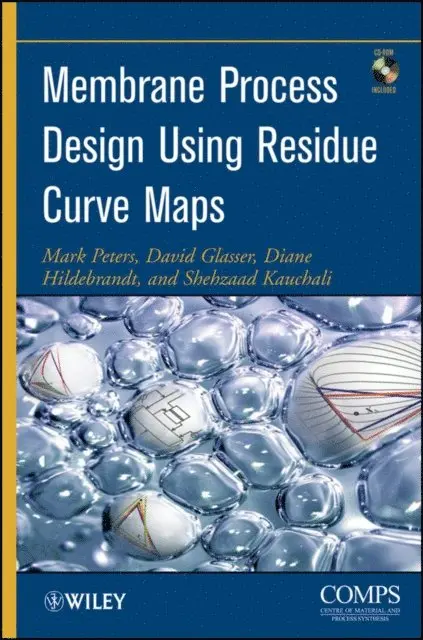
The method, which uses a graphical technique, allows one to calculate and visualize the change in composition of the retentate (non-permeate) phase. This graphical approach is based on Membrane Residue Curve Maps. One of the strengths of this approach is that it is exactly analogous to the method of Residue Curve Maps that has proved so successful in distillation system synthesis and design.
2 061 kr
Läs direkt efter köp
The method, which uses a graphical technique, allows one to calculate and visualize the change in composition of the retentate (non-permeate) phase. This graphical approach is based on Membrane Residue Curve Maps. One of the strengths of this approach is that it is exactly analogous to the method of Residue Curve Maps that has proved so successful in distillation system synthesis and design.
1 917 kr
Skickas inom 11-20 vardagar
2 202 kr
Läs direkt efter köp
Researchers share their pioneering graphical method for designing almost any distillation structure
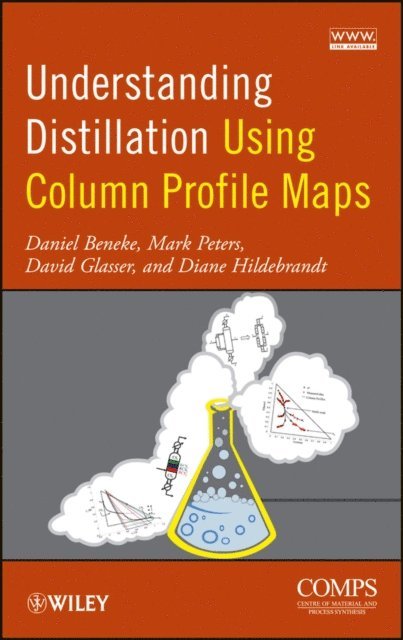
Developed by the authors in collaboration with other researchers at the Centre of Material and Process Synthesis, column profile maps (CPMs) enable chemical engineers to design almost any distillation structure using novel graphical techniques. The CPM method offers tremendous advantages over other design methods because it is generalized and not constrained to a particular piece of equipment.
Understanding Distillation Using Column Profile Maps enables readers to understand, analyze, and design distillation structures to solve common distillation problems, including distillation by simple columns, side rectifiers and strippers, multiple feed columns, and fully thermally coupled columns. In addition, the book presents advanced topics such as reactive distillation, membrane permeation, and validation of thermodynamic models. For all these processes, the authors set forth easy-to-follow design techniques, solution strategies, and insights gained using CPMs.
This book offers everything needed to fully understand and use CPMs as a design tool:
Figures help readers understand how to use CPMs as design and optimization tools Examples clearly illustrate how to solve specific problems using CPMs Tutorials allow readers to explore key concepts through experimentation Design and Optimization of Distillation Systems software package, developed for this book, enables readers to reproduce the examples in the book, follow the tutorials, and begin designing their own distillation systemsWith its many examples and step-by-step tutorials, Understanding Distillation Using Column Profile Maps is recommended for students in chemical engineering in advanced undergraduate and graduate courses. The book also provides new practical techniques that can be immediately applied by chemical engineering professionals in industry.
2 183 kr
Läs direkt efter köp
Researchers share their pioneering graphical method for designing almost any distillation structure
Developed by the authors in collaboration with other researchers at the Centre of Material and Process Synthesis, column profile maps (CPMs) enable chemical engineers to design almost any distillation structure using novel graphical techniques. The CPM method offers tremendous advantages over other design methods because it is generalized and not constrained to a particular piece of equipment.
Understanding Distillation Using Column Profile Maps enables readers to understand, analyze, and design distillation structures to solve common distillation problems, including distillation by simple columns, side rectifiers and strippers, multiple feed columns, and fully thermally coupled columns. In addition, the book presents advanced topics such as reactive distillation, membrane permeation, and validation of thermodynamic models. For all these processes, the authors set forth easy-to-follow design techniques, solution strategies, and insights gained using CPMs.
This book offers everything needed to fully understand and use CPMs as a design tool:
Figures help readers understand how to use CPMs as design and optimization tools Examples clearly illustrate how to solve specific problems using CPMs Tutorials allow readers to explore key concepts through experimentation Design and Optimization of Distillation Systems software package, developed for this book, enables readers to reproduce the examples in the book, follow the tutorials, and begin designing their own distillation systemsWith its many examples and step-by-step tutorials, Understanding Distillation Using Column Profile Maps is recommended for students in chemical engineering in advanced undergraduate and graduate courses. The book also provides new practical techniques that can be immediately applied by chemical engineering professionals in industry.
2 570 kr
Skickas inom 3-6 vardagar
2 564 kr
Läs direkt efter köp
2 587 kr
Läs direkt efter köp
3 055 kr
Skickas inom 5-8 vardagar
2 733 kr
Läs direkt efter köp
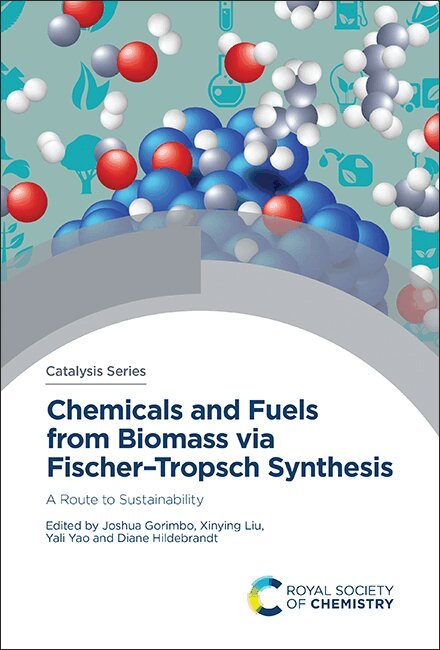
In an effort to reduce dependency on fossil fuel resources, biomass could essentially be converted into chemicals using high capacity processes. The Fischer–Tropsch Synthesis (FTS) pathway has been chosen as the focus of this book as it is a mature area, and unlike other pathways such as pyrolysis, FTS is a potential way of producing fuel/hydrocarbons with no sulfur, no nitrogen, and no heavy metals contamination, making it a good choice. Integrating technological development and business development rationales to highlight the key technological developments that are necessary to industrialize biofuels on a global scale, this book focusses on the key challenges that still hinder the effective biomass use and the realization of zero fossil fuel use. Traditional biomass to hydrocarbons pathways are covered, showcasing how they are tailored to yield a specific group of chemicals with the aim of reducing downstream processes. New developments are considered, including process synthesis, catalysts, and reactors, etc. Providing an up-to-date overview of the production of specialty chemicals and fuels from biomass via the Fischer–Tropsch Synthesis pathway, this title makes an excellent addition to the libraries of academics and practitioners working in catalysis and chemical engineering.
2 733 kr
Läs direkt efter köp
In an effort to reduce dependency on fossil fuel resources, biomass could essentially be converted into chemicals using high capacity processes. The Fischer–Tropsch Synthesis (FTS) pathway has been chosen as the focus of this book as it is a mature area, and unlike other pathways such as pyrolysis, FTS is a potential way of producing fuel/hydrocarbons with no sulfur, no nitrogen, and no heavy metals contamination, making it a good choice. Integrating technological development and business development rationales to highlight the key technological developments that are necessary to industrialize biofuels on a global scale, this book focusses on the key challenges that still hinder the effective biomass use and the realization of zero fossil fuel use. Traditional biomass to hydrocarbons pathways are covered, showcasing how they are tailored to yield a specific group of chemicals with the aim of reducing downstream processes. New developments are considered, including process synthesis, catalysts, and reactors, etc. Providing an up-to-date overview of the production of specialty chemicals and fuels from biomass via the Fischer–Tropsch Synthesis pathway, this title makes an excellent addition to the libraries of academics and practitioners working in catalysis and chemical engineering.