Emanuel Deutschmann - Böcker
Visar alla böcker från författaren Emanuel Deutschmann. Handla med fri frakt och snabb leverans.
8 produkter
8 produkter
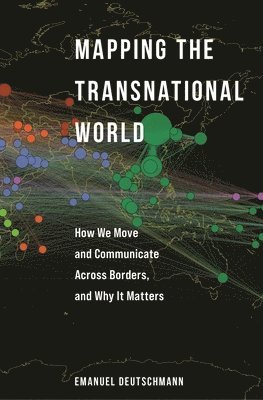
Mapping the Transnational World
How We Move and Communicate across Borders, and Why It Matters
Häftad, Engelska, 2022
276 kr
Skickas inom 7-10 vardagar
A study of the structure, growth, and future of transnational human travel and communicationIncreasingly, people travel and communicate across borders. Yet, we still know little about the overall structure of this transnational world. Is it really a fully globalized world in which everything is linked, as popular catchphrases like “global village” suggest? Through a sweeping comparative analysis of eight types of mobility and communication among countries worldwide—from migration and tourism to Facebook friendships and phone calls—Mapping the Transnational World demonstrates that our behavior is actually regionalized, not globalized.Emanuel Deutschmann shows that transnational activity within world regions is not so much the outcome of political, cultural, or economic factors, but is driven primarily by geographic distance. He explains that the spatial structure of transnational human activity follows a simple mathematical function, the power law, a pattern that also fits the movements of many other animal species on the planet. Moreover, this pattern remained extremely stable during the five decades studied—1960 to 2010. Unveiling proximity-induced regionalism as a major feature of planet-scale networks of transnational human activity, Deutschmann provides a crucial corrective to several fields of research.Revealing why a truly global society is unlikely to emerge, Mapping the Transnational World highlights the essential role of interaction beyond borders on a planet that remains spatially fragmented.
Mapping the Transnational World
How We Move and Communicate across Borders, and Why It Matters
Inbunden, Engelska, 2022
876 kr
Skickas inom 7-10 vardagar
A study of the structure, growth, and future of transnational human travel and communicationIncreasingly, people travel and communicate across borders. Yet, we still know little about the overall structure of this transnational world. Is it really a fully globalized world in which everything is linked, as popular catchphrases like “global village” suggest? Through a sweeping comparative analysis of eight types of mobility and communication among countries worldwide—from migration and tourism to Facebook friendships and phone calls—Mapping the Transnational World demonstrates that our behavior is actually regionalized, not globalized.Emanuel Deutschmann shows that transnational activity within world regions is not so much the outcome of political, cultural, or economic factors, but is driven primarily by geographic distance. He explains that the spatial structure of transnational human activity follows a simple mathematical function, the power law, a pattern that also fits the movements of many other animal species on the planet. Moreover, this pattern remained extremely stable during the five decades studied—1960 to 2010. Unveiling proximity-induced regionalism as a major feature of planet-scale networks of transnational human activity, Deutschmann provides a crucial corrective to several fields of research.Revealing why a truly global society is unlikely to emerge, Mapping the Transnational World highlights the essential role of interaction beyond borders on a planet that remains spatially fragmented.
1 953 kr
Skickas inom 10-15 vardagar
This book showcases the potential of computational approaches for research questions at the heart of migration and integration research via a set of original, cutting-edge empirical studies by a diverse, international team of authors.Why do people emigrate? Do weather conditions and climate change affect decisions to migrate? How do migration networks evolve on a global scale? Can we predict refugee movements? How do host communities respond to the influx of refugees? Do right-wing populist parties get stronger where lots of refugees are located? Do terror attacks lead to more hostility towards immigrants? What mechanisms explain neighborhood ethnic segregation? The collection of studies in this book harnesses the power of an emerging interdisciplinary research field known as computational social science to shed new light on such classic questions of migration and integration research. The cutting-edge empirical studies use a wide range of computational approaches, from agent-based modeling and network analysis to machine learning, natural language processing, and advanced spatial methods and cover detailed spatial, textual, and network data from both online and offline sources. The book thus demonstrates the potential of computational approaches for migration and integration research, while also discussing the challenges that arise in this emerging field.This book will be an invaluable resource for researchers, students of sociology, ethnic and migration studies, international politics, and computational social science. It was originally published as a special issue of the Journal of Ethnic and Migration Studies.
590 kr
Skickas inom 10-15 vardagar
This book showcases the potential of computational approaches for research questions at the heart of migration and integration research via a set of original, cutting-edge empirical studies by a diverse, international team of authors.Why do people emigrate? Do weather conditions and climate change affect decisions to migrate? How do migration networks evolve on a global scale? Can we predict refugee movements? How do host communities respond to the influx of refugees? Do right-wing populist parties get stronger where lots of refugees are located? Do terror attacks lead to more hostility towards immigrants? What mechanisms explain neighborhood ethnic segregation? The collection of studies in this book harnesses the power of an emerging interdisciplinary research field known as computational social science to shed new light on such classic questions of migration and integration research. The cutting-edge empirical studies use a wide range of computational approaches, from agent-based modeling and network analysis to machine learning, natural language processing, and advanced spatial methods and cover detailed spatial, textual, and network data from both online and offline sources. The book thus demonstrates the potential of computational approaches for migration and integration research, while also discussing the challenges that arise in this emerging field.This book will be an invaluable resource for researchers, students of sociology, ethnic and migration studies, international politics, and computational social science. It was originally published as a special issue of the Journal of Ethnic and Migration Studies.
538 kr
Skickas inom 10-15 vardagar
This open access book brings together a set of original studies that use cutting-edge computational methods to investigate conflict at various geographic scales and degrees of intensity and violence.
538 kr
Skickas inom 10-15 vardagar
This open access book brings together a set of original studies that use cutting-edge computational methods to investigate conflict at various geographic scales and degrees of intensity and violence.
339 kr
Skickas inom 3-6 vardagar
Netzwerk Europa
Wie ein Kontinent durch Mobilität und Kommunikation zusammenwächst
Inbunden, Tyska, 2020
334 kr
Skickas inom 10-15 vardagar
Das Buch widmet sich dieser europäischen Vergesellschaftung anhand von Migration, Auslandsstudium, Tourismus und Telefonie – und diskutiert, welche Chancen und Konflikte sich daraus für das Zusammenleben der Europäerinnen und Europäer ergeben.