Fischer Olga Fischer – författare
Visar alla böcker från författaren Fischer Olga Fischer. Handla med fri frakt och snabb leverans.
15 produkter
15 produkter
E-bok
Engelska, 20221 384 kr
Läs direkt efter köp
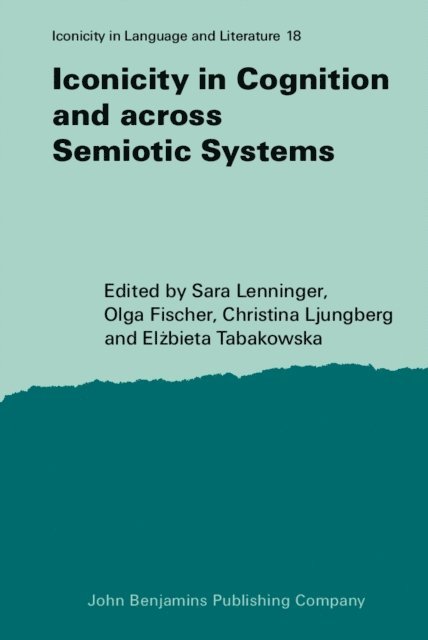
This volume investigates iconicity as to both comprehension and production of meaning in language, gesture, pictures, art and literature. It highlights iconic processes in meaning-making and interpretation across different semiotic systems at structurally, historically and pragmatically different levels of iconicity, with special focus on Cognitive Semiotics. Exploring the ubiquity of iconicity in verbal, visual and gestural communication, these contributions discuss it from the point of view of human meaning-making, examined as a phenomenon that is experienced, embodied and often polysemiotic in nature.
E-bok
Engelska, 20201 384 kr
Läs direkt efter köp
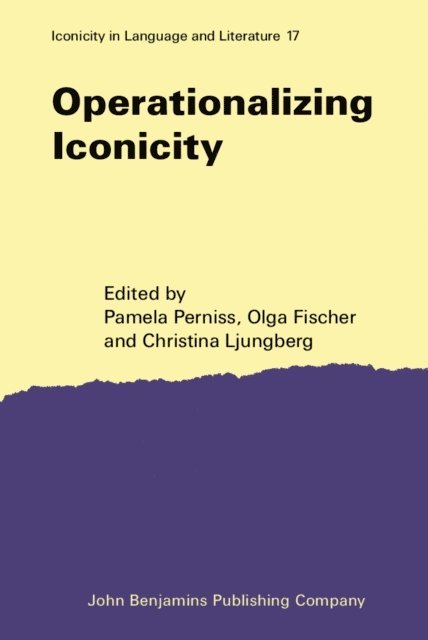
The Iconicity in Language and Literature series has long been dedicated to the recognition and understanding of the pervasiveness of iconicity in language in its many forms and functions. The present volume, divided into four sections, brings together and unifies different perspectives on iconicity. Chapters in the first section (Iconicity in language) provide linguistic analyses of systems of iconic forms in different languages, across both space (areally) and time (diachronically). The second section (Iconicity in literature) is concerned with stylistic analyses of iconicity in literature, in both poetry and prose and across a range of devices and genres. The third section (Iconicity in visual media) highlights the use and effects of iconicity in pictorial, photographic and cinematic media. The final section (Iconicity in semiotic analysis) offers a theoretical perspective, targeting an operationalisation of iconicity with respect to the relationship between types and subtypes of Peircean signs.
E-bok
Engelska, 20171 384 kr
Läs direkt efter köp
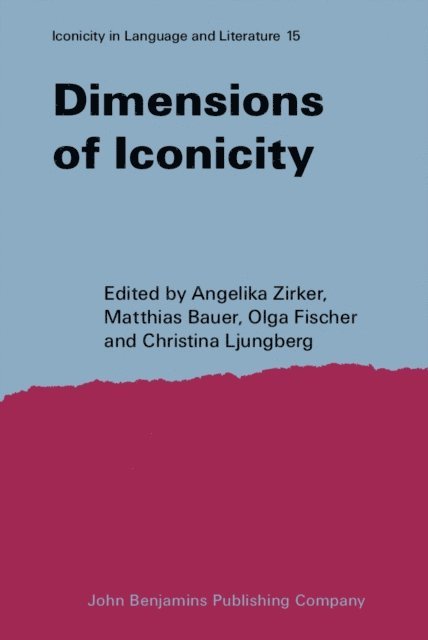
This volume addresses five different Dimensions of Iconicity. While some contributions examine the phonic dimensions of iconicity that are based on empirical, diachronic and theoretical work, others explore the function of similarity from a cognitive point of view. The section on multimodal dimensions takes into account philosophical, linguistic and literary perspectives in order to analyse, for example, the diagrammatic interplay of written texts and images. Contributions on performative dimensions of iconicity focus on Buddhist mantras, Hollywood films, and the dynamics of rhetorical structures in Shakespeare. Last but not least, the volume also addresses new ways of considering iconicity, including notational iconicity, the interplay of iconicity, ambiguity, interpretability, and the iconicity of literary analysis from a formal semanticist point of view.
E-bok
PDF, Engelska, 20131 384 kr
Läs direkt efter köp
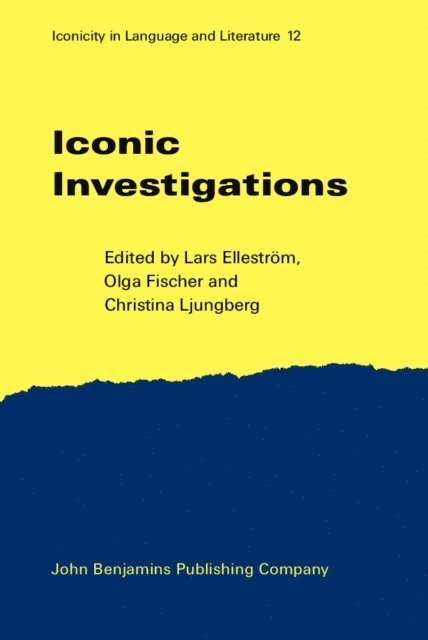
The contributions to Iconic Investigations deal with linguistic or literary aspects of language. While some studies analyze the cognitive structures of language, others pay close attention to the sounds of spoken language and the visual characteristics of written language. In addition this volume also contains studies of media types such as music and visual images that are integrated into the overall project to deepen the understanding of iconicity - the creation of meaning by way of similarity relations. Iconicity is a fundamental but relatively unexplored part of signification in language and other media types. During the last decades, the study of iconicity has emerged as a vital research area with far-reaching interdisciplinary scope and the volume should be of interest for students and researchers interested in scholarly fields such as semiotics, cognitive linguistics, conceptual metaphor studies, poetry, intermediality, and multimodality.
E-bok
PDF, Engelska, 19861 588 kr
Läs direkt efter köp
This volume presents the outcome of a workshop, held in Amsterdam in 1985, on the nature, even possibility, of explanation in Historical Linguistics: why changes take place and others do not, and why they occur at a particular time and place. The workshop, and this volume, aim to explore questions such as i) are the factors which explain the actuation of a change different from those that explain its implementation?; ii) is it possible to give a typology of changes?; iii) should linguistic explanation hope to meet the same requirements as explanation in the pure sciences?; iv) are all linguistic changes necessarily the product of variation?; v) should there be a formal theory of change apart from a general thoery of grammar?
E-bok
PDF, Engelska, 19851 666 kr
Läs direkt efter köp
These papers are a selection from papers presented at the 4th International Conference on English Historical Linguistics (Amsterdam, 1985). Most studies deal with some aspect of an earlier stage of English, though present day varieties of English are also under investigation. Many of the papers show that there is a growing interest in the question why a certain change has taken place. Furthermore, the volume contains a considerable number of papers on historical syntax.
E-bok
PDF, Engelska, 20111 384 kr
Läs direkt efter köp
The articles assembled in Semblance and Signification explore linguistic and literary structures from a range of theoretical perspectives with a view to understanding the extent, prevalence, productivity, and limitations of iconically grounded forms of semiosis. With the complementary examination of large theoretical issues, extensive corpus analysis in several modern languages such as Italian, Japanese Sign Language, and English, and applied close studies across a range of artistic media, this volume brings a fresh understanding of the cognitive underpinnings of iconicity. If primary and secondary modelling systems are rarely studied in tandem, it is clear from this volume that their fruitful juxtaposition yields striking insight into the cognitive concerns that pervade current semiotic research.
E-bok
PDF, Engelska, 20101 325 kr
Läs direkt efter köp
The title of this volume strives to capture the dynamic scope and range of the essays it contains, applying insights into the workings of iconicity to texts as far removed from each other in time as the Medieval tale of a bishop-fish and the war-poems of 20th century Italian Futurist F.T. Marinetti, and as thematically diverse as the Pilgrim’s Progress and the poetry of e.e. cummings. Applications reference both language and linguistics as well as literature and literary theory – and related fields such as sign language and translation; the former approached from the point of view of Japan Sign Language, the latter with reference to translations of the Koran and the Sesotho Bible, as well as modern German and English Bible translations. On the language side, the intricate relationships between sound symbolism and etymology, and between analogy and grammaticalization are examined in depth. On the literary side, the iconic effects of techniques such as enjambment and metrical inversion are considered, but also the ways in which an understanding of iconicity can open up meanings in complex poetry, like that of the Afrikaans poet T.T. Cloete – in this particular instance three poems inspired by figures as diverse as Dante, Paul Klee and the pop icon Marilyn Monroe. In view of the fact that form is able to mime meaning and meaning itself can be mimed by meaning, the theoretical question is asked – on the basis of a wide range of examples from literature, language, music and other sign-systems – whether meaning can also mime form. An introduction to the work of H.C.T. Müller, an early scholar in the field of iconicity, highlights a regrettably little known South African contribution to the development of iconicity theory.
E-bok
PDF, Engelska, 20071 714 kr
Läs direkt efter köp
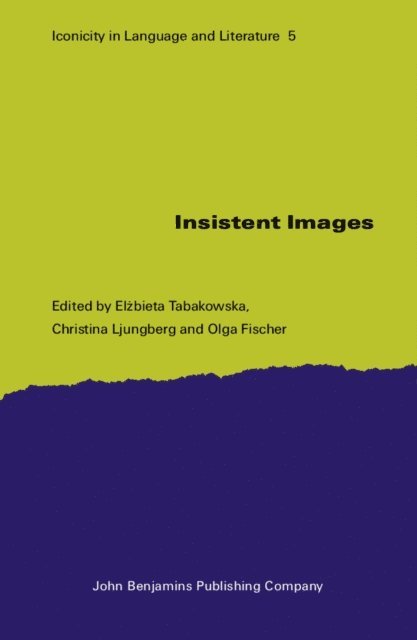
Insistent Images presents a number of new departures dealing with iconicity on the conceptual and the structural levels. On the level of structure, the interface between different aspects of iconicity, lexical meaning and grammar is discussed in reference to both spoken and signed languages. Novel approaches to aural iconicity investigate a wide range of phenomena from phonological iconicity to the role of iconic features in discourse, in the nineteenth century practice of reading aloud, in the almost magic incantations of fin de siecle poetry and in Tolkien's invented languages. Several papers examine the function of iconicity in visual and avant-garde poetry, where iconic features allow a reduction of means, which, paradoxically, generates textual diversification and complexity. A discussion of iconic text strategies shows how texts are comprehended through iconic holistic transfer from complex natural and action patterns. 'Liberature', which integrates text, image and physical space, is another novel area of study, as are the investigations into the iconic properties of film and of multimedia performance. Film is intrinsically iconic, while at the same time being, like photography, indexical; in multimedia performance, on the other hand, iconicity functions intermedially by both integrating and reflecting processes of perception and conceptualization. These last two new fields of inquiry further enhance this truly interdisciplinary volume's explorations of icons as 'insistent images'.
E-bok
PDF, Engelska, 20051 918 kr
Läs direkt efter köp
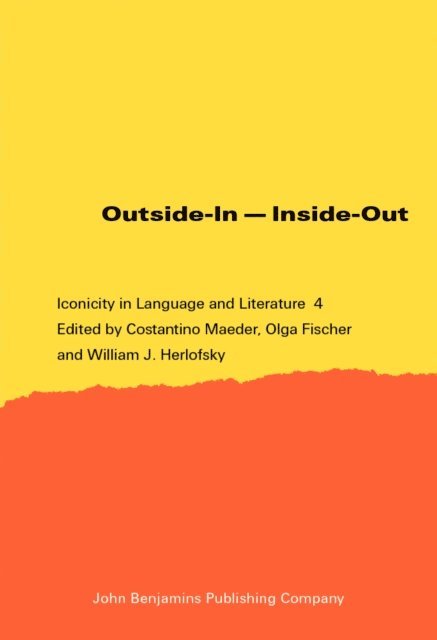
This fourth volume of the Iconicity series is like its predecessors devoted to the study of iconicity in language and literature in all its forms. Many of the papers turn the notion of iconicity 'inside-out', some suggesting that 'less-is-more'; others focus on the cognitive factors 'inside' the brain that are important for the iconic phenomena that are produced in the 'outside' world. In addition this volume includes a paper related to iconicity in music and its interaction with language. Other papers range from the theoretical issues involved in the evolution of language, to those that offer many 'inside-out' claims, such as claiming that nouns are derived from pronouns, and as such should more properly be called 'pro-pronouns'. Also, this volume includes perhaps the first English-language analysis of the iconic aspects of sound symbolism in a prayer from the Koran. This is a truly interdisciplinary collection that should turn some of the notions of iconicity in language and literature 'outside-in' and 'inside-out'.
E-bok
PDF, Engelska, 20041 651 kr
Läs direkt efter köp
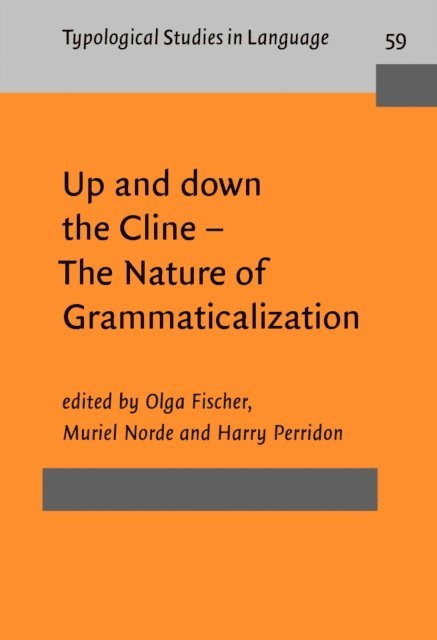
The basic idea behind this volume is to probe the nature of grammaticalization. Its contributions focus on the following questions: (i) In how far can grammaticalization be considered a universal diachronic process or mechanism of change and in how far is it conditioned by synchronic factors? (ii) What is the role of the speaker in grammaticalization? (iii) Does grammaticalization itself provide a cause for change or is it an epiphenomenon, i.e. a conglomeration of causal factors/mechanisms which elsewhere occur independently? (iv) If it is epiphenominal, how do we explain that similar pathways so often occur in known cases of grammaticalization? (v) Is grammaticalization unidirectional? (vi) What is the nature of the parameters guiding grammaticalization? The overall aim of the book is to enrich our understanding of what grammaticalization does or does not entail via detailed case studies in combination with theoretical and methodological discussions.
E-bok
PDF, Engelska, 20031 918 kr
Läs direkt efter köp
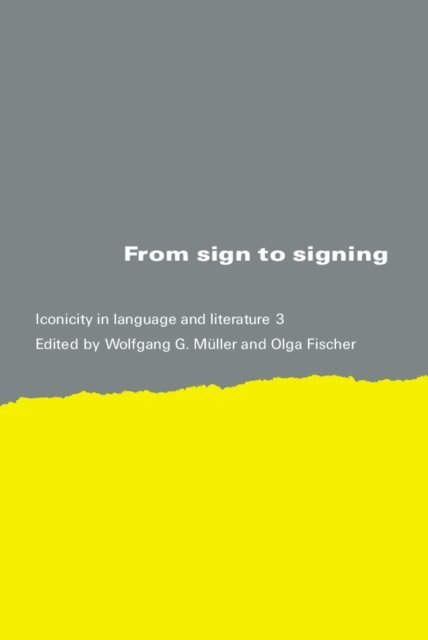
This volume, a sequel to Form Miming Meaning (1999) and The Motivated Sign (2001), offers a selection of papers given at the Third International Symposium on Iconicity in Language and Literature (Jena 2001). The studies collected here present a number of new departures. Special consideration is given to the way non-linguistic visual and auditory signs (such as gestures and bird sounds) are represented in language, and more specifically in 'signed' language, and how such signs influence semantic conceptualization. Other studies examine more closely how visual signs and representations of time and space are incorporated or reflected in literary language, in fiction as well as (experimental) poetry. A further new approach concerns intermedial iconicity, which emerges in art when its medium is changed or another medium is imitated. A more abstract, diagrammatic type of iconicity is again investigated, with reference to both language and literature: some essays focus on the device of reduplication, isomorphic tendencies in word formation and on creative iconic patterns in syntax, while others explore numerical design in Dante and geometrical patterning in Dylan Thomas. A number of theoretically-oriented papers pursue post-Peircean approaches, such as the application of reader-response theory and of systems theory to iconicity.
E-bok
PDF, Engelska, 20001 651 kr
Läs direkt efter köp
There is a continual growth of interest among linguists of all-theoretical denominations in grammaticalization, a concept central to many linguistic (change) theories. However, the discussion of grammaticalization processes has often suffered from a shortage of concrete empirical studies from one of the best-documented languages in the world, English. Pathways of Change contains discussion of new data and provides theoretical lead articles based on these data that will help sharpen the theoretical aspects involved, such as the definition and the logical connection of the component processes of grammaticalization. The volume is concentrated around a number of themes that are important or controversial in grammaticalization studies, such as the principle of unidirectionality, the relation between lexicalization and grammaticalization - and connected with these two factors the possibility of degrammaticalization - the way iconicity interweaves with grammaticalization processes, and with the phenomenon of grammaticalization on a synchronic or discourse level, also often termed subjectifization.
E-bok
PDF, Engelska, 20011 714 kr
Läs direkt efter köp
This volume, a sequel to Form Miming Meaning (1999), offers a selection of papers given at the second international symposium on iconicity (Amsterdam 1999). In the light of semiotic, linguistic and literary theory the studies gathered here investigate how iconicity works on all levels of language, in literary texts and other forms of verbal discourse. They investigate, among other subjects, the semiotic foundations of iconicity, the role played by iconicity in language evolution and in the way words are positioned syntactically. Special consideration is given to the iconic nature of metaphor and the ‘mise en abyme’, to iconically motivated punctuation and other typographic matters such as the manipulation of colour, fonts and spacing in advertising and in poetry. Other studies show how iconicity influences Shakespeare’s rhetoric, the structural design of Margaret Atwood’s writings and the changing fashions in fictional landscape description. Thus, these analyses of ‘the motivated sign’ represent yet another strong challenge to “Saussure’s dogma of arbitrariness” (Jakobson).
E-bok
PDF, Engelska, 19991 903 kr
Läs direkt efter köp
The recent past has seen an increasing interest in iconicity especially among linguists. This collection puts the interdisciplinary study of iconic dimensions (comprising what has been termed ‘imagic iconicity’, as well as ‘diagrammatic iconicity’, i.e. iconicity of a more abstract and less semiotic type) on the map, paying special attention to the use of iconicity in literary texts. The studies presented here explore iconicity from two different angles. A first group of authors brings into focus how far the primary code, the code of grammar is influenced by iconic motivation (with contributions on rules involved in discourse; rules in word formation; and phonological rules), and how originally iconic models have become conventionalized. Others go one step further in exploring how, for instance, the presence of iconicity can tell us more about the structure of human cognition, or how the “iconicist desire for symmetry” can be related to the symmetry of the human body. A second group of contributors is more interested in the presence of iconicity as part of the secondary code, i.e. in how speakers and writers remotivate or play with the primary code; how they concretise what has become conventional or how they use form to add to meaning in literary texts, commercial language and in the new electronic use of texts.