Government-University-Industry Research Roundtable – författare
Visar alla böcker från författaren Government-University-Industry Research Roundtable. Handla med fri frakt och snabb leverans.
25 produkter
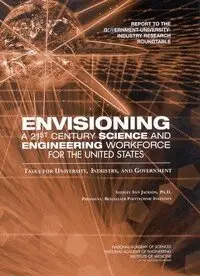
Envisioning a 21st Century Science and Engineering Workforce for the United States
Tasks for University, Industry, and Government
Av Shirley Ann Jackson, Government-University-Industry Research Roundtable m. fl.
E-bok, 2003
502 kr
Lägg i varukorg
At the request of the Government-University-Industry Research Roundtable (GUIRR), Shirley Ann Jackson, President of Rensselaer Polytechnic Institute, presents in this brief paper her views of the challenges of the 21st century for the science and engineering workforce. Dr. Jackson identifies …
Overcoming Barriers to Collaborative Research
Report of a Workshop
Av Government-University-Industry Research Roundtable, Policy Division m. fl.
E-bok, 1999
428 kr
Lägg i varukorg
This report summarizes discussions and insights from the workshop on Overcoming Barriers to Collaborative Research held March 23-24, 1998, in Irvine, California. The workshop was organized by the Government-University-Industry Research Roundtable of the National Academy of Sciences, National …
National Science and Technology Strategies in a Global Context
Report of an International Symposium
Av Government-University-Industry Research Roundtable, National Academy of Sciences m. fl.
E-bok, 1998
644 kr
Lägg i varukorg
This report covers discussions at a symposium on the International Context for National Science and Technology Strategies. The meeting was held May 7, 1997 at the National Academy of Sciences in Washington, D.C., and was organized by the Government-University-Industry Research Roundtable (GUIRR). …
Here or There?
A Survey of Factors in Multinational R&D Location -- Report to the Government-University-Industry Research Roundtable
Av Jerry Thursby, Marie Thursby m. fl.
E-bok, 2006
295 kr
Lägg i varukorg
In this report to the Government-University-Industry Research Roundtable, authors Jerry Thursby and Marie Thursby summarize their research on the globalization of corporate R&D. The authors surveyed 200 multinational companies about recent and future R&D location decisions, and the factors …
Examining Core Elements of International Research Collaboration
Summary of a Workshop
Av Institute of Medicine, National Academy of Engineering m. fl.
Häftad, 2011
591 kr
Lägg i varukorg
The globalization of science, engineering, and medical research is proceeding rapidly. The globalization of research has important implications for the U.S. research enterprise, for the U.S. government agencies, academic institutions, and companies that support and perform research, and for the …
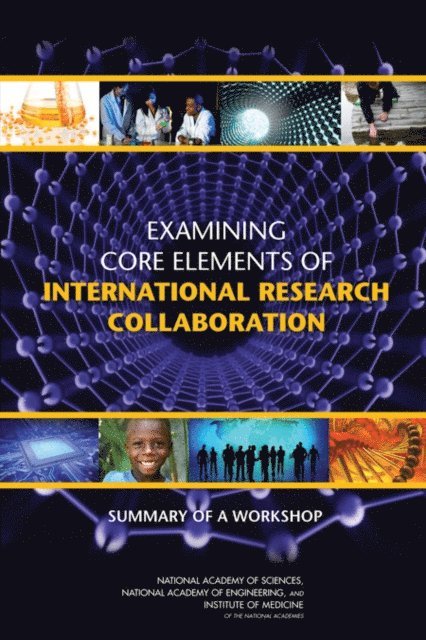
Examining Core Elements of International Research Collaboration
Summary of a Workshop
Av Planning Committee for the Workshop on Examining Core Elements of International Collaboration, Government-University-Industry Research Roundtable m. fl.
E-bok, 2011
485 kr
Lägg i varukorg
The globalization of science, engineering, and medical research is proceeding rapidly. The globalization of research has important implications for the U.S. research enterprise, for the U.S. government agencies, academic institutions, and companies that support and perform research, and for the …
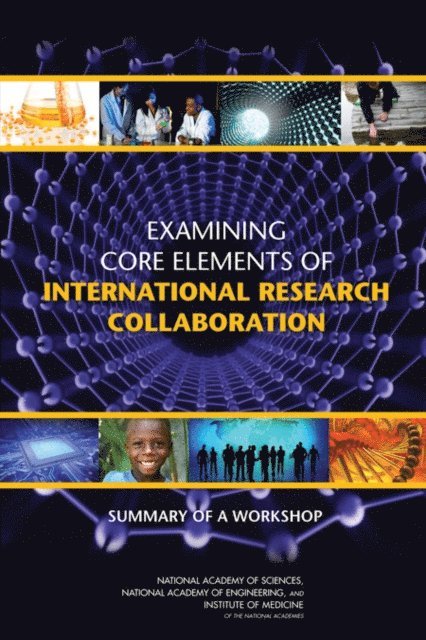
Examining Core Elements of International Research Collaboration
Summary of a Workshop
Av Planning Committee for the Workshop on Examining Core Elements of International Collaboration, Government-University-Industry Research Roundtable m. fl.
E-bok, 2011
508 kr
Lägg i varukorg
The globalization of science, engineering, and medical research is proceeding rapidly. The globalization of research has important implications for the U.S. research enterprise, for the U.S. government agencies, academic institutions, and companies that support and perform research, and for the …
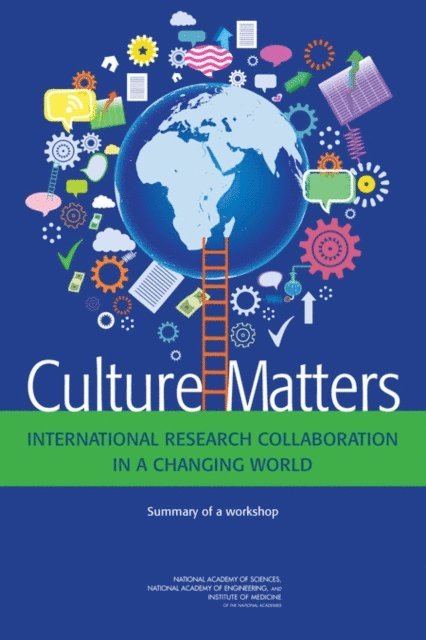
Culture Matters
International Research Collaboration in a Changing World: Summary of a Workshop
Av Planning Committee for the Workshop on Culture Matters: An Approach to International Research Agreements, Government-University-Industry Research Roundtable m. fl.
E-bok, 2014
554 kr
Lägg i varukorg
In an increasingly interconnected world, science and technology research often transects international boundaries and involves researchers from multiple nations. This paradigm provides both new opportunities and new challenges. As science and technology capabilities grow around the world, United …
Data Matters
Ethics, Data, and International Research Collaboration in a Changing World: Proceedings of a Workshop
Av and International Research Collaboration in a Changing World Planning Committee for the Workshop on Ethics, Data, Government-University-Industry Research Roundtable m. fl.
E-bok, 2018
849 kr
Lägg i varukorg
In an increasingly interconnected world, perhaps it should come as no surprise that international collaboration in science and technology research is growing at a remarkable rate. As science and technology capabilities grow around the world, U.S.-based organizations are finding that international …
Envisioning a 21st Century Science and Engineering Workforce for the United States
Tasks for University, Industry, and Government
Av Shirley Ann Jackson, Government-University-Industry Research Roundtable m. fl.
E-bok, 2003
337 kr
Lägg i varukorg
At the request of the Government-University-Industry Research Roundtable (GUIRR), Shirley Ann Jackson, President of Rensselaer Polytechnic Institute, presents in this brief paper her views of the challenges of the 21st century for the science and engineering workforce. Dr. Jackson identifies …
Overcoming Barriers to Collaborative Research
Report of a Workshop
Av Government-University-Industry Research Roundtable, Policy Division m. fl.
E-bok, 1999
295 kr
Lägg i varukorg
This report summarizes discussions and insights from the workshop on Overcoming Barriers to Collaborative Research held March 23-24, 1998, in Irvine, California. The workshop was organized by the Government-University-Industry Research Roundtable of the National Academy of Sciences, National …
Science and Technology in the Academic Enterprise
Status, Trends, and Issues
Av The Government-University-Industry Research Roundtable, Government-University-Industry Research Roundtable m. fl.
E-bok, 1989
200 kr
Lägg i varukorg
The U.S. academic research enterprise is entering a new era characterized by remarkable opportunities and increased strain. This two-part volume integrates the experiential knowledge of group members with quantitative data analyses in order to examine the status of scientific and technological …
Academic Research Enterprise within the Industrialized Nations
Comparative Perspectives
Av Government-University-Industry Research Roundtable, Institute of Medicine m. fl.
E-bok, 1990
194 kr
Lägg i varukorg
Future National Research Policies Within the Industrialized Nations
Report of a Symposium
Av Government-University-Industry Research Roundtable, Institute of Medicine m. fl.
E-bok, 1992
260 kr
Lägg i varukorg
This book is a summary and proceedings of a symposium sponsored by the Government-University-Industry Research Roundtable and the National Science Foundation. It includes presentations by senior government science policy officials and leading scientists who are directly involved in the research and …
Fateful Choices
The Future of the U.S. Academic Research Enterprise
Av Working Group on the Academic Research Enterprise, Government-University-Industry Research Roundtable m. fl.
E-bok, 1992
260 kr
Lägg i varukorg
This volume describes a vision for the future of U.S. academic research and the near-term actions and policies required to maintain the quality of academic research in the United States. It also describes longer-term strategic considerations for the enterprise in the next century, concluding with a …
Industry-University Research Collaborations
Report of a Workshop
Av Government-University-Industry Research Roundtable, and Economic Policy Board on Science, Technology m. fl.
E-bok, 1997
200 kr
Lägg i varukorg
National Science and Technology Strategies in a Global Context
Report of an International Symposium
Av Government-University-Industry Research Roundtable, National Academy of Sciences m. fl.
E-bok, 1998
468 kr
Lägg i varukorg
This report covers discussions at a symposium on the International Context for National Science and Technology Strategies. The meeting was held May 7, 1997 at the National Academy of Sciences in Washington, D.C., and was organized by the Government-University-Industry Research Roundtable (GUIRR). …
Here or There?
A Survey of Factors in Multinational R&D Location -- Report to the Government-University-Industry Research Roundtable
Av Jerry Thursby, Marie Thursby m. fl.
E-bok, 2006
200 kr
Lägg i varukorg
In this report to the Government-University-Industry Research Roundtable, authors Jerry Thursby and Marie Thursby summarize their research on the globalization of corporate R&D. The authors surveyed 200 multinational companies about recent and future R&D location decisions, and the factors …
Science and Technology in the Academic Enterprise
Status, Trends, and Issues
Av National Academy of Engineering, National Academy of Sciences m. fl.
Häftad, 1989
1816 kr
Tillfälligt slut
The U.S. academic research enterprise is entering a new era characterized by remarkable opportunities and increased strain. This two-part volume integrates the experiential knowledge of group members with quantitative data analyses in order to examine the status of scientific and technological …
Academic Research Enterprise within the Industrialized Nations
Comparative Perspectives
Av National Academy of Engineering, National Academy of Sciences m. fl.
Häftad, 1990
1765 kr
Tillfälligt slut
Future National Research Policies Within the Industrialized Nations
Report of a Symposium
Av National Academy of Engineering, National Academy of Sciences m. fl.
Häftad, 1992
1351 kr
Tillfälligt slut
This book is a summary and proceedings of a symposium sponsored by the Government-University-Industry Research Roundtable and the National Science Foundation. It includes presentations by senior government science policy officials and leading scientists who are directly involved in the research and …
Fateful Choices
The Future of the U.S. Academic Research Enterprise
Av National Academy of Engineering, National Academy of Sciences m. fl.
Häftad, 1992
1275 kr
Tillfälligt slut
This volume describes a vision for the future of U.S. academic research and the near-term actions and policies required to maintain the quality of academic research in the United States. It also describes longer-term strategic considerations for the enterprise in the next century, concluding with a …
Industry-University Research Collaborations
Report of a Workshop
Av Council on Competitiveness, Industrial Research Institute m. fl.
Häftad, 1997
1100 kr
Tillfälligt slut
National Science and Technology Strategies in a Global Context
Report of an International Symposium
Av Institute of Medicine, National Academy of Engineering m. fl.
Häftad, 1998
1346 kr
Tillfälligt slut
This report covers discussions at a symposium on the International Context for National Science and Technology Strategies. The meeting was held May 7, 1997 at the National Academy of Sciences in Washington, D.C., and was organized by the Government-University-Industry Research Roundtable (GUIRR). …
Envisioning a 21st Century Science and Engineering Workforce for the United States
Tasks for University, Industry, and Government
Av National Academy of Sciences, Policy and Global Affairs m. fl.
Häftad, 2003
557 kr
Tillfälligt slut
At the request of the Government-University-Industry Research Roundtable (GUIRR), Shirley Ann Jackson, President of Rensselaer Polytechnic Institute, presents in this brief paper her views of the challenges of the 21st century for the science and engineering workforce. Dr. Jackson identifies …