Guido Tabellini – författare
619 kr
Skickas inom 3-6 vardagar
713 kr
Läs direkt efter köp
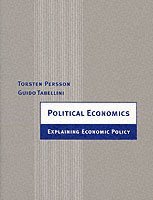
What determines the size and form of redistributive programs, the extent and type of public goods provision, the burden of taxation across alternative tax bases, the size of government deficits, and the stance of monetary policy during the course of business and electoral cycles? A large and rapidly growing literature in political economics attempts to answer these questions. But so far there is little consensus on the answers and disagreement on the appropriate mode of analysis.
Combining the best of three separate traditions—the theory of macroeconomic policy, public choice, and rational choice in political science—Torsten Persson and Guido Tabellini suggest a unified approach to the field. As in modern macroeconomics, individual citizens behave rationally, their preferences over economic outcomes inducing preferences over policy. As in public choice, the delegation of policy decisions to elected representatives may give rise to agency problems between voters and politicians. And, as in rational choice, political institutions shape the procedures for setting policy and electing politicians. The authors outline a common method of analysis, establish several new results, and identify the main outstanding problems.
712 kr
Skickas inom 5-8 vardagar
591 kr
Skickas inom 5-8 vardagar
393 kr
Läs direkt efter köp
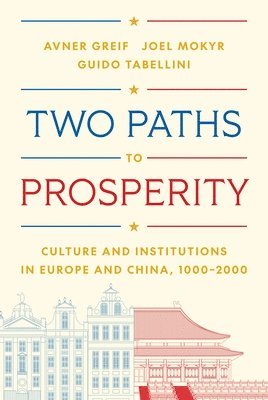
How the social organization of Europe and China shaped their divergent economic and political trajectories over the past millenniumIn the eleventh century, when Europe was still backward and poor, China was a rich and sophisticated civilization. Yet Europe became the birthplace of democracy and the Industrial Revolution, driving the Great Enrichment, while China stagnated until the end of the twentieth century and was always ruled by autocracies. Two Paths to Prosperity traces the emergence of two very different social organizations in premodern China and Europe—the clan and the corporation—showing how they were key factors in the economic and political divergence of these two great civilizations.In this landmark book, three leading economists offer a bold new account of why Europe and China evolved along such different trajectories. In the early Middle Ages, public goods like risk sharing, religious worship, education, and conflict resolution were provided by nonstate organizations in both societies. China increasingly relied on kin-based cooperation within clans, while weaker kinship ties in Europe gave rise to corporations such as guilds, universities, and self-governing towns. Despite performing similar functions, clans and corporations were built on very different principles—with lasting consequences until today.Providing a novel answer to a fundamental question in economic and political history, Two Paths to Prosperity shows how extended kinship in Chinese society facilitated the consolidation of autocracy and hindered innovation and economic development, and how corporations in Europe influenced emerging state institutions and set the stage for the Industrial Revolution.
600 kr
Tillfälligt slut