Haiyan Zhao - Böcker
Visar alla böcker från författaren Haiyan Zhao. Handla med fri frakt och snabb leverans.
5 produkter
5 produkter
1 752 kr
Skickas inom 10-15 vardagar
This book addresses the digital twinning of manufacturing processes, cells, and systems and attempts to bring in the basic characteristics of the Fourth Industrial Revolution along with an emphasis on cyber-physical systems.Digital Twinning for Discrete Manufacturing discusses how to maximize the use of the pillars of Industry 4.0 and 5.0 in discrete manufacturing. It presents how digital twinning has a very special characteristic that can be applied in the training of novice workers on expensive equipment. The book explains how digital twinning of laboratory industrial equipment is cheap to build and can be used to train workers on intricate machinery with real involvement, without any injury to workers or damage to the machines. The book also portrays the full scope of digital twinning based on AR/VR with a physical interface to real machinery.Digital twinning is currently an advanced topic that is of interest to researchers, postgraduates, graduates, senior undergraduates, as well as professionals.
1 625 kr
Skickas inom 10-15 vardagar
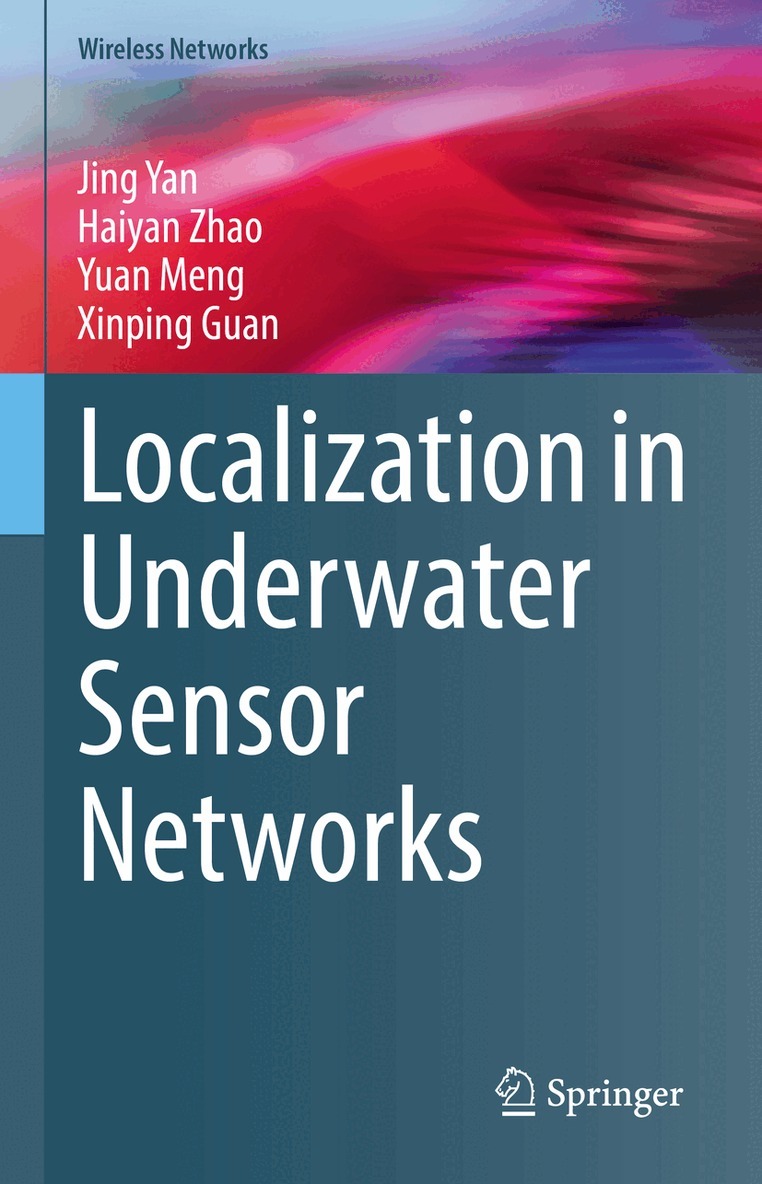
However, the openness and weak communication characteristics of USNs make underwater localization much more challenging in comparison to terrestrial sensor networks. In this book, we focus on the localization problem in USNs, taking into account the unique characteristics of the underwater environment.
1 625 kr
Skickas inom 10-15 vardagar
However, the openness and weak communication characteristics of USNs make underwater localization much more challenging in comparison to terrestrial sensor networks. In this book, we focus on the localization problem in USNs, taking into account the unique characteristics of the underwater environment.
1 578 kr
Skickas inom 10-15 vardagar
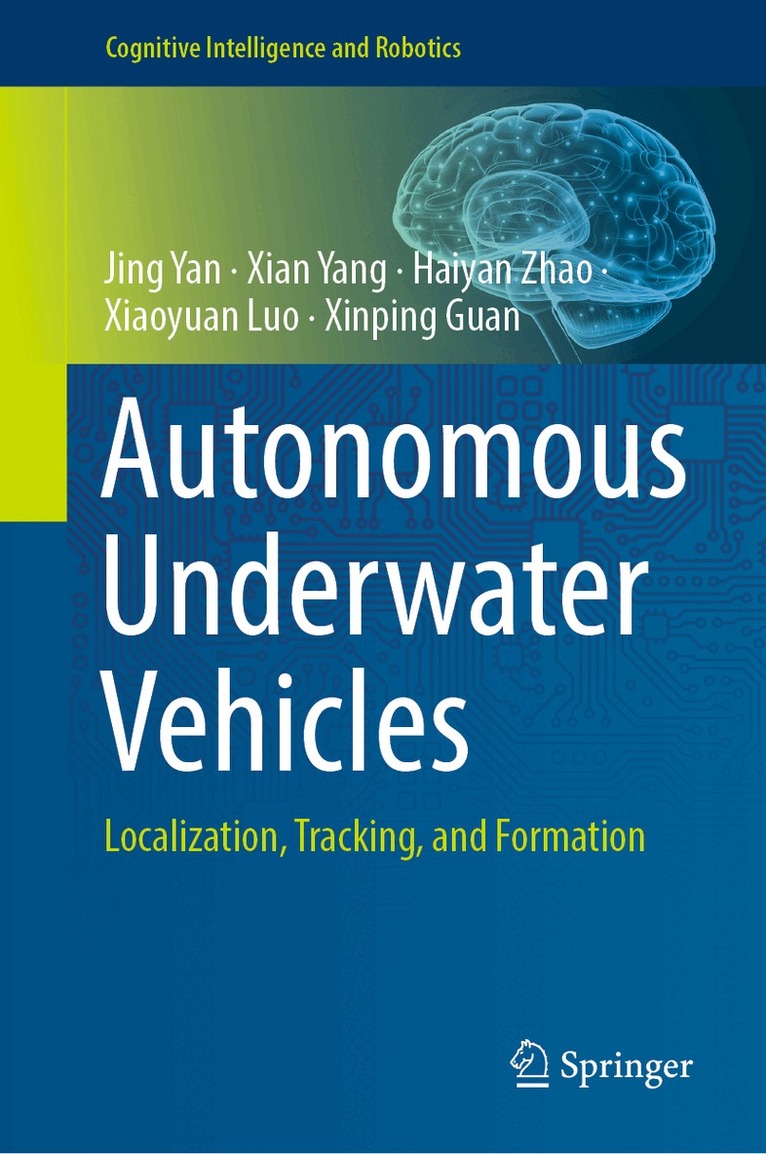
Autonomous underwater vehicles (AUVs) are emerging as a promising solution to help us explore and understand the ocean. The global market for AUVs is predicted to grow from 638 million dollars in 2020 to 1,638 million dollars by 2025 – a compound annual growth rate of 20.8 percent. To make AUVs suitable for a wider range of application-specific missions, it is necessary to deploy multiple AUVs to cooperatively perform the localization, tracking and formation tasks. However, weak underwater acoustic communication and the model uncertainty of AUVs make achieving this challenging. This book presents cutting-edge results regarding localization, tracking and formation for AUVs, highlighting the latest research on commonly encountered AUV systems. It also showcases several joint localization and tracking solutions for AUVs. Lastly, it discusses future research directions and provides guidance on the design of future localization, tracking and formation schemes for AUVs. Representing a substantial contribution to nonlinear system theory, robotic control theory, and underwater acoustic communication system, this book will appeal to university researchers, scientists, engineers, and graduate students in control theory and control engineering who wish to learn about the core principles, methods, algorithms, and applications of AUVs. Moreover, the practical localization, tracking and formation schemes presented provide guidance on exploring the ocean. The book is intended for those with an understanding of nonlinear system theory, robotic control theory, and underwater acoustic communication systems.
1 578 kr
Skickas inom 10-15 vardagar
Autonomous underwater vehicles (AUVs) are emerging as a promising solution to help us explore and understand the ocean. The global market for AUVs is predicted to grow from 638 million dollars in 2020 to 1,638 million dollars by 2025 – a compound annual growth rate of 20.8 percent. To make AUVs suitable for a wider range of application-specific missions, it is necessary to deploy multiple AUVs to cooperatively perform the localization, tracking and formation tasks. However, weak underwater acoustic communication and the model uncertainty of AUVs make achieving this challenging. This book presents cutting-edge results regarding localization, tracking and formation for AUVs, highlighting the latest research on commonly encountered AUV systems. It also showcases several joint localization and tracking solutions for AUVs. Lastly, it discusses future research directions and provides guidance on the design of future localization, tracking and formation schemes for AUVs. Representing a substantial contribution to nonlinear system theory, robotic control theory, and underwater acoustic communication system, this book will appeal to university researchers, scientists, engineers, and graduate students in control theory and control engineering who wish to learn about the core principles, methods, algorithms, and applications of AUVs. Moreover, the practical localization, tracking and formation schemes presented provide guidance on exploring the ocean. The book is intended for those with an understanding of nonlinear system theory, robotic control theory, and underwater acoustic communication systems.